1.
Introduction
This thesis seeks to demonstrate
that personal computers (PC’s) can be integrated into the Distributed Computing
Environment (DCE) and to illustrate the compromises that exist among various
methods of such integration. The thesis
was initially conceived as a tutorial on porting DCE applications to PC’s. It was also to provide a guide to writing
applications that are generally portable across all DCE and environments that
support Remote Procedure Calls (RPC).
As work on the thesis progressed, it became clear that it would be
necessary to not only examine ways that PC’s can be integrated into DCE, but
also to explore the role of personal computers in distributed computing in
general.
1.2 The challenges
Most computing environments deployed within businesses,
schools, universities, and other organizations today are heterogeneous in
nature. That is, no one vendor’s
products are used exclusively to meet all of the computing needs of all users
within these organizations. Some
sub-groups may use Unix workstations from a variety of vendors, including Sun
Microsystems, Digital Equipment Corporation, Hewlett Packard, and many
others. Some may use IBM standard
personal computers, running such operating systems as Microsoft DOS, Microsoft
Windows, Microsoft Windows 95, Microsoft Windows NT, IBM OS/2, or one of many
versions of Unix. It is also the case
that these personal computers may be obtained from a wide selection of
vendors. Some users may use mainframes
or minicomputers (such as IBM’s AS/400) from IBM and other sources. In addition, many users may use some or all of
these platforms at various times for differing tasks, since some platforms tend
to be used for specialized purposes.
Yet, with this dizzying array of
heterogeneous hardware, peripherals, and software, there exists a need for
interoperability. The information
contained on one system may be needed to perform an analysis on another system. Although data may have many representations
on the disparate platforms (e.g., EBCDIC or ASCII), the information stored on
each of these systems must be made to cross the boundaries among machines. That is, the increasingly naïve users of
computing systems should not have to be concerned with the technical details
regarding the way data is stored or even where it is stored. They should simply be able to find and
utilize the information that they seek.
Although typical computing
environments are composed of a mix of platforms, these platforms are typically
interconnected through some form of network.
A larger heterogeneous network may be composed of locally homogeneous
subnetworks, each operating over a possibly unique topology (e.g., ATM,
ethernet, or token ring) and a possibly unique protocol (e.g., TCP/IP, IPX,
Netbios, Netbeui [Netbios Extended User Interface], DECnet, etc.). However, the subnetworks that comprise this
larger network are all typically interconnected via bridges and gateways to form
an intranet (which may, in fact, be connected to the global Internet). This configuration allows an organization to
exchange information among its component platforms, as long as the data can be
coaxed into a format appropriate for its destination platform. Of course, moving data from platform to
platform can be a significant problem in and of itself. It may require translation from one encoding
scheme to another (such as big-endian notation to little-endian notation) and
perhaps from one application’s proprietary format to another (such as
Wordperfect to Word).
Moreover, performance problems
can arise if large quantities of data are to be transported across the network
to be operated upon by a remote computer.
This can be a very time-consuming process and can quickly use up all
available bandwidth (the capacity of a network to transport data) if it is a
common occurrence. This may result in
performance issues for all users of the network, not merely for the user or set
of users who require the transport of the data in question.
The task for programmers to make
all disparate platforms and networks work seamlessly together is immense. What is really needed is a way for
programmers to write programs in the way they are accustomed (i.e., with the
assumption that data and code dwell on the same physical machine), while
remapping the programmer’s code to work across the network.
Users also benefit from the
concept of transparency. A typical user
of a computer system simply wishes to get work done. That is, the user wants to know about some information and
perhaps put it together with other information that exists elsewhere on the
network. It should not be up to the
user to discover which physical machine or computing platform happens to house
this information. Rather, the user
should employ the same means when working with data that is stored on the
network or on the local workstation.
The problems presented by
heterogeneity of hardware platforms and operating systems, limited
communications bandwidth, and the need to transparently code distributed
systems are far from trivial. In the
past (and even today), distributed applications have been built without regard
to previously developed applications.
These applications are usually written utilizing the TCP/IP protocol
(e.g., web browsers), the IPX protocol (e.g., Novell Netware file servers), or
some other custom protocol. This has
resulted in systems that are limited with regard to platform and/or operating
system, and which required highly specific expertise on the part of
applications developers. For example,
many Novell Netware applications have not survived the recent and swift
conversion to TCP/IP. These problems
beg for an abstraction layer which hides the specifics of individual protocols
from the application developer and which allows the developer to write code
with little regard for whether code executes on the local machine or on another
machine located across the network.
The
client/server style of coding helps the developer to make this abstraction. The developer creates a client application
that provides, minimally, a user interface.
The client application relies upon a server that may be located remotely
to do some or all of the actual computing work. This distribution of computing effort allows the server to run in
closer proximity to the data on which it operates, perhaps on the same physical
machine. This can reduce the bandwidth
problems discussed earlier. However,
without some additional layer of abstraction, the distribution still does not
free the developer from many of the details of wire protocols and platform
dependencies.
1.3 Why DCE?
The Open Software Foundation (OSF; now called the Open
Group [22]) has developed a standard for distributed computing
called the Distributed Computing Environment (DCE). DCE is rapidly becoming the standard for the interoperation of
heterogeneous computers that run some implementation of the Unix operating
system. In fact, DCE run-time services
are being incorporated into the base operating systems support provided by many
manufacturers. DCE allows clients on
one platform to access servers on another, without regard to the hardware,
operating system, or available network transports between and among the
cooperating machines. In theory, this
frees the application developer from mundane tasks and provides a layer of
abstraction on which to rest the development process: The application developer
creates a client and a server, each of which should be able to run on any platform, operating system, or
transport.
In practice, this works quite
well for many of the operating systems that support DCE. These include Digital Equipment
Corporation’s line of Alpha workstations running Digital Unix, HP systems
running HP/UX, IBM’s RS/6000 line running AIX, Silicon Graphics machines
running IRIX, Cray Supercomputers, and even Sun workstations with the addition
of some third party software. In many
environments, these platforms can co-exist using DCE very effectively. However, many real environments today, both
academic and commercial, contain large numbers of personal computers based on
the IBM standard using Intel processor chips.
The vast majority of these machines run Microsoft Corporation operating
systems; primarily Microsoft DOS, Microsoft Windows 3.0 and successors (a.k.a.
Windows 3.x), Microsoft Windows 95 and its successors (a.k.a. Windows 9x), and
Microsoft Windows NT. In order to make
a DCE application available to the greatest number of users, the client portion
(at least) must be made to run on the various Microsoft-based operating
systems.
Microsoft itself has recognized
the need for its operating systems to function in the DCE world. To facilitate this, Microsoft provides
support for the core component of DCE; the remote procedure call (RPC; see [19]). The RPC is
a standard way to create a procedure which runs on a server that can be called
from a client just as though this procedure were a normal procedure, local to
the client. In the case of DOS and
Windows 3.x, this support is in the form of a toolkit of redistributable
dynamic link libraries (DLL’s) that can be freely added to machines running one
of these operating systems. In the case
of Windows 9x and Windows NT, support is built into the system itself.
However, Microsoft’s
implementations of RPC’s are not based on the Open Group’s source code for DCE,
as are most other manufacturers’ implementations. Worse, Microsoft does not provide interoperability with other DCE
functions that are standard in true DCE environments. Such important functions as Cell Directory Service (CDS),
security service, Distributed Time System (DTS), and DCE threads are
unavailable in current Microsoft operating systems. CDS provides a mechanism for discovering services which are
available within a DCE cell. DTS is a
service which keeps time accurate and consistent among the cell members. The security service provides authentication
and encryption capability, and DCE threads are the standard POSIX threads which
allow multiple threads of execution within a single program.
Due to the limited compatibility,
many programs originally written for the DCE environment cannot be run, or even
compiled, on Microsoft platforms. The
goal of this paper is to explore ways that the popular PC environments can
function as a part of the Distributed Computing Environment. In some cases this entails adding additional
software to these platforms, writing work-around code to deal with
incompatibilities, and sometimes even submitting to a loss of
functionality. Each of the popular PC
environments has its own challenges and limitations.
1.4 Programming in the DCE
world
The Distributed Computing Environment runs best and is
fully functional on a variety of Unix based platforms and the IBM mainframe
systems (e.g., AS/400, VM, and OS/390).
By fully functional, it is meant that all of the standard DCE services
are available on these platforms. The basic
services (see [14]) include the Cell Directory Service (CDS), the
Distributed Time Service (DTS), security services, Remote Procedure Calls
(RPC), and the Distributed File System (DFS).
A fully featured DCE client machine has a CDS clerk (a clerk is a
process running on a client machine which provides access to a given service),
a DTS clerk, a Security clerk, DFS client software, and a DCE runtime
library. Each DCE server system may
have some or all of the client software, plus it may include a CDS server, a DTS
server, a DFS server, and a Security server.
A typical developer of a DCE
application can assume that most or all of these services are available to his
or her program. Furthermore, since DCE
has grown out of Unix and Unix-like environments, the developer typically
assumes that standard Unix operating systems calls and standard ANSI C library
support is available. In general, it is
assumed that the target system is POSIX compliant.
POSIX is an attempt to
standardize the disparate flavors of Unix.
It is a set of IEEE standards (IEEE 10003.0 to 10003.22 a.k.a. POSIX
level 0 to POSIX level 22) which define minimal requirements for an operating
system to be considered compliant.
There are several levels of POSIX compatibility. One of the serious problems for writing
applications which function across Unix and PC platforms is that most PC
platforms are not strictly POSIX
compliant. Even Microsoft Windows NT
(NT) is merely POSIX level 1 compliant.
Since threading, for example, is not a requirement until POSIX level 4a,
applications running on NT cannot presume thread support.
An even more difficult problem is
NT’s support for POSIX. POSIX on NT is
implemented as a compatibility “subsystem”.
Windows NT was designed with a protected kernel that provides basic
operating system services. On top of
this kernel, a layer of subsystems is provided which run as standard user mode
applications (see Figure 1). These
subsystems add richer functionality that is not available directly from the
kernel. Supplied with the OS, are OS/2
and POSIX subsystems. These subsystems
are on an equal footing with standard Win32 applications in terms of services
available to them. However, these
subsystems have their own executable formats.
They cannot be linked with standard libraries available to typical Win32
applications.
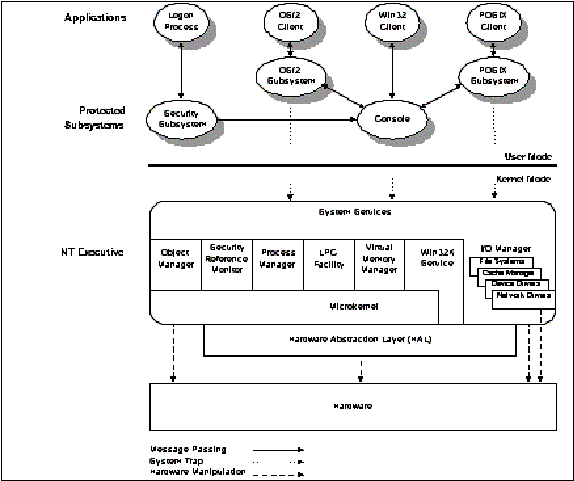
Figure 1: Microsoft Windows NT Architecture
From “The
Foundations of Microsoft Windows NT System Architecture” whitepaper by
Microsoft Corporation, September 1997.
Since POSIX applications cannot
link to standard Win32 libraries, they cannot take advantage of the rich
functionality available to typical Win32 applications. Since there are few
libraries available for the POSIX subsystem, POSIX applications are reduced to
the role of poor step-relatives when compared to their Win32 counterparts. Further confounding the situation, is the
fact that DOS, Windows 3.x, and Windows 95 do not even purport to be POSIX
compliant, as does NT.
1.5 What about the future?
It seems clear that DCE will continue to be important for
the foreseeable future. While arguments
about what to distribute (e.g., the
current concern with distributed object technology) may continue, there seems
to be little question on the choice of whether or not to distribute. The major camps regarding distributed objects
both support DCE after a fashion. The
Object Management Group’s (OMG) Common Object Request Broker Architecture
(CORBA) (see http://www.omg.org/corba/corbiiop.htm)
standard contains provisions for interoperation with DCE. Microsoft’s Distributed Component Object
Model (DCOM) sits securely atop DCE’s RPC.
The Open Group has recently published standards for interoperation of
the World Wide Web (WWW) with DCE (see http://www.camb.opengroup.org/RI/www/dceweb/). Each of these is further examined in Section
6.
DCE has been making great strides
into corporate America and the world as well.
As downsizing and right-sizing continue to drive companies away from
completely centralized databases and applications, client-server and peer
computing have made DCE an attractive standard. As DCE continues to penetrate corporate America, it will become
increasingly important for personal computers (deployed on great numbers of corporate
desktops) to be able to participate as standard DCE platforms. This project demonstrates that it is
possible for personal computers to fulfill this role, with varying success,
depending on the operating system and third party tools available.
2. Choosing Platforms
Software developers who wish to deploy distributed
applications must make allowances for the operating systems and platforms that
are deployed within their target organizations. Although the developer may wish to leverage DCE, the target
platforms may not support DCE, or may support it only partially. Nonetheless, few organizations can afford to
replace large numbers of systems, and this may require that developers find
ways to integrate existing platforms into their solutions.
2.1
Microsoft DOS and Windows 3.x
The Microsoft Disk Operating System (DOS) and the
windowing system that runs on top of it, Microsoft Windows 3.x, are very nearly
ubiquitous in the PC environment.
Almost every PC ever made has been bundled with some flavor of DOS
(including some compatible non-Microsoft versions such as products from IBM and
Digital Research). Since the
introduction of Microsoft Windows 3.0, almost all PC’s are also bundled with
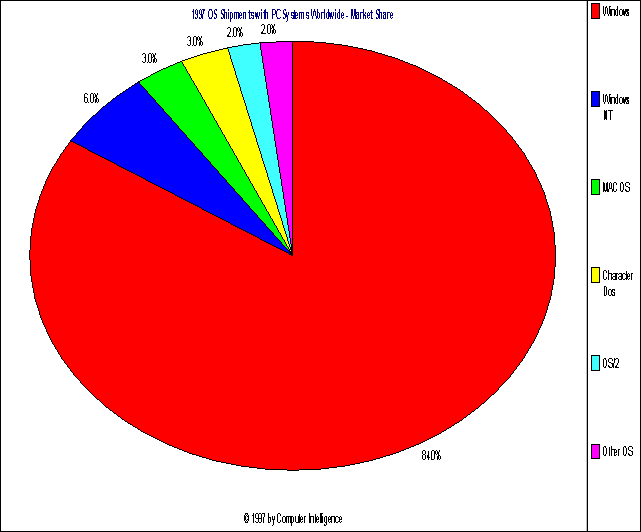
Windows. Windows 9x and Windows NT have
replaced DOS and Windows 3.x (see Figure 3) in recent years in bundles with new
machines. However, the two-headed
operating system of DOS/Windows 3.x remains deployed on vast numbers of
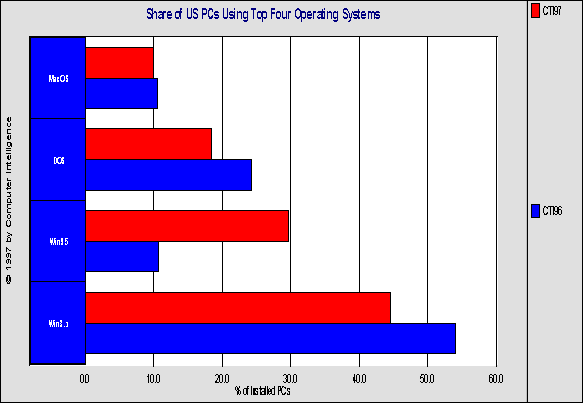
corporate, academic, and home personal computers (see Figure 2).
Figure 2:
Share of US PC’s Using Top Four Operating Systems
 From Computer Intelligence InfoBeads study. Used in accordance with “InfoBead End-User
License Agreement” (see http://www.ci.infobeads.com/InfoBeads/Pages/Viewer/VIEWER_REGISTRATION.ASP?INFOBEAD_ID=C0000938AA)
From Computer Intelligence InfoBeads study. Used in accordance with “InfoBead End-User
License Agreement” (see http://www.ci.infobeads.com/InfoBeads/Pages/Viewer/VIEWER_REGISTRATION.ASP?INFOBEAD_ID=C0000938AA)
Figure 3:
1997 OS Shipments With PC Systems Worldwide – Market Share
From Computer Intelligence InfoBeads study. Used in accordance with “InfoBead End-User
License Agreement” (see
http://www.ci.infobeads.com/InfoBeads/Pages/Viewer/VIEWER_REGISTRATION.ASP?INFOBEAD_ID=M0000913AB)
These facts might lead one to the
conclusion that any project seeking to integrate personal computers into the
world of the DCE would need to include support for DOS and Windows 3.x. Unfortunately, these operating systems were
not designed with remote computing in mind, and therefore do not support many
of the features that make it possible to fully integrate them with DCE.
There are, however, “work
arounds” that allow some degree of interoperability for these operating
systems. Microsoft provides a freely
distributable product called Microsoft Remote Procedure Call Run-time that adds
basic RPC functionality to DOS and Windows 3.x, but lacks all of the other
standard DCE services. By installing
the Microsoft Remote Procedure Call Run-time on a DOS or Windows 3.x workstation,
some very simple DCE applications can be made to run in this environment. However, as shall be discussed later, such
an application not only suffers from the lack of the aforementioned DCE
services, but may also require a significant porting effort to compensate for
differences in system calls, and general lack of POSIX compliance displayed by
this environment.
2.1.2 Third party solutions
Another possible way to bring
DOS/Windows 3.x into the DCE fold is through a set of commercial products from
Gradient Technologies, Inc. (see http://www.gradient.com/Products/Pc-dce/dce_frt.htm)
collectively called PC-DCE. PC-DCE
consists of the PC-DCE Runtime Kit which must be installed on each workstation
that runs a DCE application that has been ported using PC-DCE plus an
Application Developer’s Kit which provides all of the tools (e.g., IDL
compiler, UUID Generator, libraries, and source headers) needed by a developer
to port or write a DCE application.
Additional information on the Gradient product is provided in Section
4.2. Even presuming that the PC-DCE
product solves all other incompatibility issues between DOS/Windows 3.x and DCE
proper, it is still a significant disadvantage to a developer to require a
“for-cost” runtime that all users of a product would have to purchase or that
would have to be redistributed with the product, thus increasing the base
product cost.
However, even with third party
additions to DOS and/or Windows 3.x, there is no support for the server portion
of DCE services. That is, the client
(or “clerk” in DCE terminology) side of the various services may be available
if the appropriate third party add-on is installed. The server side portion of these various services must be run on
a Unix machine within the cell or, as shall be demonstrated, from a Windows NT
machine with third party add-ons.
2.1.3 Intermediary servers
One additional method for
integrating DOS/Windows 3.1 workstations, as well as Windows 95 or Windows NT
workstations, into the DCE standard environment is through the use of
intermediary servers. Intermediary
servers are programs which act as servers in one environment and clients in
another, forwarding the requests they receive to servers in the final target
environment. In this way, these
programs bridge two disparate environments.
For more detailed information, see Shirolkar [27].
An intermediary server strategy
could be employed on a machine (e.g., a Unix workstation) which is a normal
member of a DCE cell. If this machine
also supported a protocol that is accessible to typical PC machines (e.g., IPX
or TCP/IP), it could function as an intermediary server. That is, a program could be written that
accepts requests via, for example, TCP/IP and then makes a corresponding call
to a true DCE server application that actually services the request and returns
information to the intermediary server.
The intermediary could then return the results to the client via the
client’s understood protocol.
This system would allow PC
clients to access specific DCE servers without any additional software. However, it would require that a custom
intermediary server be written for each server to which access was desired. While this might be a very good solution if
an organization required access to only one or a small number of DCE servers
from their personal computers, the effort involved with writing many
intermediary servers in the more general case might be deemed too great.
Sirish [28] proposes a variation on intermediary servers called
application gateways. An application
gateway is a mechanism for redirecting the input/output of a client (or
stand-alone) program. This solution
allows a PC to talk to an application gateway that is running on a member of a
DCE cell, again via a protocol supported by both the PC and the DCE
machine. However, in this scenario, the
PC is actually interoperating with a DCE client program. The client program communicates as normal
with the DCE server, but the user interface is remotely transported to the PC,
essentially enabling the PC to function as a DCE client.
The primary drawback of such a
solution is that it can only work with programs that use standard I/O mechanisms
such as the stdio library. Modern
windowing user interfaces could conceivably be supported as well, but this
would likely increase bandwidth requirements significantly. Another disadvantage of this solution is
that it requires recompilation of the client software, which may not be
possible in some instances due to the lack of source code availability.
2.2
Microsoft Windows 95
In late 1995, Microsoft released the successor to Windows
3.x, dubbed Windows 95. Windows 95 was
a dramatic departure from Windows 3.x with regard to user interface, as well as
some of its internal architecture.
Windows 9x refers to Windows 95 and its successors (Windows 98 has only
recently been released at the time of this writing). Windows 9x is largely a 32 bit operating system, while Windows
3.x is completely 16 bit. In the
Microsoft world, this means not only that Windows 9x supports 32 bit integers,
but more importantly that it natively supports a set of API’s (Application
Programming Interfaces) called Win32, as well as many advanced OS features such
as threading. Win32 is the basis for
writing applications that run on both Windows 9x and Windows NT.
Although Windows 9x is
dramatically more advanced than Windows 3.x, it remains focused on backward
compatibility with DOS and Windows 3.x applications. This means that much of Windows 9x retains 16 bit subsystems and
that the designers of Windows 9x continue to choose compatibility when
tradeoffs exist between support for legacy applications and robustness and/or
security. Microsoft has stated that
Windows 9x will continue to support virtually all DOS and Windows 3.x
applications, including “poorly behaved” games and other applications. By committing to the support of these legacy
applications, Microsoft is forced to allow applications to perform dangerous
operations (such as, in some cases, writing to memory that is in the process
space of another application) that may compromise the integrity of the entire
OS session.
In terms of support for DCE
applications, Windows 9x natively ships with support for RPC’s, but does not
support any of the other DCE services.
Here again, as with Windows 3.x, a DCE developer porting an application
to Windows 9x would come up against the lack of DCE services as well as the
total lack of POSIX support. An
application written for even the most basic level of POSIX compliance does not
typically compile under Windows 9x.
Again, a third party add-on such as Gradient’s products can somewhat
improve this situation, but the developer then must rely on deployment of the
third party product upon all target workstations (and must be prepared for the
consequences of the associated expense).
As with DOS and Windows 3.x,
there are currently no add-ons for Windows 9x which implement the server side
of the various DCE services. Therefore
a Unix workstation or a Windows NT machine is required to provide the server
side services within a DCE cell.
2.3
Microsoft Windows NT
Windows NT is Microsoft’s modern fully 32 bit operating
system. Unlike Windows 9x, which was
developed from earlier Windows 3.x code, Windows NT was written from the ground
up with the goal of being a secure and robust operating system. Since its introduction, many features have
been added to Windows NT and some code is now shared between the development
teams at Microsoft, which work on Windows 9x and Windows NT respectively. It has been noted in the press that sharing
code with the Windows 9x team may tend to compromise the NT design goals of
robustness and security. Personal
experience tends to validate this criticism.
Windows NT natively supports
RPC’s in the same way that Windows 9x does.
The Microsoft implementation of RPC is compatible with DCE RPC, but is
developed independently by Microsoft.
Windows NT does not ship with any DCE services beyond RPC. However, Gradient and Digital Equipment
Corporation both provide solutions that fully implement DCE client (clerk)
services on Windows NT. Windows NT can
also be extended to provide the DCE server side services (CDS server, DTS server,
DFS server, and Security server) via packages available from each of
these vendors.
2.4
IBM OS/2 and Apple Macintosh
While the Microsoft family of operating systems dominate
in terms of installed base (see Figure 2), there are still many installations
which have large numbers of Apple Macintosh computers running their own
proprietary “System” operating system (currently System 8). Likewise, certain organizations have large
numbers of IBM’s OS/2 operating systems deployed.
Currently, the Apple Macintosh
may be integrated into the DCE world only through the DCE client extensions
supplied by Gradient (see http://www.gradient.com/Products/Pc-dce/pcdce_front.htm). Gradient’s kit supplies the same client or
clerk side services, as do the analogous kits for Windows 3.x, Windows 9x, and
Windows NT. IBM’s OS/2 can be brought
into the DCE world through either Gradient’s product (again, with the same
features as those available on the Macintosh platform), or through IBM’s own
DCE package (http://www.networking.ibm.com/dce/dceprod.html). In addition, IBM has recently introduced a
new product called Directory Systems Series (DSS; see http://www.software.ibm.com/is/sw-servers/directory/index.html) which provides the server side software
for DCE on OS/2 servers (as well as other platforms for that matter).
2.5
OS choices conclusion
While Apple Macintosh computers and computers running
IBM’s OS/2 are certainly relevant and important to certain environments, they
have each essentially become niche players.
Therefore, these two operating systems are excluded from further
discussion.
A similar case can be made that
Microsoft DOS and Microsoft Windows 3.x systems are rapidly fading into the
past and should not be considered further either. Though this is true to some extent, there remain vast numbers
(see Figure 2) of DOS and Windows 3.x clients deployed throughout business and
academia. It seems premature to discard
consideration of these platforms entirely.
Though neither can be full players in the DCE world due to their
inherent lack of capabilities (e.g., true threading), they can, in many cases,
be used for client-side solutions which leverage the more mature capabilities
available on servers from other environments.
For example, a single-threaded DOS DCE client application may be
completely sufficient to access and utilize a multi-threaded DCE server
application running on a Windows NT system or a Unix system.
In the next section the tools and
environment needed to implement a DCE application on each of the selected
target platforms will be explored. Each
of the DOS/Windows 3.x, Windows 9.x, and Windows NT platforms has unique
requirements and can benefit from specific additional third party software in
order to function as part of a DCE cell.
3. What You Need
This chapter provides a minimal list of software and tools
that are required to create an RPC enabled application. Such applications are not fully DCE enabled, lacking security, name services, and
distributed file system support.
However, applications written with these minimal standard Microsoft tools
can be distributed without a need for expensive and cumbersome third party
software, and are able to interoperate with standard DCE applications through
RPC’s.
One alternative to forgoing CDS
capability that can augment this approach is to install the Name Service
Interface Daemon (NSID). NSID can be
installed on a CDS capable client (such as an NT workstation with Digital DCE
installed). NSID can then forward
Microsoft RPC calls to the real CDS in the cell. NSID can thus partially obviate the need for CDS support on all
client workstations. However, all
Microsoft RPC clients in the cell will have to be configured to access the
specific machine with NSID installed, and this can present both configuration
and load-balancing issues (i.e., the machine with NSID installed may be
overtaxed if many clients utilize it).
This problem can be mitigated by deploying multiple instances of NSID to
balance the load, but the lack of any centralized capability for configuring
clients could prove problematic.
3.1
Supported protocol stacks
DCE is able to sit atop a long list of supported wire
protocols. Wire protocols, or protocol
stacks in Microsoft parlance, are software modules which essentially implement
the Data Link Layer, the Network Layer, and the Transport Layer of the Open
Systems Interconnection (OSI) Reference model.
However, in Microsoft environments, DCE must sit atop a protocol stack
that is specifically designed to support DCE.
For DOS and Windows 3.x, this generally means a stack called the Microsoft
Remote Procedure Call 16 Bit Run-time (Microsoft RPC RT16). Despite its name, Microsoft RPC RT16
provides not only the actual RPC run-time modules, but also a wide selection of
underlying protocol stacks. These
include UDP/IP, TCP/IP, Named Pipes, Netbios, DEC Net, SPX, and IPX, all for
use under both Windows 3.x and MS DOS.
Microsoft RPC RT16 is available
from Microsoft as part of the Windows 32 SDK which is included in the Microsoft
Developer Network Library (MSDN). MSDN
is a set of software and reference material available via an annual
subscription from Microsoft. The
January 1998 edition of MSDN provides the RPC RT16 on disk number 7 in the
directory \MSTOOLS\RPC_RT16. Windows
for Workgroups 3.11 came with a protocol stack that is essentially the same as
RPC RT16, and so does not require installation of this additional
software. Installations using Microsoft
LAN Manager also natively support the RPC RT16, and do not require additional
software.
Other protocol stacks which
support Windows Sockets may also function correctly as RPC transports for DOS
and Windows 3.x environments, but there are no guarantees. Windows 9x and Windows NT each come equipped
with native protocol stacks that support Microsoft’s RPC, as well as the
necessary RPC run-time. No additional
software is required.
3.2
Development kits
In order to use RPC’s (the base feature that is available
as a standard for Microsoft operating systems), a developer of software needs
the appropriate software development kit (SDK). This SDK consists of the appropriate C language header files,
libraries, and binary tools needed to create an RPC enabled application. In the case of DOS and Windows 3.x, this is
provided as an add-on called the Microsoft Remote Procedure Call SDK (RPC
SDK). Like the RPC RT16, the RPC SDK is
available as part of MSDN. In the January 1998 edition, RPC SDK is included on
disk number 7 under the \MSTOOLS\RPC_SDK subdirectory.
For 32 bit environments (i.e.,
Windows 9.x and Windows NT), the requisite header files, libraries, and tools
are available as a standard part of Microsoft’s C compiler. The current version at the time of this
writing is Visual C++ version 5.0 (VC 5).
No additional software is required if a standard VC 5 installation is
used. Non-Microsoft compilers are
supported for Win32 if they can link to standard Microsoft libraries. The requisite libraries are also included in
MSDN and called the Win32 SDK. The
Win32 SDK is on disk number 7 under the \MSTOOLS subdirectory in the January
1998 edition of MSDN.
3.3
Hardware
Apart from a standard IBM compatible PC, the main hardware
requirement to utilize RPC’s is an NDIS compliant network card. Most all network cards currently available
on the market come with NDIS drivers, and so hardware is typically not an
issue.
As is the
goal of DCE, the types of network card and network topology are not at
issue. Token ring, Ethernet, and other
topologies that support NDIS are transparently supported.
3.4
Summary of what you need
By installing the appropriate protocol stack and the
requisite RPC run-time code on an IBM standard PC with a network card that
supports NDIS drivers, one has all that is needed to run a simple application
that can use RPC’s. Such applications
can interoperate with standard DCE applications running on any DCE compliant
machine, provided that only RPC facilities are needed. If security services, name services,
threading, or any other DCE service is required on the client PC, additional
software is needed. To develop limited
applications such as this, one also needs the appropriate SDK software.
For some simple applications,
these requirements are quite sufficient.
Nonetheless, the developer of such an application must be clear that the
target platform is, in fact, a PC. The
developer must not assume when writing code that POSIX support is available,
and must not rely on any DCE service, save RPC. This is fine for an application that simply makes a call to be
executed on a remote machine. However,
most real world applications certainly require security, and likely require
name space service. In addition, the
great strength of DCE is that it promises to free developers from making assumptions about platforms. This makes the basic solution available from
Microsoft rather unsatisfying. A more
complete solution must include some third party software to add DCE features
and services that are not available from Microsoft.
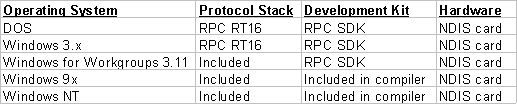
Figure 4: Summary Of Requirements For
RPC On Microsoft Platforms
4. Third Party Tools
In this chapter, software that simplifies and improves the
integration of personal computers into DCE is explored. This includes tools provided by third party
companies that add to the native capabilities of PC operating systems by adding
support for additional DCE services, or enhancing the environment of developers
seeking to write DCE compatible code.
4.1
Digital DCE for Windows NT and Windows 95
Digital Equipment Corporation (DEC; now a subsidiary of
Compaq Computer Corporation) offers a full implementation of DCE for Windows NT
and Windows 95 (see http://www.dec.com/dce/). Products are available both for the client
(or clerk) side and for the server side of DCE for Windows NT, and for the
client side for Windows 95. IBM offers
the same set of products rebranded under the IBM name.
For this project, version 1.1 of
the client side product on the Windows NT platform was tested. The product comes in two parts. The first is called “Digital DCE for Windows
NT Runtime”, and must be deployed on any NT workstation that is to be part of a
standard DCE cell. The second part is
called “Digital DCE for Windows NT ADK”, meaning the “Application Development
Kit”. Those who wish to write (as
opposed to use) DCE applications on NT require this part. It includes the needed binary tools (e.g.,
the IDL compiler) as well as the header files and libraries needed to create a
full-fledged DCE application.
Digital DCE for Windows NT
includes fully DCE-compliant RPC (though still sitting atop Microsoft’s
implementation of RPC rather than the Open Group source), POSIX threads,
Security Client, CDS Clerk, Name Service Interface Daemon (NSID), and
Distributed Time Service Clerk (DTS).
Additional packages are available to provide DCE Security Server and CDS
Server on the NT platform. With the
runtime product installed on NT, a workstation was successfully configured as a
normal DCE machine within a University of Missouri campus DCE cell, even though
the NT workstation was initially located in the Datastorm Technologies offices
across town from the University campus.
Version 1.1 of Digital DCE was
designed to run on Windows NT 3.51. For
this project, the software was deployed on Windows NT 4.0 as well. However, version 1.1 seems to require a
dynamic link library (DLL) which was only installed under Windows NT 3.51. When installing the product on NT 4.0, it is
necessary to copy RPCDCE4.DLL into the \WINNT\SYSTEM32 directory before
applications compiled with the ADK will run.
RPCDCE4.DLL ships with Windows NT 3.5.
Another difficulty with version 1.1, is the necessity of cell
administrator security to install the product.
Digital claims that this will not be necessary for the new “Local
Client” option in version 2.0 (see http://www.dec.com/dce/products/v20ntwp.htm),
which incidentally adds support for C++ applications. Since version 2.0 is designed to run on NT 4.0, it seems likely
that the dependency on RPCDCE4.DLL will also be removed.
As mentioned, Digital also provides
a client side DCE package for Windows 95 (see http://www.dec.com/dce/dcefiles/win95.htm). This has not been tested as a part of this
project, but will likely have some of the same advantages and disadvantages of
the NT product (e.g., porting “normal” DCE applications that assume full POSIX
compliance will continue to be a challenge).
There is no Security Server or CDS Server module available for Windows
95, so Windows 95 DCE installations require either a Unix machine in the cell
to provide these services or a Windows NT machine with such modules installed.
4.2
Gradient’s PC/DCE
Like Digital’s offering, Gradient provides DCE software
that has been ported from the standard OSF DCE source code to PC environments
(see http://www.gradient.com/Products/Pc-dce/pcdce_front.htm).
Gradient offers runtime and ADK modules for Windows NT and Windows 95,
as well as Security Server and CDS Server modules for NT. Gradient also offers runtime and ADK modules
for Windows 3.1 and Apple Macintosh platforms.
Gradient’s products are available
for testing through a free limited-time download (see http://www.gradient.com/Products/evals/evals.htm). However, this program was not available in
time to allow testing on Gradient’s platform.
Previously, Gradient’s software was not available for free evaluations
and the cost of procuring the software was deemed prohibitive. Nonetheless, since Gradient’s products are
based on OSF source code, it seems likely that they may be a very viable
alternative to Digital’s products.
4.3 Hewlett-Packard OODCE
OODCE is a set of C++ classes layered on top of the
standard DCE API’s. The goal is to
simplify DCE development and bring it more naturally into the
C++/Object-Oriented world. However,
OODCE is currently a proprietary extension to DCE available only for
Hewlett-Packard’s HP/9000 Unix platform (see http://www.hp.com/gsy/3b4.html). While applications written in OODCE are
interoperable with traditional C based DCE applications, the code itself is
non-portable.
Although OODCE may allow
developers in a purely HP/9000 environment to write DCE code more quickly and
reliably, the sacrifice of true cross-platform coding seems too great. As concepts from OODCE make their way into
the OSF DCE standard, it will be appropriate to take advantage of them. However, until then, it may be best to
ignore this proprietary solution.
5. Porting An Existing OSF DCE
Application to Microsoft Platforms (BINOP)
BINOP is a program written by Prof. Gordon K. Springer at
the University of Missouri-Columbia to demonstrate DCE remote procedure
calls. The BINOP client module
communicates with BINOP servers that are registered in the DCE namespace by
issuing calls to them to do additions and subtractions. BINOP is composed of a demonstration shell
(BINOPDEMO), a worker client (BINOPC), a statistics gathering client (BINOPST),
a help-providing client (BINOPHLP), and a server (BINOPS). While the actual work performed by BINOP is
trivial, the program serves to demonstrate RPC’s, the utility of the CDS,
strategies for finding servers outside the local cell, and the
client-per-thread server strategy.
BINOP can be built for DEC Alpha,
Mips, Cray, HP 9000, IBM RS6000, and IBM mainframe platforms. It was written with standard DCE platforms
in mind as the target, presuming that most standard Unix facilities are also
available. This project sought to make
a BINOP build and run on Microsoft platforms.
To that end, the results are available in Appendix A: BINOP Source
Code. As will be noted, there are
several ways to build and use BINOP on Microsoft platforms, each with various
tradeoffs in terms of features, portability, and requirements. In the end, BINOP was able to interoperate
with standard DCE BINOP servers using a DOS/Windows 3.x client and with a Win32
client. Using Digital DCE for Windows
NT, it was also possible to setup a BINOP server on the NT platform that could
be accessed from any other DCE platform client.
5.1
Straight Microsoft
The first step in porting BINOP to Microsoft platforms was
to try to make BINOP as fully functional as possible using only the native
Microsoft tools available. This meant
that it should be possible to build BINOP with only Visual C++ installed on
Win32 platforms, and with only Visual C++ and the RPC SDK installed on DOS and
Windows 3.x platforms. Of course, where
BINOP uses DCE or Unix facilities that are unavailable on Microsoft platforms,
it is necessary to either write workarounds or simply live with the loss of
functionality.
This goal was accomplished only
for the BINOPC program. BINOPC is the
worker executable that actually makes the addition and subtraction RPC’s. Even here, however there was a need to
conditionally compile portions of the code.
For example, the file MAKEPASS.C includes PTHREAD.H. This is a support file for POSIX threads. Since Microsoft platforms do not directly
support POSIX threads, this header file had to be conditionally excluded (based
on the Win32RAW macro, which was used to indicate a Microsoft native only
compilation). In addition, the
Microsoft DCE compatibility file DCEPORT.H had to be included since Microsoft
changed the names and calling conventions of many standard DCE API’s in their
implementation of the RPC (e.g., rpc_binding_vector_free() becomes
RpcBindingVectorFree()).
Several other compromises were necessary,
including conditionally removing the error handling for the RPC’s in MAKEPASS.C
since the TRY-CATCH syntax has been changed under current Microsoft
compilers. TRY, CATCH, CATCH_ALL, and
ENDTRY are macros used for structured exception handling in the C and C++
languages. While Microsoft provides a
header file called DCEPORT.H to map these macros (as well as make numerous
other remappings) to appropriate Microsoft syntax, the mappings currently
appear to be outdated.
Figure 5 shows a successful trial
run of the BINOPC client compiled using the WIN32RAW target (and thereby
lacking the error handling mentioned).
Notice that the program completes the series of additions and
subtractions successfully. This trial
was performed on a Windows NT 4.0 workstation that was interoperating with a
BINOPS server, running on a Digital Unix machine called “Condor” on the
University of Missouri campus.
Figure 5: Successful WIN32RAW Binopc
Run.

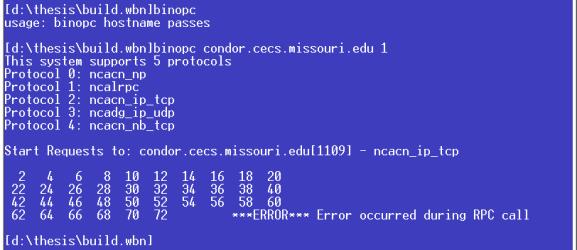
Figure 6 shows the same BINOPC
client, again running on the same Windows NT machine and communicating with the
same Digital Unix machine. After the
program printed the result “38”, a communication failure was simulated by
disconnecting Windows NT Dial-up Networking (which was being used to achieve
Internet connectivity). Figure 7 shows
the error dialog displayed by Windows NT when this communication error
occurred. Clearly, this is not a
desirable way to handle such a fault.
Figure 6: WIN32RAW Binopc Run With
Communication Error.
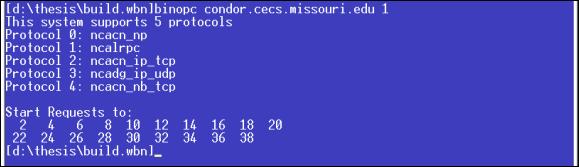
Figure 7: Windows NT OS Error Dialog.

Figure 8 shows BINOPC on the same
Windows NT workstation, but recompiled using the WIN32 target (discussed in
Section 5.2). Again, the program is
communicating with the “Condor” BINOPS server, and again a communications error
is simulated. This time, however, the
error handling code is in place, and the program gracefully degrades by
reporting the error.
Figure 8: WIN32 Binopc Run With
Communication Error.
An effort was made to port the
remainder of the BINOP code to the “Win32RAW” platform. However, it eventually seemed clear that the
amount of code necessary to accomplish this without use of third party software
was prohibitive. For example, in order
to port the server code properly, it would be necessary to write a custom
implementation of POSIX threads. Since
DOS and Windows 3.x do not support true threads, this seemed beyond
reason. Although mapping POSIX threads
to Win32 threads would certainly have been possible, it was more sensible to
rely on a third party product for POSIX threads as well as many other standard
DCE features.
5.2 Full DCE
After creating the raw build of BINOP, a build of the
BINOP source that relied on the Digital DCE for Windows NT ADK for compilation
and on the Digital DCE for Windows NT Runtime for execution of the resultant
binaries was created. As can be seen
from the source in Appendix A, this build is termed the Win32 build. The goal for this build was to fully port
BINOP and be able to run both clients and servers on a Windows NT
platform. This goal assumes that the
Digital DCE for Windows NT Runtime is installed and that the host machine is
properly configured as part of a DCE cell.
That is, it is assumed that there is a machine in the cell providing the
CDS server and security server and that the host is able to access them in
standard DCE fashion. No assumption is
made with regard to supported wire protocols, though tests for this project
focused on TCP/IP and UDP/IP since these protocols are available on nearly
every platform.
5.2.1 Porting
difficulties
Again, the porting process uncovered serious
incompatibilities between standard DCE platforms and the Microsoft platforms
that had to be worked around, even with the additional Digital software. Many problems were sufficiently subtle that
long hours of pouring over the code were necessary to discover their
source. Even small differences can
cause code to fail. For example, code
that attempts to parse a file path must look for a backslash (“\”) on Microsoft
platforms and a forward slash (“/”) on Unix platforms. This was dealt with in BINOPS.C. Also in BINOPS.C, it was necessary to change
a function (rindex()) that was not strictly POSIX compliant to its POSIX
equivalent (strrchr()).
Any code that deals directly with
file systems or file permissions also tends to fail. One such function is the umask() function which is unsupported on
Microsoft platforms. There were many
other incompatibilities that were essentially the result of NT’s lack of POSIX
compliance in its Win32 subsystem or minor variances from POSIX in the BINOP
code. These incompatibilities are
identified throughout the code in Appendix A where conditional compilation
constructs based upon the Win32 macro are used.
Several other incompatibility
challenges arose due to the fact that even using Digital DCE for Windows NT,
one is still left using Microsoft’s implementation of RPC’s and the RPC set of
API’s. For example, in BINOPST.C,
special code was added to deal with a difference under the Microsoft implementation
of the rpc_mgmt_inq_stats() function.
Here, the universal unique identifier (UUID) of the server is required for this API, rather than the client as is the case under standard
DCE. Since Gradient’s product is
reputed to use OSF source even for RPC’s, it may not suffer from some of the incompatibilities
of Digital’s product. This was not
tested, however.
Perhaps the most difficult
compatibility problem to track down was a difference in Microsoft’s
implementation of a DCE interface-specification. An interface-specification is an opaque data structure containing
information the RPC run-time library uses to communicate with the stubs. A stub is a piece of code created by an IDL
compiler, which acts as a surrogate for a function. A stub communicates with the RPC runtime in order to contact
remote processes, marshals and/or unmarshals parameters, and then calls the
actual worker function that it represents.
Under standard DCE, the IDL compiler-generated IDL_ifspec variable is a
rpc_if_rep_t structure, while under Microsoft it is a RPC_CLIENT_INTERFACE
structure. Admittedly, these are
considered to be “opaque” structures that are not strictly supposed to be used
by application programs. However, the
server finding module used by BINOP (FINDSRVS) utilizes the
interface-specification as a convenient way to pass UUID’s to the finding
server, and this technique works fine on all standard DCE platforms. Since Microsoft’s structure is dramatically
different in format than the standard structure used by DCE, it was necessary
to create a temporary structure and use it to reformat the information
contained in Microsoft’s structure under Win32. It should be noted that incompatibilities between Microsoft RPC
and DCE RPC were almost completely undocumented, prior to the publication of
this document. Many months were spent
discovering the causes of problems such as the interface-specification
incompatibility.
The build process itself also
suffered from platform incompatibilities.
For example, the syntax of the standard Unix MAKE utility is slightly different
than the Microsoft NMAKE utility. The
Unix makefile’s for BINOP contained lines with the ‘date’ macro, which simply
does not evaluate under Microsoft’s NMAKE (under Unix it prints the current
date). For this project, a proprietary
utility called TM that echoes the current time and date was substituted. Other incompatibilities included the lack
of the Unix CHMOD utility on Microsoft platforms and differing syntax for
dealing with library files.
5.2.2 Platform advantages
While there were limitations and difficulties in moving
BINOP to the Win32 platform, there were also opportunities to take advantage of
platform specific strengths and features.
Since there was no direct concept of a Unix daemon process under Win32,
the ability for the BINOP server to run as a Win32 service was added. A service is a user-interface-less program
that can be controlled via the Microsoft Control Panel Service applet. This applet allows the user to start, stop,
pause, and control the automatic start-up options for the service. Some Microsoft-supplied code was modified
and included in the project, in order to turn BINOPS into a service. However, it should be noted that it was a
significant task even with the Microsoft code to turn BINOPS into a service,
since BINOPS was designed to execute as a Unix daemon process. Some instability was encountered when
running the server for long periods of time as a service, but this was not
conclusively proven to be related to the service code.
For the future, it would be
sensible to take advantage of the rich user interface features of the Win32
platform. It would be possible to
further separate the user interface portions of BINOP from the worker
portions. This would facilitate
replacing the user interface modules in a platform specific manner, allowing
Win32 in particular to have an excellent user interface. This was not done, but would be a relatively
straightforward extension of the porting process.
5.2.3 General challenges
In addition to the direct issues involved with porting
BINOP to the Win32 platform, several issues that are general to setting up and
using DCE in the real world were encountered during the project. Since some of the effort took place on the
University of Missouri campus and some took place in a private business
(Datastorm Technologies, Inc. – now the Columbia, Missouri site for Quarterdeck
Corporation), several problems became apparent that might not otherwise surface
in a project that was conducted in one physical locale. For example, it was found that the
Distributed Time Service (DTS) was often generating errors due to occasional
extended lags in routing packets between the two sites (although the two sites
were located within the same city, packets often went across the country,
taking as many as 20 hops, before getting to the other site!).
Toward the end of the project,
Quarterdeck installed a “firewall”, ostensibly to protect its network from
unwanted outside influences. This
firewall was configured to allow certain of the most popular types of TCP/IP
traffic to pass through it (e.g., HTTP, FTP, etc.). The firewall was not, however, configured to allow DCE traffic to
pass through it. This effectively ended
the ability to do multi-site testing for this project. Client-side testing was largely possible
through dial-up TCP/IP (PPP), but since DCE requires a static IP address
endpoint for actual membership in a cell, server side testing on the dialing
host was not possible. As DCE becomes
more prevalent in private businesses, firewalls must evolve to support the
multi-protocol and multi-port nature of DCE.
6. The Future (Is Sooner Than You Think)
6.1 DCOM
DCOM is Microsoft’s Distributed Component Object
Model. DCOM allows an object to be
utilized by a client program without regard to whether the component is
actually executing on the local machine or across a network. It is based on the Component Object Model
(COM), which is Microsoft’s standard for creating reusable components (see http://www.microsoft.com/com/
and the seminal Inside OLE 2nd Edition by Kraig Brockschmidt,
Microsoft Press, 1995). While COM
itself is not concerned with distributed computing, Microsoft has built COM on
top of an Interface Definition Language (IDL) scheme that is very similar to
the IDL facilities in both DCE and CORBA (see section 6.2 for a discussion of
CORBA). The object methods in the COM
IDL files can have attributes that correspond to DCE RPC’s (e.g., [in], [out],
etc.).
With Microsoft’s introduction of
DCOM (see the DCOM specification: (http://www.microsoft.com/oledev/olecom/draft-brown-dcom-v1-spec-01.txt,
which is an Internet Engineering Task Force (IETF) working document) in Windows
NT 4.0, standard COM objects can be “remoted”.
That is, Microsoft provides marshaling code via their IDL compiler, the
Microsoft Interface Definition Language compiler (MIDL), that allows methods of
defined objects to execute on a remote machine. In fact, this remoting mechanism is Microsoft’s RPC! This
means that standard RPC code can be written to take advantage of services
provided by DCOM objects, with the proviso that RPC code would have to deal
with C++ name mangling (see Glossary entry on name mangling) and with special
DCOM protocol concerns, noted hereafter.
In an effort to make DCOM more open, Microsoft has entered into a
project with the Open Group to make this technology available on other platforms
(see http://www.activex.org/announce/ActiveX_Core_Technologies.htm).
Figure 9: DCOM Architecture
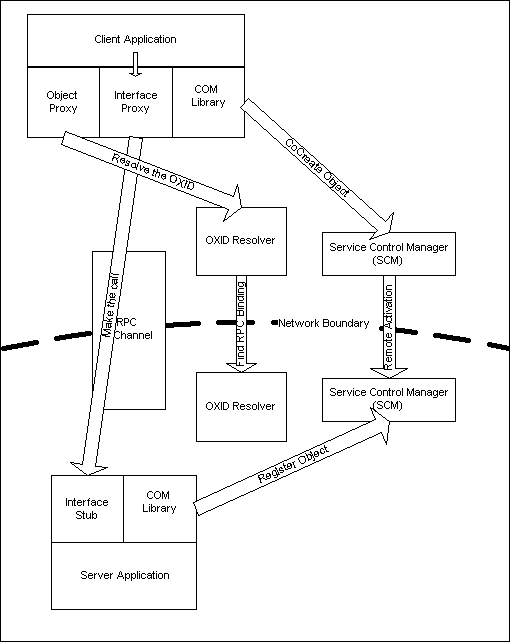
Adapted and simplified from “C++ Report” January 1998, p. 26
Patterns++ column.
Figure 9 shows a simplified view
of the DCOM architecture. Essentially,
Microsoft has added an infrastructure that transparently creates and manages
objects on remote machines, so the writer of the client application does not
need to know anything about RPC’s. For
example, the author of the client application does not need to know whether or
not the server on the remote machine is running. The application simply creates and uses the object, and DCOM
takes care of actually creating and shutting down the server object as
necessary.
It is worth noting, however, that
Microsoft has not currently defined a
scheme for object discovery. That is, DCOM does not have anything akin to
DCE’s Cell Directory Service. A client
DCOM application (or at least a field in the client machine’s registry
database) does need to know on what
machine the remote object is executing!
Microsoft plans to correct this problem in the future through the
proliferation of their Active Directory Services (see http://www.microsoft.com/ntserver/guide/activedirectory.asp).
Microsoft hopes that DCOM will
become a cross platform standard that essentially replaces DCE. In partnership with Microsoft, Software AG
is currently porting DCOM to various non-Microsoft platforms, including IBM
MVS, Sun Solaris, Digital Unix, and several others (see http://www.sagus.com/Prod-i~1/Net-comp/dcom/index.htm).
6.1.1 DCOM/DCE interoperability mechanics
The following is a brief discussion of the mechanics that
allow DCOM to sit atop DCE RPC. Note
that much of the code to implement DCOM’s scheme is automatically generated by
the MIDL compiler, and is not typically a concern for a developer merely
wishing to utilize DCOM. For complete
details of the DCOM protocols see Microsoft [17], and Stal [29].
Each computer supporting DCOM
provides a service known as the “Object Exporter”. The Object Exporter communicates via standard DCE RPC on
well-known endpoints (protocol specific identifiers unique to a given server
process, such as a TCP/IP port number), and its function is very similar to the
standard DCE endpoint mapper. The DCE
endpoint mapper is a service that runs on any workstation having DCE servers,
and in most implementations is simply a component of the RPC daemon. The service tracks the endpoints the servers
on that node are currently using, and communicates this information to the RPC
runtime of clients wishing to use a given server. In fact, Microsoft has proposed that the special endpoints used
by the Object Exporter to talk to the runtime be the same as that used by the
DCE endpoint mapper.
The Object Exporter supports
several remotely callable procedures, bound up in what Microsoft refers to as
the IObjectExporter interface. This
name is somewhat misleading because it seems to imply that IObjectExporter is a
COM interface, when in fact it is not.
Actually, IObjectExporter is merely a collection of the following RPC’s
implemented on every computer that supports DCOM: ResolveOxid(), SimplePing(),
and ComplexPing().
Every DCOM object provided by a
server must support the IRemUnknown interface.
Unlike IObjectExporter, this is a true COM interface. Its methods are similar to those in the
standard COM IUnknown interface with the “Rem” prefix added:
RemQueryInterface(), RemAddRef(), and RemRelease().
By implementing these interfaces,
and dealing with standard C++ name mangling, any platform should be able to
support DCOM. At least, of course,
until Microsoft changes the rules! It
is worth noting that Microsoft hopes to make DCOM into a platform independent
standard, although history tells us that Microsoft generally respects only
those standards over which it has control.
6.2 CORBA
The Common Object Request Broker Architecture (CORBA) is
the Object Management Group’s (OMG) (see http://www.omg.org/corba/)
answer to the problems of distributed computing. While similar to DCE and DCOM in that it uses an Interface
Definition Language (IDL) to specify remote object procedures and methods, it
does not build directly upon standard RPC’s.
The designers of CORBA consider the wire protocol an implementation
detail (while RPC specifies a layer above the wire protocol and allows various
wire protocols to “plug in” to it). The
strength of this approach is that any protocol can potentially be used by an
implementation of a CORBA Object Request Broker (ORB). The weakness, of course, is that there are
no clear means for ORB’s using different wire protocols to interoperate.
Figure 10: OMG’s CORBA
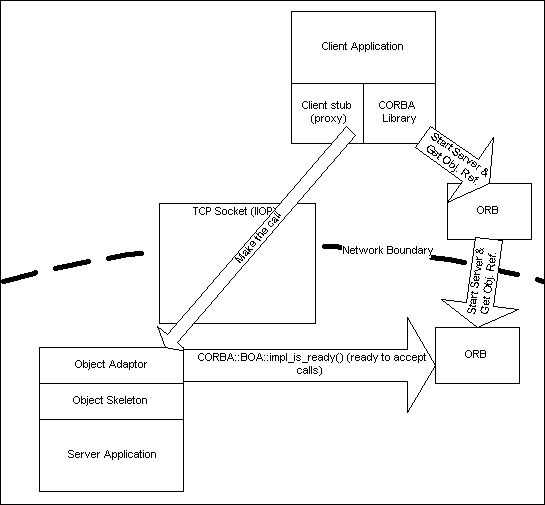
Adapted
and simplified from “C++ Report” January 1998, p. 26 Patterns++ column.
Figure 10 is a bird’s eye view of
OMG’s flexible CORBA architecture. Note
that a TCP socket is specified as the transport for the CORBA remote
function. This is actually true
specifically for the Internet Inter-ORB Protocol (IIOP), which is a particular
implementation of an ORB protocol that is commonly implemented by vendors of
various ORB’s. If this ORB protocol is
implemented on all ORB’s involved in a given communication session, then the
ORB’s can interoperate. Again, a given
vendor’s ORB may use any wire protocol, but most will also support IIOP in
order to work in multi-vendor environments.
Like DCE, CORBA is not a standard
part of common personal computer environments.
In order to deploy CORBA clients and servers on PC’s, it is necessary to
install additional third party software.
For example, Digital Equipment Corporation sells a product called Object
Broker, which includes PC desktop connectivity with CORBA (see http://www.digital.com/objectbroker/). The product accomplishes this by mapping
CORBA functionality to Microsoft OLE/COM for use on the PC. The Distributed System Object Model (DSOM),
which is IBM’s CORBA ORB, is also available for Microsoft Windows platforms, as
well as IBM OS/2 (see http://www.software.ibm.com/ad/somobjects/).
6.3
WWW and DCE
The World Wide Web (WWW or Web) has become a popular tool
for nearly every networked computer.
The Web was initially a medium for the exchange of academic information,
and soon grew to provide corporate and recreational information as well. However, recently, businesses have begun to
use the Web to truly conduct business, through electronic commerce, electronic
brokerage services, and connection of geographically diverse corporate
Intranets. With this change has come a
need for security and authentication.
Many businesses still resist connecting their internal networks to the
Internet, feeling that these security issues are inadequately addressed.
The organization responsible for
the continued development of the DCE standard (The Open Group) has supported
the “DCE Web Project” in an attempt to resolve these concerns (see http://www.camb.opengroup.org/www/dceweb/ and http://www.camb.opengroup.org/RI/www/prism/index.html). The initial strategy of the project is to
provide what is called a Secure Local Proxy (SLP) for browsers within the
corporate Intranet. This means that
browsers on desktops within a corporation (presumably behind a firewall) can
reach a proxy (installed on that client machine) through standard browser means
(i.e., the HTTP protocol). The proxy
may then access secure information via DCE connection to other internal
resources, allowing for standard DCE encryption and authentication services, as
well as the ability to use CDS for discovering relevant servers (and thereby
potentially providing such services as load-balancing). This scheme allows a corporation to
internally publish sensitive or secured information on the “DCE Web”, and yet
allow users to access this information through the standard browsers to which
they’ve become accustomed.
An auxiliary strategy for the
project is to provide a Security Domain Gateway (SDG), accessible through the
standard Secure Sockets Layer (SSL) protocol (which is now available to most
popular web browsers). Here, no
installation of software on client machines is necessary. SSL is employed to provide security and
authentication from the client to the SDG, and the SDG uses a temporary DCE
identity (derived from the SSL properties of the client) to access secure DCE
resources. Like the SLP strategy, the
SDG can also take advantage of other DCE services such as CDS. Organizations can determine which groups of
users can access a given document through standard DCE Access Control Lists
(ACL). This solution is essentially an
intermediary server for web browser applications (see Section 2.1.3).
Both the SLP and the SDG can
access the multi-protocol DCE Web Server.
This third component allows corporations to publish given documents
through standard Web methods (e.g., HTTP), but to also publish security
sensitive documents as available only through secure DCE methods, invoked by
either the SLP or the SDG. Figure 11,
following, illustrates the general architecture of the complete DCE Web
project.
Figure 11: DCE-Web
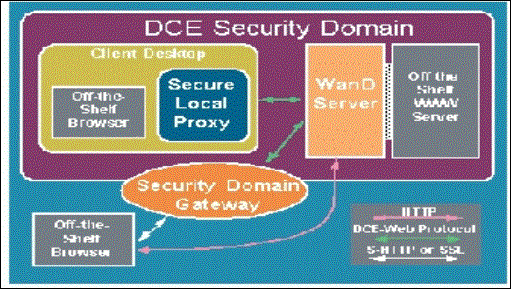
The Open Software Group provided this clip art.
The Open Software Group’s DCE Web
project is a viable alternative to true DCE client software for organizations
primarily interested in deploying DCE security on their personal
computers. While this method of integrating
PC’s into DCE does not allow standard DCE software to run on client machines,
it does provide a middle ground that may be very useful for some organizations.
7. Conclusion
DCE can solve many of the inherent problems of distributed
computing. It allows heterogeneous
computers to interoperate across a wide variety of network topologies and
protocols. It allows software
developers to write traditional functionally-decomposed code with little
consideration for which functions are executing locally and which ones are
actually being executed on a remote system.
DCE improves the use of network bandwidth by allowing developers to
deploy computing functions in close physical proximity to data resources, thus
dramatically reducing the volume of data that must be transmitted across the
network.
However, DCE is not yet fully the
seamless solution that is advertised.
This is largely due to incompatibilities between standard DCE
implementations and partial implementations of DCE contained in the widely
deployed Microsoft family of operating systems for personal computers. This problem can be viewed as falling under
the category of accidental complexity (as opposed to inherent complexity),
since it has essentially been introduced by Microsoft’s failure to adhere to
the DCE standard. Nonetheless, few
software developers can afford to ignore the Microsoft family of platforms
since they are nearly ubiquitous in most business and academic settings. Hopefully, this thesis can be used as a
guide to choose among the wide variety of possible methods to overcome these
problems.
In addition to accidental
complexities, there are inherent complexities in distributed computing that are
not addressed by DCE. Microsoft’s DCOM
essentially recasts DCE in an object-oriented paradigm, but it does not truly
add much in the way of solving several major challenges. The promise of distributed computing is
decoupling: decoupling code from its components’ execution contexts (as DCE
does), decoupling compile-time interfaces from their run-time implementations
(as COM does and DCE can be made to do), and someday decoupling compile-time
semantic need from run-time syntax (which is currently not done).
The last of these is an item for
future research. It seems that DCOM,
through OLE automation, has gone far enough to provide syntactic information
for using distributed objects. This is
accomplished through “type libraries” which provide binary representations of
syntactic information. For example, it
is possible to write a program that can construct calls to DCOM objects about
which the program had no knowledge at compile time. So, a program might be able to call SpellCheck(“string1”,
“string2”). However, there is no method
in DCOM for the program to discern the meaning
of the function or its arguments.
A program might discover an
object out somewhere in the Internet which provides this SpellCheck()
function. It might discover that the
function takes two arguments, each of which is a string. It might even discover that the names of the
arguments are “StringToBeChecked” and “DictionaryFileName”. However, the program has no way of
determining the meaning or semantic information behind these parameter names.
In the end, DCE is an excellent
solution for many of the problems of distributed computing. However, it is not a panacea. Distributed computing, by its very nature,
intensifies the difficulties inherent in writing cross platform applications,
and DCE itself has no answer for this.
DCE does not solve the problems of differing operating system
capabilities (e.g., lack of POSIX support), nor does it guarantee that every
platform will implement all of its features.
Nonetheless, DCE can help make distributed computing less effort
intensive for programmers, and it can help to make cross platform applications
possible if some care is taken by the developer. Even Microsoft environments with their legendary lax adherence to
standards can be brought into the DCE fold and made to interoperate with other DCE
systems.
This thesis has demonstrated that
a DCE application can be ported to prevalent PC environments and that such an
application can easily interoperate with a DCE cell containing a variety of
heterogeneous systems. Although PC
environments may natively lack full DCE compliance, third party solutions along
with some custom work-arounds can be employed to provide nearly complete
interoperation. This author has learned
a great deal about porting applications between Unix and PC platforms, DCE’s
influence and relevance to other distributed technologies such as DCOM and
CORBA, and particularly about the tendency of a certain large software company
to create standards rather than adhere to them. The author has tried to pass on this knowledge, through this
document, that others may benefit should they find themselves on this same
path.
Glossary
API – Application Programming Interface.
Bandwidth – The capacity of a network to transport data, typically
measured in mega-bits per second.
Big-endian/little-endian – Data storage techniques. Little-endian systems place the least
significant byte first and the most significant byte last. Big-endian orders bytes in the opposite
manner. These storage schemes are
respectively employed on various processors.
Client/Server – A style of programming in which code is distributed
between clients and servers. Typically,
client applications present and retrieve information from users while server
applications perform calculations and retrieve data. It is often useful to locate servers “near” to their data sources
(i.e., on the same machine or a short number of network hops away from the
data).
DCE – Distributed Computing Environment. This is a software architecture for distributed applications
developed by OSF.
Endpoint – A protocol specific identifier (e.g., a TCP/IP port
number), unique to a given DCE server process.
Upon obtaining an endpoint, a DCE client may use it to directly
communicate with a DCE server.
IDL – Interface Definition Language. This is a language used to specify how parameters are passed
between entities in a distributed application.
It is converted by an IDL compiler to either C or C++. The language specifies interfaces or
functions that are to be deployed remotely.
It includes special keywords to indicate how parameters are to be transported
across the network, such as [in] or [out].
Marshaling – The process of turning data structures into a
bit-stream representation suitable for transmission across a network.
MSDN – Microsoft Developer Network. This is a subscription service available from Microsoft which
provides documentation and software development kits for Microsoft platforms.
Name Mangling - Name mangling or name decoration is the practice of
most C++ compilers of creating unique names for method entry points by adding
the class name and some special characters to represent the parameters. For example, int MyClass::MyFunc(int I)
might be exported as MyFunc@MyClass@i. This guarantees that each method has a
unique entry point name, so it is legal to have additional functions with the
same name such as MyClass::MyFunc(char c).
The specific scheme used to create mangled names is an implementation
detail for each compiler. There is no
standard.
RPC – Remote Procedure Call.
This is the foundation upon which DCE is built. Microsoft’s version of RPC is binary
compatible with DCE, but is not based on the same source code.
Stub - A piece of code created by an IDL compiler, which acts as a
surrogate for a function. A stub
communicates with the RPC runtime in order to contact remote processes,
marshals and/or unmarshals parameters, and then calls the actual worker
function that it represents.
UUID – Universally Unique Identifier. This is a key value that is guaranteed to be unique. It is also referred to as a GUID or Globally
Unique Identifier by Microsoft.
Win32 – The API used to write programs that can run on either
Windows 9x or Windows NT.
Windows 3.x – Any of the 16 bit family of Microsoft Windows
products, including Windows 3.0, Windows 3.1, Windows 3.11, and Windows for
Workgroups 3.11.
Windows 9x – Any of the 32 bit “compatibility” Microsoft Windows
products, including Windows 95, Windows 98, and beyond. These are referred to by the term
“compatibility” in order to distinguish them as products designed to maintain
compatibility with older products (DOS applications, Windows 3.x applications,
etc.). This differentiates this group
from Windows NT.
Windows NT – Any version of Microsoft Windows NT, including Windows
NT 3.5, Windows NT 4.0, Windows NT 5.0, and beyond. These products were designed to compete with Unix and other
robust operating systems used for “mission critical” applications. Dave Cutler, who was instrumental in
developing the VMS operating system while at Digital Equipment Corporation, led
the development of Windows NT.
References
1. Active
Group World Wide Web site, http://www.activex.org.
2. Don
Box, Essential COM, Addison Wesley Longman, Inc., 1998.
3. Chappell
and Associates Report, http://www.camb.opengroup.org/dce/3rd-party/ChapRpt1.html.
4. Digital
Equipment Corporation, “Digital Distributed Computing Environment (DCE) for
Windows NT”, in the Microsoft Developer Network under Backgrounder\Platform
Articles\Networking, October 1994.
5. Digital
Equipment Corporation World Wide Web site, http://www.dec.com.
6. Digital
Equipment Corporation, “Digital DCE for Windows NT helpfiles”, 1996.
7. Gradient
World Wide Web site, http://www.gradient.com.
8. Richard
Grimes, Professional DCOM Programming, Wrox Press Ltd., 1997.
9. Hewlett
Packard World Wide Web site, http://www.hp.com.
10. P. E. Chung, Y.
Huang, S. Yajnik, D. Liand, J. Shih, C. Y. Wang, and Y. M. Wang, “DCOM and
CORBA: Side by Side, Step by Step, and Layer by Layer”, Patterns++ Column, C++
Report, SIGS Publications, Inc., January 1998.
11. IBM World Wide Web
software site, http://ww.software.ibm.com.
12. IBM World Wide Web
networking site, http://www.networking.ibm.com.
13. Infobeads World
Wide Web site, http://www.ci.infobeads.com.
14. Harold W.
Lockhart, Jr., OSF DCE Guide to Developing Distributed Applications,
McGraw-Hill, Inc., 1994.
15. Microsoft
Corporation, “The Foundations of Microsoft Windows NT System Architecture”,
September 1997.
16. Microsoft
Corporation, “Windows NT Resource Kit”, 1997.
17. Microsoft
Corporation, “The Component Object Model Specification”, Draft 0.9, October 24,
1995. Available on MSDN.
18. Microsoft
Corporation World Wide Web site, http://www.microsoft.com.
19. Microsoft
Corporation, Microsoft Developers Network (MSDN) CD collection, “Platform SDK
Documentation – Networking and Distributed Services – RPC – The Microsoft RPC
Model”, January 1998.
20. Microsoft
Corporation, Microsoft Developers Network (MSDN) CD collection, January 1998.
21. Object Management
Group World Wide Web site, http://www.omg.org.
22. Open Group World Wide Web site, http://www.camb.opengroup.org.
23. Ward Rosenberry,
David Kenney, and Gerry Fisher, Understanding DCE, O’Reilly and
Associates, Inc., 1992.
24. Ward Rosenberry
and Jim Teague, Distributing Applications Across DCE and Windows NT,
O’Reilly and Associates, Inc., 1993.
25. John Shirley and
Ward Rosenberry, Microsoft RPC Programming Guide, O’Reilly and
Associates, Inc., 1995.
26. John Shirley, Wei
Hu, and David Magid, Guide to Writing DCE Applications, O’Reilly and
Associates, Inc., 1994.
27. Swapnesh C.
Shirolkar, “Intermediary Servers”, Masters Thesis, University of Missouri,
1994.
28. Vepa V. Sirish,
“Application Level Gateways”, Masters Thesis, University of Missouri, 1996.
29. Michael Stal,
Siemens AG, “Distributed Object Computing”, presented at the 1997 OOPSLA
conference in Atlanta, GA., sponsored by the Association for Computing
Machinery (ACM).
30. Bjarne Stroustrup,
The C++ Programming Language, Third Edition, Addision Wesley Longman,
Inc., 1997.
31. Andrew S.
Tanenbaum, Computer Networks, Second Edition, Prentice-Hall, Inc., 1988.
Appendix
A: BINOP Source Code
The code, including the build environment, for the BINOP
project was originally written by Prof. Gordon K. Springer of the University of
Missouri-Columbia . Included here is a
modified version of BINOP, used with permission of the author, which can be
built and executed on Microsoft platforms.
The files SERVICE.H and SERVICE.C were originally written by Microsoft
as samples and are included here in slightly modified form as part of the BINOP
project.
Note that there are two build
targets: Win32 and Win32RAW. The
Win32RAW target builds the project with only the Microsoft supplied DCE services
(i.e., Microsoft RPC). This target only builds BINOPC, the BINOP worker
client program, since BINOPC only requires RPC to function, and the target does
not require any special tools, libraries, or headers save the
Microsoft-supplied utility header file, DCEPORT.H. The Win32 target builds the complete BINOP project, but requires
the Digital DCE ADK in order to build.
The resultant binaries from the Win32 target require the Digital DCE
Runtime in order to execute.
It is helpful to note that
several environment variables control the execution of the various BINOP
programs. The variable “PRINCIPAL”
controls the principal name that is used by a server (either FINDS or BINOPS)
to login to a DCE cell. Similarly, the
variable “PASSWORD_FILE” directs the server programs to the location of a file
that contains an (optionally) encrypted password for the principal. The “MUNS_CONF” variable provides a
space-delimited list of FINDS servers that can be used to lookup BINOPS
servers. For the purposes of easy demonstration,
each of these variables has a predefined default. The WIN32 platform defaults follow: PRINCIPAL defaults to “Springer”. PASSWORD_FILE defaults to “D:\Thesis\password.fil”. MUNS_CONF defaults to “D:\Thesis\muns.cfg”.
BINOP
Subproject
FILE:BINOP1.C
/*************************************************************************
* DCE Program
Binop1: BINOP1.C - Functions in the
Binop V2 Interface
*
* Author: G.K. Springer
* Date: June 1991
* Node: condor.cs.missouri.edu
* Location: Computer
Science Department, University of Missouri-Columbia
*
* Purpose: Demonstrate DCE Application Program
*
* Function: Define
the addition and subtraction functions in Server.
* This code is invoked directly by
the Binop Server (BINOPS.C)
* and indirectly from the Binop
Client (BINOPC.C)
*
* V2 has two functions exported by the
server: binop_add & binop_sub
*
* Syntax: None -
these are the functions the client calls in the server
*
* Change Log:
* 03/26/93 - GKS - Defined Version 1 Exported
Functions
* 09/15/93 - GKS - Redefined coding for use in
DCE
*
*************************************************************************/
#include "binop1.h" /* NIDL generated Interface Definition */
/*************************************************************************
* Remote ADD
function in the Binop Server Interface
*************************************************************************/
void binop_add
#ifdef IDL_PROTOTYPES
(
/* [in]
*/ handle_t h,
/* [in]
*/ idl_long_int a,
/* [in]
*/ idl_long_int b,
/* [out] */ idl_long_int *c
)
#else
(h, a, b, c)
/* [in]
*/ handle_t h;
/* [in]
*/ idl_long_int a;
/* [in]
*/ idl_long_int b;
/* [out] */ idl_long_int *c;
#endif
{
*c = a + b; /* Compute result and return to caller */
} /* end
binop_add() */
/*************************************************************************
* Remote
SUBTRACTION function in the Binop Server Interface
*************************************************************************/
void binop_sub
#ifdef IDL_PROTOTYPES
(
/* [in]
*/ handle_t h,
/* [in]
*/ idl_long_int a,
/* [in]
*/ idl_long_int b,
/* [out] */ idl_long_int *c
)
#else
(h, a, b, c)
/* [in]
*/ handle_t h;
/* [in]
*/ idl_long_int a;
/* [in]
*/ idl_long_int b;
/* [out] */ idl_long_int *c;
#endif
{
*c = a - b; /* compute result and return to caller
*/
} /* end
binop_sub() */
FILE:BINOP1.IDL
/*
* IDL definition of special binary operations
server (BINOP)
*
* Exports Functions: binop$add and binop$sub
* Uses: IP Communication to a system
allocated port
*
* By: G.K. Springer - July 1991
* Modified: GKS - March 1993
* GKS - redone for DCE
implementation
*/
[
uuid(249dacc0-ac8d-11cc-89ce-08002b37598d),
version(1.0)
]
interface binop
{
/* Define Addition Exported Function */
[idempotent]
void binop_add(
[in] handle_t
h, /* Communication Handle */
[in] long
a, /* Parameter 1 for add
*/
[in] long
b, /* Parameter 2 for add
*/
[out] long *c
/* Result of add to return */
);
/* Define Subtraction Exported Function */
[idempotent]
void binop_sub(
[in] handle_t
h, /* Communication Handle */
[in] long
a, /* Parameter 1 for
subtract */
[in] long
b, /* Parameter 2 for
subtract */
[out] long *c
/* Result of subtract to return */
);
}
FILE:BINOPC.C
/*************************************************************************
* DCE Program
Binopc: BINOPC.C - Client Application
Program
*
* Author: G.K. Springer
* Date: October 1993
* Node: condor.cs.missouri.edu
* Location:
Computer Science Department, University of Missouri-Columbia
*
* Purpose: Demonstrate DCE Application Program
*
* Function:
Implement an addition and subtraction RPC service.
*
* Syntax: This program is invoked with the command
line:
* BINOPC <server_host>
<num_passes>
* where:
* server_host - identifies the host
where server is running
* num_passes - indicates how many loops of requests to
perform
*
* Example: binopc cyclone.cs.missouri.edu 3
*************************************************************************/
/*
* Standard C Include
files
*/
#include <stdio.h>
#ifndef WIN32
#include <unistd.h>
#endif
#ifndef WIN32RAW
#include <pthread.h>
#endif
/* Include NCS Definitions */
#ifdef WIN32RAW
#include <rpc.h>
#include "dceport.h"
#else
#include <dce/rpc.h>
/* DCE RPC definitions */
#endif
#include "binop1.h" /* NIDL generated Interface definitions */
#include "binopnms.h" /* Binop Name Strings */
/***************************************************************************
* BINOPC - Client Main Program
***************************************************************************/
main(int argc,
char **argv)
{
int passes; /* Input parameter for passes to run */
int i; /* temp loop counter */
int result; /* temp result */
rpc_if_id_t ifid; /* interface identifier */
unsigned32 st; /* Return status from RPC calls */
rpc_binding_handle_t rh; /* RPC
handle for communication */
unsigned_char_t
*string_binding; /* String
binding handle */
rpc_protseq_vector_t *protvec;
/* protocol sequence vector */
char host[NMLEN]; /* hostname for server */
/***************************************************************************
* Start of main()
program
***************************************************************************/
if (argc < 3)
{
fprintf(stdout,"usage: %s hostname passes\n", *argv);
exit(1);
}
strcpy(host,
argv[1]); /* move Server hostname */
passes =
atoi(argv[2]); /* get number of passes to run */
/* Find supported protocols on this system */
rpc_network_inq_protseqs( &protvec, &st); /* get protocol strings */
if (st !=
rpc_s_ok) {
fprintf(stdout, "%s: Cannot obtain supported protocols\n",
*argv);
exit(1);
}
fprintf(stdout,
"This system supports %d protocols\n", protvec->count);
for (i=0;
i<protvec->count; i++) {
fprintf(stdout, "Protocol %d: %s\n", i,
protvec->protseq[i]);
}
fflush(stdout);
/*************************************************************************
* Loop thru
protocols to find a binding handle that is active on host
*************************************************************************/
for (i=0;
i<protvec->count; i++) {
/* Compose the
string first so handle can be obtained from it */
rpc_string_binding_compose((unsigned_char_t *)OBJSTR,
protvec->protseq[i], (unsigned_char_t
*)host,
NULL, NULL, &string_binding, &st);
if (st !=
rpc_s_ok) {
fprintf(stdout,"Cannot compose string
binding\n");
result = -1;
}
/* Get the
partially bound handle from the constructed string */
rpc_binding_from_string_binding (string_binding, &rh, &st);
if (st !=
rpc_s_ok) {
printf("Cannot convert name %s to
binding\n",string_binding);
result = -1;
}
else result =
0;
/* Free the
string info we don't need any more */
rpc_string_free(&string_binding, &st);
/* Set timeout
commensurate with the protocol */
rpc_mgmt_set_com_timeout(rh, i+1, &st);
rpc_ep_resolve_binding(rh, C_IFSPEC, &st);
if (st !=
rpc_s_ok) result=-1;
if (result==0)
break;
} /* end of for loop to build a handle */
/* We have a handle or we don't - so free protocol vector
*/
rpc_protseq_vector_free(&protvec, &st);
if (result != 0)
{
printf("Unable to connect to server on %s\n", host);
exit(1);
}
/***********************************************************************
* All set - make
appropriate number of passes to Server RPC Functions
***********************************************************************/
makepass(rh,
passes); /* All work is done in this
routine */
exit(0); /* We are done - Let's go home */
} /* End BINOPC
main() */
FILE:BINOPDEM.C
/****************************************************************************
* DCE Demo
Program: BINOPDEMO.C - Client
Application
*
* Author: G.K. Springer
* Date: February 1992
* Node: condor.cs.missouri.edu
* Location:
Computer Science Department - MU, Columbia, MO.
*
* Purpose: Demonstrate DCE Application Program
*
* Function:
Implement an addition and subtraction RPC service.
*
* Syntax: This program is invoked with the command
line:
* BINOPDEMO
*
* Change Log:
* 09/93 - GKS -
Rewrite code for DCE Nameservice Lookup
*
****************************************************************************/
/*
* Standard C
Include files
*/
#include <stdio.h>
#ifndef WIN32
#include <unistd.h>
#endif
#include <stdlib.h>
#include <signal.h>
#include <sys/types.h>
#include <time.h>
#include <pthread.h>
/*
* Include DCE
Definitions
*/
#include <dce/rpc.h>
/* DCE RPC definitions */
#include <dce/dce_error.h> /* DCE error definitions */
#include "binop1.h" /* NIDL generated Interface definitions */
#include "binopnms.h" /* Binop Name Definitions */
char *mc =
{"bcdefghijk"};
#ifdef WIN32
#define
CLEARIT "cls"
#else
#define
CLEARIT "clear"
#endif
#define HELPER "binophlp | more"
#define STATS "binopst | more"
#define MaxSrv 20
/***********************************************************************
* BINOPDEMO - Demo Main Program
***********************************************************************/
main(int argc, char **argv)
{
int passes; /* Input parameter for passes to run */
int num_entry; /* Number of server registrations */
int nsrv; /* number of servers in demo run */
int i, j, l; /* Temp variables */
int index[MaxSrv+1]; /* Index to servers */
int proto[MaxSrv+1]; /* Index to
handles we use */
rpc_binding_vector_t
*results; /* NS lookup results
*/
unsigned32 st;
/* Return status from RPC calls */
char group_name[NMLEN]; /* name of group to search NS */
char ch; /* read character input */
char maxsrv; /* max servers in run */
char string[256], *sp;
unsigned_char_t
*string_binding;
/***************************************************************************
* Start of main()
program
***************************************************************************/
printf("Please wait a minute while we get setup ...\n");
/*
* Lookup the BINOP Object Uuid in the DCE
NameService Database
*/
strcpy(group_name,
GRPNAME); /* identify the group desired
*/
num_entry =
findsrvs(group_name, OBJSTR, binop_v1_0_c_ifspec, &results,
MaxSrv, &st); /* lookup
servers */
if (num_entry ==
0) {
/* No servers found registered */
printf("Lookup for BINOP Servers
Failed - %s\n", dcemsg(st));
}
/*
* Sort out the
unique servers in the list of handles
*/
j =
s_handle(num_entry, &nsrv, results, index, proto);
/*
* For each server found running, complete the
binding information
*/
for (i=0;
i<nsrv; i++) {
rpc_mgmt_set_com_timeout(results->binding_h[proto[i]],
rpc_c_binding_min_timeout, &st); /* timeout quickly */
rpc_ep_resolve_binding(results->binding_h[proto[i]],
binop_v1_0_c_ifspec,
&st);
} /* End for each server loop */
maxsrv = 'a' +
nsrv;
passes = 1; /*
get number of passes to run */
/************************************************************************
* Loop on the menu until request to quit
************************************************************************/
for (;;) {
system(CLEARIT);
printf("\t\tDCE Remote Procedure Call Demonstration\n");
printf("\t\t---------------------------------------\n\n");
printf("a: Issue RPC requests to ALL Systems\n");
for (i=0; i
< nsrv; i++) { /* Output the menu for servers */
printf("%1c: Issue RPC
requests to ", mc[i]);
p_handle(results->binding_h[proto[i]]); /* print who we talk to */
}
if(nsrv > 0)
printf("\n");
printf("r: Refind the
running servers\n");
printf("s: Print statistics
from servers\n");
printf("u: Print a
description of the RPC Demo\n\n");
printf("q: Terminate the
Demo\n\n");
printf("Please enter the character for the menu item
desired\n");
sp
=gets(string);
if (sp == NULL)
break;
l =
sscanf(string,"%c",&ch);
if (l == 1) {
if
(((ch<'a') | (ch > maxsrv)) &
(ch!='u') & (ch!='q') & (ch!='r') & (ch!='s') ) ch='z';
else {
i = ch -
'b'; /* get index of hostname desired
*/
if
((ch>'a') & (ch<'k')) ch='b'; /* access 1 server */
}
switch (ch)
{
case 'a':
system(CLEARIT);
for (i=0; i<nsrv; i++) { /*
Call all servers */
makepass(results->binding_h[proto[i]], passes);
}
break;
case 'b':
system(CLEARIT);
makepass(results->binding_h[proto[i]], passes);
break;
case 'r':
rpc_binding_vector_free(&results, &st); /* free vector */
num_entry = findsrvs(group_name, OBJSTR, binop_v1_0_c_ifspec,
&results, MaxSrv,
&st); /* lookup servers */
j = s_handle(num_entry,
&nsrv, results, index, proto);
maxsrv = 'a' + nsrv; /* identify
last server index */
for (i=0; i<nsrv; i++) {
rpc_ep_resolve_binding(results->binding_h[proto[i]],
binop_v1_0_c_ifspec, &st);
} /* End for each server loop */
break; /* done - just go back
and redisplay menu */
case 's':
system(CLEARIT); /* show stats on
servers */
system(STATS); /* give them stats from the servers */
break;
case 'u':
system(CLEARIT);
system(HELPER); /* give them
help info on demo */
break;
case 'q':
printf("\n***End of RPC Demo***\n");
rpc_binding_vector_free(&results, &st); /* free vector */
exit(0); /* We are done - Let's go home */
default: printf("Invalid
option selected - try again.\n");
break;
} /* end switch */
} /* end if */
printf("\nHit
ENTER key to make next selection\n");
sp =gets(string);
if (sp == NULL)
break;
} /* end for */
rpc_binding_vector_free(&results, &st); /* free binding vector */
exit(0);
} /* End BINOPDEMO
main() */
FILE:BINOPHLP.C
/****************************************************************************
* BINOPHLP.C - Print HELP information about
the BINOPDEMO demonstration.
*
* Author: G.K. Springer
* Date: March 1993
* Node: cyclone.cs.missouri.edu
* Location:
Computer Science Department - MU, Columbia, MO.
*
* Purpose: Tell user about the BINOPDEMO demonstration
program.
* Function: This
program simply prints lines to stdout that explains the
* demonstration program. This program is invoked from the demo
* menu (option 'h'). During its execution, this program searches
* for the BINOP servers registered in
the network. For each
* server found, bind to the server
and print out the information
* found in the Location Broker
database about the server. This
* information may or may not exactly
agree with the servers listed
* on the menu and an entirely new
lookup is performed here. If
* there is a disagreement with the
menu, requesting the demo to
* relookup the servers should put
this HELP and the menu back in
* synchronization.
*
* Change Log:
* 09/93 - GKS - Revised for use in DCE
environment
****************************************************************************/
/*
* Standard C
Include files
*/
#include <pthread.h>
#ifndef WIN32
#include <unistd.h>
#endif
#include <stdio.h>
#include <stdlib.h>
#include <signal.h>
#include <sys/types.h>
/*
* DCE Definitions
*/
#include <dce/rpc.h>
#include <dce/rpcexc.h>
#include <dce/uuid.h>
/* Include DCE Application Definitions */
#include "binop1.h" /* IDL generated Interface definition */
#include "binopnms.h" /* Binop Name Strings */
extern char *error_text();
#define MaxSrv 6
/************************************************************************
* BINOPHLP - Server Status Main Program
***********************************************************************/
main(int argc, char **argv)
{
int i,j; /* Counters - temp */
unsigned32 st; /* Status of calls made */
unsigned32 max_entry; /* NS lookup max entries */
unsigned32 num_entry; /* NS lookup num entries returned */
rpc_binding_vector_t *results; /* NS lookup results */
char group_name[NMLEN]; /* name of group to search NS */
/************************************************************************
* Start of main program
***********************************************************************/
/* Print help info about the binopdemo program */
printf("
DCE Remote Procedure Call Demonstration\n");
printf("
---------------------------------------\n");
printf("\n");
printf("\n");
printf("This demonstration shows the operation of
using remote procedure\n");
printf("calls from one workstation to another
workstation that is running\n");
printf("a server. In this demonstration, some number
of servers have been\n");
printf("started on separate machines in the
network. The exact number is\n");
printf("not known until this program searches the network to find where\n");
printf("the servers are located. The servers found to be running in
the\n");
printf("network will be listed on the main menu of
this demonstration. If\n");
printf("no servers
are found to be running, no servers will be listed on\n");
printf("the menu.
The search for the location of running servers is done\n");
printf("by using
Distributed Computing Environment (DCE) Name Service to\n");
printf("find the servers that have
\"registered\" themselves in the network.\n");
printf("\n");
printf("Each time
this demonstration program is run,
a different set of\n");
printf("servers
may be listed on the menu. Depending upon where each\n");
printf("server has been started, this demonstration program will locate\n");
printf("them dynamically and list only those servers that are currently\n");
printf("active in the network. By looking at the server locations
listed\n");
printf("on the main menu, you can see where they are located and be able\n");
printf("to request services from them individually or
as a group. As an\n");
printf("example, the current list of registered
servers is:\n");
printf("\n");
/*
* Lookup the BINOP Object Uuid in the
NameService Database
*/
strcpy(group_name, GRPNAME); /*
identify the group desired */
num_entry =
findsrvs(group_name, OBJSTR, binop_v1_0_c_ifspec, &results,
MaxSrv, &st); /* lookup
servers */
if (num_entry ==
0) {
/* No servers found registered */
printf("\n\t*** No Binop Servers are currently registered
***\n");
}
else {
/*
* For each server found running, Print out
where it is located.
*/
printf("\n");
for (j=0;
j<num_entry; j++) {
rpc_mgmt_set_com_timeout(results->binding_h[j],
rpc_c_binding_min_timeout, &st); /* timeout quickly */
printf("\tServer %c:
", 'b'+j);
p_handle(results->binding_h[j]); /* print who we talk to */
} /* end for */
rpc_binding_vector_free(&results, &st); /* free binding vector */
} /* end else */
printf("\n");
printf("\n");
printf("Each of the servers offer two services; an
addition service and a\n");
printf("subtraction
service. Each request
to a server passes two\n");
printf("parameters, A and B, which are to be operated
upon by the server.\n");
printf("The
addition service ADDS
the two parameters and returns
the\n");
printf("result C to the caller. The subtraction service SUBTRACTS the\n");
printf("two parameters and returns the result C to the
caller.\n");
printf("\n");
printf("In this demo, a loop that performs 50 requests
to the add service\n");
printf("and
50 requests to
the subtract service
are made to
the\n");
printf("designated server. As the result from each request
is returned\n");
printf("to the caller (this demo program), it is
displayed on the screen.\n");
printf("This lets you see how quickly each of the
requests are serviced.\n");
printf("Timing
is done across
all of the requests and a final line is\n");
printf("written
to the screen that shows
the average number
of\n");
printf("milliseconds each particular request took to
complete.\n");
printf("\n");
printf("The requests to the servers are all of the
form:\n");
printf("\n");
printf("
c = i + i (for Addition
Service)\n");
printf("\n");
printf("
c = 51 - i (for Subtraction
Service)\n");
printf("\n");
printf("
where: i is the index of loop sending requests to the server.\n");
printf("
c is the result computed by the server and returned to\n");
printf("
the caller.\n");
printf("\n");
printf("\n");
printf("Although this is a very simple demonstration,
it shows the power\n");
printf("of
being able to
utilize the computational power of another\n");
printf("machine to
perform the operations
needed by an
application\n");
printf("program.
There is no
limit to the
type and volume
of\n");
printf("computations that could be performed by the
server. If you think\n");
printf("about
it, the server could be a very
large machine (like a CRAY\n");
printf("supercomputer) which could perform the needed
computations far\n");
printf("faster
than the local application program could perform them for\n");
printf("itself.\n");
printf("\n");
printf("Since the calls to the server are made in
the same way as you\n");
printf("would
make them to a procedure or
function in your own program,\n");
printf("the amount of time needed to build such
distributed applications\n");
printf("is actually very small. As a case in point, the actual code
used\n");
printf("to make the server requests in this demo are
shown below.\n");
printf("\n");
printf("To run this demo, simply select one of the
options displayed on\n");
printf("the menu screen and sit back and watch what
happens.\n");
printf("\n");
printf("Hope you enjoy the demonstration!!\n");
printf("\n");
printf("\n");
printf("\n");
printf("\n");
printf("
Source Code used in DEMO to make Server Requests\n");
printf("
------------------------------------------------\n");
printf("\n");
printf("\n");
printf("/*****************************************************************\n");
printf(" * makepass() - run the demo on one of the
requested servers \n");
printf("
*****************************************************************/\n");
printf("makepass(handle_t rh, int passes) \n");
printf("{\n");
printf("
int k; /* Temp counter for passes run
*/\n");
printf("
int i, n; /* Temp variables */\n");
printf("
status_t st; /* Return status from RPC calls
*/\n");
printf(" int
start_time, stop_time; /* Timing variables */\n");
printf(" \n");
printf("
printf(\"\\nStart Requests to Server: \\n\");\n");
printf("
p_handle(rh);\n");
printf("\n");
printf("/*********************************************************************\n");
printf(" * Loop for the requested number of passes to
Server RPC Functions\n");
printf("
*********************************************************************/\n");
printf(" for
(k = 1; k <= passes; k++) {\n");
printf("
start_time = time(NULL); /* Get
TOD at start of a pass */\n");
printf(" \n");
printf("
/*\n");
printf(" *
Call addition service the required number of times\n");
printf(" */\n");
printf("
for (i = 1; i <= CALLS_PER_PASS; i++) {\n");
printf("
binop_add(rh, i, i, &n); /*
Call RPC ADD service on Server */\n");
printf("
printf(\"%%3d \",n); /* Print result returned */\n");
printf("
/* add a newline every 10 results returned */\n");
printf("
if ((i%%10 == 0) && (i != CALLS_PER_PASS))
printf(\"\\n\");\n");
printf("
} /* end for i - addition loop
*/\n");
printf("
printf(\" *** end of
addition ***\\n\");\n");
printf(" \n");
printf("
/*\n");
printf(" *
Call subtraction service the required number of times\n");
printf("
*/\n");
printf("
for (i = 1; i <= CALLS_PER_PASS; i++) {\n");
printf("
binop_sub(rh, CALLS_PER_PASS+1 , i, &n); /* Call RPC SUB service */\n");
printf("
printf(\"%%3d \",n);
/* Print result returned */\n");
printf("
/* add a newline every 10 results returned */\n");
printf("
if ((i%%10 == 0) && (i != CALLS_PER_PASS))
printf(\"\\n\");\n");
printf("
} /* end for i - subtraction
loop */\n");
printf("
printf(\" *** end of
subtraction ***\\n\");\n");
printf(" \n");
printf("
/*\n");
printf(" *
Calculate average time to process a call\n");
printf("
*/\n");
printf("
stop_time = time(NULL); /* Get
TOD at end of pass */\n");
printf("
printf(\"***** pass %%3d; real/call: %%2d ms\\n\",\n");
printf("
k, ((stop_time - start_time) * 1000) / (2*CALLS_PER_PASS));\n");
printf("
} /* end for k - number of
passes */\n");
printf("} /*
end makepass() */\n");
printf("\n");
exit(0);
} /* end binophlp()
*/
FILE:BINOPMSG.C
/****************************************************************************
* BINOPSMSG.C - Get
DCE Error Messages from error message table.
*
* Author: G.K. Springer
* Date: March 1993
* Node: cyclone.cs.missouri.edu
* Location:
Computer Science Department - MU, Columbia, MO.
*
* Purpose: Utility to get an NCS run-time error message
from the message
* table and return the message string
to the caller.
* Function: Access
external message table by error number and return string
* to the caller.
*
* Change Log:
* 09/93 - GKS - Changed for DCE implementation
*
* Note:
* To get error messages an environment
variable NLSPATH is required.
* Define it as: setenv NLSPATH "/opt/dcelocal/nls/msg/en_US.88591/%N"
*
****************************************************************************/
/* Include DCE Definitions */
#include <dce/rpc.h>
#include <dce/dce_error.h>
char *error_text(int st)
{
int err_st; /*CRAY*/
static char
buff[dce_c_error_string_len];
dce_error_inq_text(st, buff, &err_st);
if (err_st != -1)
return(buff);
else {
if (st ==
0xc038a0e0)
sprintf(buff, "DCE/RT - Server not responding");
else
sprintf(buff, "DCE/RT - No error text translation,
st=%08x",st);
return(buff);
}
} /* binopsmsg() */
FILE:BINOPNMS.H
/*************************************************************************
* DCE Program
Binop: BINOPNMS.H - Include File.
*
* Author: G.K. Springer
* Date: September 1993
* Node: condor.cs.missouri.edu
*
* Purpose: Include file for BINOP application programs
*
* Function: Define
the OBJ UUID string, Group Name, Entry Name
* and Annotation Names for the Binop
Application code.
*
* Syntax: Include file for C syntax programs
*
* Update Log:
* 09/93 - GKS -
Rewrite of code for DCE environment
*************************************************************************/
#define
GRPNAME
"/.:/hpcc/Binop_Group"
#define
ENTNAME
"/.:/hpcc/Binop_"
//#define
GRPNAME
"/.:/hpcc/test/Binop_Group"
//#define
ENTNAME
"/.:/hpcc/test/Binop_"
#define EPNAME "BINOP Server V2"
#define NMLEN 50
#define S_IFSPEC
binop_v1_0_s_ifspec
#define
C_IFSPEC binop_v1_0_c_ifspec
#define OBJSTR
"aaaa4000-b04b-11cc-bf88-08002b37598d"
FILE:BINOPS.C
/*************************************************************************
* DCE Program
Binops: BINOPS.C - Server Routine.
*
* Author: G.K. Springer
* Date: June 1991
* Node: condor.cs.missouri.edu
* Place: Computer Science Department, University of
Missouri-Columbia
*
* Purpose: Demonstrate DCE Application Program
*
* Function:
Implement an addition and subtraction RPC service.
*
* Syntax: This
program is invoked with the command line:
* BINOPS [&] (should invoke
program in background)
*
* Change Log:
* 10/93 - GKS - Rework code to run in DCE
environment using DCE Name
* Service across multiple DCE
Cells.
* Note:
* February 1994 - GKS - Added processing
code
* A dedicated signal catching thread is used
to allow the server to
* terminate gracefully in the presence of a
fatal asynchronous signal.
* This thread is created by the server and
gains control in sigcatch()
* whenever a non-DCE termination signal is
received by the server.
*
* A dedicated self-authentication thread is
used to keep the server's
* credentials current. It wakes up just prior to the credentials
* expiring and reauthenticates itself to DCE
so it always remains
* authenticated - regardless of what its
expiration limit is and how
* long it has been running. One requirement is the principle must be
* able to refresh its certificates and the
ticket lifetime must be
* greater than 10 minutes.
*************************************************************************/
/*
* Standard C
Include files
*/
#include <stdio.h>
#ifndef WIN32
#include <unistd.h>
#include <sys/errno.h>
#else
#include <errno.h>
#endif
#include <stdlib.h>
#include <string.h>
#include <sys/types.h>
#include <sys/stat.h>
#include <pthread.h>
/* Include DCE Definitions */
#include <dce/rpc.h>
/* DCE RPC definitions */
char
*pnm; /*
program name pointer for msgs */
char
msg[144]; /* For
time-stamped messages */
#ifndef WIN32
pid_t
pid; /*
Process id of the server */
#else
int pid; /* Process id of the server */
#endif
uuid_t
objuuid; /* binary
object uuid string */
rpc_if_id_t
ifid; /*
interface identifier */
uuid_vector_t
*obj_uuid_vector; /* object
uuid vector for register */
rpc_binding_vector_t
*binding_vector; /* Bindings for
server */
int
logflg;
/* Define Server Specific Functions and Names */
#include <musrv.h>
/***************************************************************************/
/***************************************************************************/
/* This conditional code has been added to allow WIN32
servers to start as */
/* services. The
utility code contained in service.h and service.c is */
/* taken from a Microsoft sample program called
"Simple Service". It is */
/* included with minor modifications. */
/* JimR 3/1/97 */
/***************************************************************************/
#ifdef WIN32
#ifndef NODAEMON
#include <service.h>
#define SZAPPNAME "BinopS"
#define SZSERVICENAME "BinopS"
#define SZSERVICEDISPLAYNAME "DCE BINOP Server"
#define SZDEPENDENCIES ""
#include <service.c>
VOID ServiceStart (DWORD dwArgc, LPTSTR *lpszArgv)
{
/**********************************************/
/* PROBLEM! -
We really shouldn't tell control*/
/* panel that
we are up and running until we */
/* have
registered the endpoints and all. */
/* However,
this way allows WIN32 to act more */
/* nearly like
the other environments. */
/**********************************************/
/* Let control
panel know that we are running */
ReportStatusToSCMgr(SERVICE_RUNNING,NO_ERROR,0);
/* Start doing
our work as usual */
main_worker(lpszArgv);
}
VOID ServiceStop()
{
/* Warn the
SCMgr that we may take up to 10 secs to stop */
ReportStatusToSCMgr(SERVICE_STOP_PENDING,NO_ERROR,10000);
/* Fake a
CTRL-C to shutdown service */
SignalHandlerRoutine(CTRL_C_EVENT);
}
#else /*
NODAEMON */
main(int argc, char **argv)
{
main_worker(argv);
}
#endif /* NODAEMON */
#else /* WIN32
*/
main(int argc, char **argv)
{
main_worker(argv);
}
#endif /* WIN32 */
/***************************************************************************/
/***************************************************************************/
/***************************************************************************
* Server Main
Program
***************************************************************************/
main_worker(char **argv)
{
double dum1; /* Force vars to align on a double boundary */
int i; /* loop index */
char logname[128]; /* name of the log file */
FILE *fp; /* temp file
pointer to log file */
unsigned32 st;
/* DCE status return codes on calls */
unsigned32 thread_stk_size; /* stack size for threads */
int thread_status;
pthread_t refresh_thread; /* refresh thread to keep server
* sec_credentials active */
pthread_t sigcatch_thread; /* signal catching thread for
* graceful shutdowns */
pthread_attr_t
attr; /* attributes of a thread */
/************************************************************************
* Start of main program
************************************************************************/
/* get short name of program */
#ifdef WIN32
/* JimR Note - Changed from rindex to strrchr since only
the latter */
/* is supported on MS platforms and is also supported on
all UNIX */
#define rindex strrchr
/* JimR Note - looking for slash on Unix, or backslash on
MS platforms */
#define PathDelimiter '\\'
#else
#define PathDelimiter '/'
#endif
pnm =
rindex(*argv, PathDelimiter);
if (pnm == NULL)
pnm = *argv;
else pnm = pnm+1;
#ifndef WIN32
umask(027); /* make desired file mode creation mask */
#endif
regstat = 0; /* init registration status */
#ifndef NODAEMON
/************************************************************************
* Compile this code
if we are creating a Daemon Server
************************************************************************/
/* create name of log file and test its use for stdout and
stderr */
sprintf(logname,
"%s/%s.log", LOGDIR, pnm);
if ((fp =
fopen(logname, "a")) == NULL) {
sprintf(msg,
"%s: could not open log:\n\t%s", pnm, logname);
tmsg(msg);
exit(1);
}
/* make ourselves into a daemon */
i = daemon_init();
if (i < 0) {
sprintf(msg,
"%s: error forking child process\n", pnm);
tmsg(msg);
fclose(fp);
exit(1);
}
/* we are now a daemon - so redirect stdout and stderr to
log file */
if
(freopen(logname, "a", stdout) == NULL) {
fprintf(fp,
"%s: could not reopen stdout to log:\n\t%s", pnm, logname);
exit(1);
}
if
(freopen(logname, "a", stderr) == NULL) {
fprintf(fp,
"%s: could not reopen stderr to log:\n\t%s", pnm, logname);
exit(1);
}
fclose(fp); /* and close the temp file pointer */
#endif
printf("\n************************************************************\n");
sprintf(msg,
"%s: Server starting execution...", pnm);
tmsg(msg);
logflg= 1;
#include <srvbase.h>
/* bring in code for the base server */
} /* end main */
#include <srvcln.h>
/* bring in code for the base cleanup routines */
FILE:BINOPST.C
/****************************************************************************
* BINOPST.C - Print
Statistics about BINOP servers running on network.
*
* Author: G.K. Springer
* Date: November 1991
* Node: cyclone.cs.missouri.edu
* Location:
Computer Science Department - MU, Columbia, MO.
*
* Purpose: Use rpc call to get server stats from BINOP
servers running.
* Function: Lookup
the BINOP servers registered in the network.
For each
* server found, bind to the server
and issue an inquire stats
* request and print out the returned
statistics. If the server
* does not respond (using short
timeout periods), print an
* error message so indicating. This code uses the pthread
* error handling facilities built
into DCE RunTime code.
*
* Change Log:
* 09/93 - GKS -
Rewrite code for DCE Nameservice Lookup
*
****************************************************************************/
/*
* Standard C
Include files
*/
#include <stdio.h>
#ifndef WIN32
#include <unistd.h>
#include <sys/errno.h>
#else
#include <errno.h>
#endif
#include <stdlib.h>
#include <sys/types.h>
/* Include DCE Definitions */
#include <pthread.h>
#include <dce/rpc.h>
/* DCE RPC definitions */
#include <dce/rpcexc.h>
/* Include DCE Application Definitions */
#include "binop1.h" /* IDL generated Interface definition */
#include "binopnms.h"
#define MaxSrv 6
char *dcemsg();
unsigned32 p_handle();
static char *stname[] = { " Calls In: ",
" Calls Out: ",
" Packets In: ",
" Packets Out:" };
/************************************************************************
* Server Status Main Program
***********************************************************************/
main(int argc, char **argv)
{
int i,j; /* Counters - temp */
int max_entry; /* LB lookup max entries */
int num_entry; /* LB lookup num entries returned */
unsigned32 st; /* Status of calls made */
rpc_stats_vector_t *stats;
/* Array of stat values returned */
rpc_binding_vector_t *results;
/* LB lookup results */
char group_name[NMLEN]; /* name of group to search NS */
/************************************************************************
* Start of main program
***********************************************************************/
printf("\n************ Start Stats from BINOPS Servers
************\n");
system("echo
%_date% %_time%"); /* timestamp
the output */
/*
* Lookup the Object Uuid in the NameService
Database
*/
if (argc == 1) {
strcpy(group_name, GRPNAME); /*
identify the group desired */
}
else {
strcpy(group_name, *(argv+1));
/* user specified the name */
}
max_entry =
MaxSrv;
#ifdef DEBUG
printf("Looking
up group name: %s.\n",group_name);
#endif
num_entry =
findsrvs(group_name, OBJSTR, C_IFSPEC,
&results, max_entry, &st);
/* lookup servers */
printf("Lookup status:
%08x num_entry= %d\n", st, num_entry);
if (num_entry ==
0) {
/* No servers found registered */
printf("Lookup for BINOPS Servers Failed - %s\n", dcemsg(st));
exit(1);
}
/*
* Found at least 1 server - allocate a RPC
handle to use
*/
printf("--------------------------------------------------------\n");
/*
* For each server found running, inquire about
its status
*/
for (j=0; j<num_entry; j++) {
rpc_mgmt_set_com_timeout(results->binding_h[j],
rpc_c_binding_min_timeout, &st); /* timeout quickly */
printf(" Server: ");
if
(p_handle(results->binding_h[j]) == 1) {
/* print who we talk to */
printf("\tserver registered, but not communicating\n");
printf("--------------------------------------------------------\n");
}
else {
TRY {
/*******************************************************/
/* Notes
on why this WIN32 specific hack is necessary
*/
/* - Jim
Ries 10/15/95
*/
/*
*/
/* Under
NT, it seems that the binding handle returned */
/* by
findsrvs() in result has the uuid of OBJSTR. */
/* At
least under NT, this is correct for making */
/*
actual calls that do work, e.g, things that binopc */
/* would
like to do. However, in order to talk
to the */
/*
management entry point vector (EPV), one needs the */
/* type
uuid assigned to the server via the
*/
/*
rpc_object_set_type() call. Therefore,
we must */
/*
inquire what that id is (using S_IFSPEC for which */
/* we
must link in the idl-generated server module) */
/* and
change the object uuid of the binding handle.
*/
/*******************************************************/
#ifdef
WIN32
{
uuid_t tuuid;
rpc_if_id_t ifid; /* interface identifier */
#ifdef
DEBUG
unsigned_char_t
* tmp;
rpc_binding_inq_object(results->binding_h[j],&tuuid,&st);
uuid_to_string(&tuuid,&tmp,&st);
printf("The
object uuid of the binding handle is: %s\n",tmp);
#endif
rpc_if_inq_id(S_IFSPEC,
&ifid, &st);
#ifdef
DEBUG
uuid_to_string(&ifid.uuid,&tmp,&st);
printf("Changing
the binding handle uuid to: %s\n",tmp);
#endif
rpc_binding_set_object(results->binding_h[j],&ifid.uuid,&st);
}
#endif
/* Get server
statistics and print them out */
rpc_mgmt_inq_stats(results->binding_h[j], &stats, &st);
if (st ==
rpc_s_ok) {
for (i=0;
i<stats->count; i++) printf("%s %d\n", stname[i],
stats->stats[i]);
printf("--------------------------------------------------------\n");
rpc_mgmt_stats_vector_free(&stats, &st); /* free stats vector */
}
else {
printf(" ***Error*** -
Could not obtain stats from server\n");
printf("--------------------------------------------------------\n");
}
}
/*
* Comes here on a communication error.
*/
CATCH (rpc_x_comm_failure) {
printf(" ***Error*** -
Server not responding!\n");
printf("--------------------------------------------------------\n");
}
/*
* Comes here on all other errors.
*/
CATCH_ALL {
printf(" ***Error*** -
%s\n", dcemsg(st));
printf("--------------------------------------------------------\n");
}
ENDTRY;
} /* if p_handle() */
} /* End for each server loop */
rpc_binding_vector_free(&results, &st); /* free binding vector */
printf("************ End of Stats from BINOPS Servers
***********\n\n");
exit(0);
} /* end main() */
FILE:DCEPORT.H
/*++
Copyright (c) 1993-1994 Microsoft Corporation
Module Name:
dceport.h
Abstract:
Include file
defining types and macros which map DCE RPC APIs to
Microsoft RPC
APIs. Useful when porting DCE RPC
applications to MS RPC.
--*/
#ifndef DCEPORT_H
#define DCEPORT_H
#ifdef __cplusplus
extern "C" {
#endif
/*
** Define various idl types
*/
#define idl_char unsigned char
#define idl_boolean unsigned char
#define idl_byte unsigned char
#define idl_small_int char
#define idl_usmall_int unsigned char
#define idl_short_int signed short
#define idl_ushort_int unsigned short
#define idl_long_int long
#define idl_ulong_int unsigned long
#define boolean32 unsigned long
#define unsigned32 unsigned long
#define unsigned16 unsigned short
#define idl_true 1
#define idl_false 0
#define unsigned_char_t unsigned char
typedef unsigned char __RPC_FAR *unsigned_char_p_t;
typedef void __RPC_FAR *idl_void_p_t;
#ifndef _ERROR_STATUS_T_DEFINED
typedef unsigned long error_status_t;
#define _ERROR_STATUS_T_DEFINED
#endif
/*
** Define various DCE RPC types
*/
#define rpc_if_handle_t RPC_IF_HANDLE
#define rpc_ns_handle_t RPC_NS_HANDLE
#define rpc_authz_handle_t RPC_AUTHZ_HANDLE
#define rpc_auth_identity_handle_t RPC_AUTH_IDENTITY_HANDLE
#define rpc_sm_thread_handle_t RPC_SS_THREAD_HANDLE
#define rpc_mgr_epv_t RPC_MGR_EPV __RPC_FAR *
#define rpc_object_inq_fn_t RPC_OBJECT_INQ_FN __RPC_FAR *
#define rpc_auth_key_retrieval_fn_t
RPC_AUTH_KEY_RETRIEVAL_FN
#define rpc_mgmt_authorization_fn_t
RPC_MGMT_AUTHORIZATION_FN
/*
** Define rpc_binding_vector_t to match DCE
*/
#ifdef rpc_binding_vector_t
#undef rpc_binding_vector_t
#endif
typedef struct
{
unsigned
long count;
handle_t binding_h[1];
} rpc_binding_vector_t, __RPC_FAR *rpc_binding_vector_p_t;
/*
** Define rpc_protseq_vector_t to match DCE
*/
typedef struct
{
unsigned
long count;
unsigned char
* protseq[1];
} rpc_protseq_vector_t, __RPC_FAR *rpc_protseq_vector_p_t;
/*
** Define rpc_stats_vector_t to match DCE
*/
typedef struct
{
unsigned
long count;
unsigned
long stats[1];
} rpc_stats_vector_t, __RPC_FAR *rpc_stats_vector_p_t;
/*
** Define uuid_t to match DCE
*/
#ifdef uuid_t
#undef uuid_t
#endif
typedef struct
{
unsigned
long time_low;
unsigned
short time_mid;
unsigned
short time_hi_and_version;
unsigned
char
clock_seq_hi_and_reserved;
unsigned
char clock_seq_low;
unsigned
char node[6];
} uuid_t, __RPC_FAR *uuid_p_t;
/*
** Define uuid_vector_t to match DCE
*/
#ifdef uuid_vector_t
#undef uuid_vector_t
#endif
typedef struct
{
unsigned
long count;
uuid_p_t uuid[1];
} uuid_vector_t, __RPC_FAR *uuid_vector_p_t;
/*
** Define rpc_if_id_t and rpc_if_id_p_t to match DCE
*/
typedef struct
{
uuid_t uuid;
unsigned
short vers_major;
unsigned
short vers_minor;
} rpc_if_id_t, __RPC_FAR *rpc_if_id_p_t;
/*
** Define rpc_if_id_vector_t to match DCE
*/
typedef struct
{
unsigned
long count;
rpc_if_id_p_t if_id[1];
} rpc_if_id_vector_t, __RPC_FAR *rpc_if_id_vector_p_t;
/*
** The MinThreads parameters to RpcServerListen()
** is not part of the DCE API rpc_server_listen().
** This is the default value.
*/
#define rpc_c_listen_min_threads_default 1
/*
** Define various constants
*/
#define rpc_c_ns_syntax_default RPC_C_NS_SYNTAX_DEFAULT
#define rpc_c_ns_syntax_dce RPC_C_SYNTAX_DCE
#define rpc_c_ns_default_exp_age RPC_C_DEFAULT_EXP_AGE
#define rpc_c_protseq_max_reqs_default RPC_C_PROTSEQ_MAX_REQS_DEFAULT
#define rpc_c_protseq_max_calls_default RPC_C_PROTSEQ_MAX_REQS_DEFAULT
#define rpc_c_listen_max_calls_default RPC_C_LISTEN_MAX_CALLS_DEFAULT
#define rpc_c_ep_all_elts RPC_C_EP_ALL_ELTS
#define rpc_c_ep_match_by_if RPC_C_EP_MATCH_BY_IF
#define rpc_c_ep_match_by_obj RPC_C_EP_MATCH_BY_OBJ
#define rpc_c_ep_match_by_both RPC_C_EP_MATCH_BY_BOTH
#define rpc_c_vers_all RPC_C_VERS_ALL
#define rpc_c_vers_compatible RPC_C_VERS_COMPATIBLE
#define rpc_c_vers_exact RPC_C_VERS_EXACT
#define rpc_c_vers_major_only RPC_C_VERS_MAJOR_ONLY
#define rpc_c_vers_upto RPC_C_VERS_UPTO
#define rpc_c_profile_default_elt RPC_C_PROFILE_DEFAULT_ELT
#define rpc_c_profile_all_elts RPC_C_PROFILE_ALL_ELTS
#define rpc_c_profile_match_by_if RPC_C_PROFILE_MATCH_BY_IF
#define rpc_c_profile_match_by_mbr RPC_C_PROFILE_MATCH_BY_MBR
#define rpc_c_profile_match_by_both RPC_C_PROFILE_MATCH_BY_BOTH
#define rpc_c_binding_min_timeout RPC_C_BINDING_MIN_TIMEOUT
#define rpc_c_binding_default_timeout RPC_C_BINDING_DEFAULT_TIMEOUT
#define rpc_c_binding_max_timeout RPC_C_BINDING_MAX_TIMEOUT
#define rpc_c_binding_infinite_timeout RPC_C_BINDING_INFINITE_TIMEOUT
#define rpc_c_stats_calls_in RPC_C_STATS_CALLS_IN
#define rpc_c_stats_calls_out RPC_C_STATS_CALLS_OUT
#define rpc_c_stats_pkts_in RPC_C_STATS_PKTS_IN
#define rpc_c_stats_pkts_out RPC_C_STATS_PKTS_OUT
#define rpc_c_mgmt_inq_if_ids RPC_C_MGMT_INQ_IF_IDS
#define rpc_c_mgmt_inq_princ_name RPC_C_MGMT_INQ_PRINC_NAME
#define rpc_c_mgmt_inq_stats RPC_C_MGMT_INQ_STATS
#define rpc_c_mgmt_inq_server_listen RPC_C_MGMT_INQ_SERVER_LISTEN
#define rpc_c_mgmt_stop_server_listen RPC_C_MGMT_STOP_SERVER_LISTEN
#define rpc_c_mgmt_cancel_infinite_timeout
RPC_C_CANCEL_INFINITE_TIMEOUT
/*
** Define DCE API equivalents
*/
#define rpc_binding_copy(source,dest,status) \
*(status) = RpcBindingCopy(source,dest)
#define rpc_binding_free(binding,status) *(status) =
RpcBindingFree(binding)
#define
rpc_binding_from_string_binding(string_binding,binding,status) \
*(status) = RpcBindingFromStringBinding(string_binding,binding)
#define rpc_binding_inq_auth_client(binding,privs,princ_name,protect_level,
\
authn_svc,authz_svc,status) \
*(status) = RpcBindingInqAuthClient(binding,privs,princ_name, \
protect_level,authn_svc,authz_svc)
#define rpc_binding_inq_auth_info(binding,princ_name,protect_level,\
authn_svc,auth_identity,authz_svc,status) \
*(status) = RpcBindingInqAuthInfo(binding,princ_name, \
protect_level,authn_svc,auth_identity,authz_svc)
#define rpc_binding_inq_object(binding,object_uuid,status)
\
*(status) = RpcBindingInqObject(binding,\
(UUID __RPC_FAR *)object_uuid)
#define rpc_binding_reset(binding,status) *(status) =
RpcBindingReset(binding)
#define rpc_binding_server_from_client(cbinding,sbinding,status)
\
*(status) = RpcBindingServerFromClient(cbinding,sbinding)
#define
rpc_binding_set_auth_info(binding,princ_name,protect_level,\
authn_svc,auth_identity,authz_svc,status) \
*(status) = RpcBindingSetAuthInfo(binding,princ_name,\
protect_level,authn_svc,auth_identity,authz_svc)
#define rpc_binding_set_object(binding,object_uuid,status)
\
*(status) = RpcBindingSetObject(binding,\
(UUID __RPC_FAR *)object_uuid)
#define
rpc_binding_to_string_binding(binding,string_binding,status) \
*(status) = RpcBindingToStringBinding(binding,string_binding)
#define rpc_binding_vector_free(binding_vector,status) \
*(status) = RpcBindingVectorFree(\
(RPC_BINDING_VECTOR __RPC_FAR * __RPC_FAR *)binding_vector)
#define
rpc_ep_register(if_spec,binding_vec,object_uuid_vec,annotation,\
status)\
*(status) = RpcEpRegister(if_spec,\
(RPC_BINDING_VECTOR __RPC_FAR
*)binding_vec, \
(UUID_VECTOR __RPC_FAR *)object_uuid_vec, annotation)
#define
rpc_ep_register_no_replace(if_spec,binding_vec,object_uuid_vec,\
annotation,status) \
*(status)
= RpcEpRegisterNoReplace(if_spec,\
(RPC_BINDING_VECTOR __RPC_FAR *)binding_vec,\
(UUID_VECTOR __RPC_FAR *)object_uuid_vec,annotation)
#define rpc_ep_resolve_binding(binding_h,if_spec,status) \
*(status) = RpcEpResolveBinding(binding_h,if_spec)
#define
rpc_ep_unregister(if_spec,binding_vec,object_uuid_vec,status) \
*(status) = RpcEpUnregister(if_spec,\
(RPC_BINDING_VECTOR __RPC_FAR *)binding_vec,\
(UUID_VECTOR __RPC_FAR *)object_uuid_vec)
#define rpc_if_id_vector_free(if_id_vector,status) \
*(status) = RpcIfIdVectorFree(\
(RPC_IF_ID_VECTOR __RPC_FAR * __RPC_FAR *)if_id_vector)
#define rpc_if_inq_id(if_spec,if_id,status) \
*(status) = RpcIfInqId(if_spec,(RPC_IF_ID __RPC_FAR *)if_id)
#define
rpc_if_register_auth_info(if_spec,princ_name,protect_level,\
authn_svc,auth_identity,authz_svc,status) \
*(status) = RpcIfRegisterAuthInfo(if_spec,princ_name,\
protect_level,authn_svc,auth_identity,authz_svc)
#define
rpc_mgmt_ep_elt_inq_begin(ep_binding,inquiry_type,if_id,vers_option,\
object_uuid,inquiry_context,status) \
*(status) = RpcMgmtEpEltInqBegin(ep_binding,inquiry_type,if_id,\
vers_option,object_uuid,inquiry_context)
#define rpc_mgmt_ep_elt_inq_done(inquiry_context,status) \
*(status) = RpcMgmtEpEltInqDone(inquiry_context)
#define rpc_mgmt_ep_elt_inq_next(inquiry_context,if_id,binding,object_uuid,\
annotation,status) \
*(status) = RpcMgmtEpEltInqNext(inquiry_context,if_id,binding,\
object_uuid,annotation)
#define rpc_mgmt_ep_unregister(ep_binding,if_id,binding,object_uuid,status)
\
*(status) = RpcMgmtEpUnregister(ep_binding,if_id,binding,\
object_uuid)
#define rpc_mgmt_inq_com_timeout(binding,timeout,status) \
*(status) = RpcMgmtInqComTimeout(binding,timeout)
#define
rpc_mgmt_inq_dflt_protect_level(authn_svc,level,status) \
*(status) = RpcMgmtInqDefaultProtectLevel(authn_svc,level)
#define rpc_mgmt_inq_if_ids(binding,if_id_vector,status) \
*(status) = RpcMgmtInqIfIds((bindings),\
(RPC_IF_ID_VECTOR __RPC_FAR * __RPC_FAR *)(if_id_vector))
#define
rpc_mgmt_inq_server_princ_name(binding,authn_svc,princ_name,status) \
*(status) = RpcMgmtInqServerPrincName(binding,authn_svc,\
princ_name)
#define rpc_mgmt_inq_stats(binding,statistics,status) \
*(status) = RpcMgmtInqStats(binding,\
(RPC_STATS_VECTOR __RPC_FAR * __RPC_FAR *)statistics)
#define rpc_mgmt_is_server_listening(binding,status) \
( ((*(status) =
RpcMgmtIsServerListening(binding)) == RPC_S_OK) \
?
(1) : (*(status) == RPC_S_NOT_LISTENING) \
?
(*(status) = RPS_S_OK, 0) : (0) )
#define rpc_mgmt_set_authorization_fn(authz_fn,status) \
*(status)
= RpcMgmtSetAuthorizathionFn(authz_fn)
#define rpc_mgmt_set_cancel_timeout(seconds,status) \
*(status) = RpcMgmtSetCancelTimeout(seconds)
#define rpc_mgmt_set_com_timeout(binding,timeout,status) \
*(status) = RpcMgmtSetComTimeout(binding,timeout)
#define rpc_mgmt_set_server_stack_size(size,status) \
*(status) = RpcMgmtSetServerStackSize(size)
#define rpc_mgmt_stats_vector_free(stats,status) \
*(status) = RpcMgmtStatsVectorFree(\
(RPC_STATS_VECTOR __RPC_FAR *
__RPC_FAR *)stats)
#define rpc_mgmt_stop_server_listening(binding,status) \
*(status) = RpcMgmtStopServerListening(binding)
#define rpc_network_inq_protseqs(prots,status) \
*(status) = RpcNetworkInqProtseqs(\
(RPC_PROTSEQ_VECTOR __RPC_FAR * __RPC_FAR *)prots)
#define rpc_network_is_protseq_valid(protseq,status) \
*(status) = RpcNetworkIsProtseqValid(protseq)
/*
** Define NSI equivalents
*/
#define
rpc_ns_binding_export(name_syntax,entry_name,if_spec,\
binding_vector, uuid_vector,status) \
*(status) = RpcNsBindingExport(name_syntax,entry_name,\
if_spec, (RPC_BINDING_VECTOR *)binding_vector,\
(UUID_VECTOR __RPC_FAR *)uuid_vector)
#define
rpc_ns_binding_import_begin(name_syntax,entry_name,if_spec,\
object_uuid,import_context,status) \
*(status) = RpcNsBindingImportBegin(name_syntax,entry_name,\
if_spec,(UUID __RPC_FAR
*)object_uuid,import_context)
#define rpc_ns_binding_import_done(import_context,status) \
*(status) = RpcNsBindingImportDone(import_context)
#define
rpc_ns_binding_import_next(import_context,binding,status) \
*(status) =
RpcNsBindingImportNext(import_context,binding)
#define
rpc_ns_binding_inq_entry_name(binding,name_syntax,entry_name,status)\
*(status) = RpcNsBindingInqEntryName(binding,name_syntax,\
entry_name)
#define
rpc_ns_binding_lookup_begin(name_syntax,entry_name,if_spec,\
object_uuid,max_count,lookup_context,status) \
*(status) = RpcNsBindingLookupBegin(name_syntax,entry_name,\
if_spec,(UUID __RPC_FAR *)object_uuid,max_count,lookup_context)
#define rpc_ns_binding_lookup_done(lookup_context,status) \
*(status) = RpcNsBindingLookupDone(lookup_context)
#define
rpc_ns_binding_lookup_next(lookup_context,binding_vector,status) \
*(status)
= RpcNsBindingLookupNext(lookup_context, \
(RPC_BINDING_VECTOR __RPC_FAR * __RPC_FAR *)binding_vector)
#define
rpc_ns_binding_select(binding_vector,binding,status) \
*(status) = RpcNsBindingSelect(\
(RPC_BINDING_VECTOR
__RPC_FAR *)binding_vector,binding)
#define
rpc_ns_binding_unexport(name_syntax,entry_name,if_spec,\
uuid_vector,status) \
*(status) = RpcNsBindingUnexport(name_syntax,entry_name,\
if_spec, (UUID_VECTOR __RPC_FAR *)uuid_vector)
#define
rpc_ns_entry_expand_name(name_syntax,entry_name,expanded_name,\
status)\
*(status) = RpcNsEntryExpandName(name_syntax,entry_name,\
expanded_name)
#define rpc_ns_entry_object_inq_begin(name_syntax,entry_name,\
inquiry_context,status)\
*(status) = RpcNsEntryObjectInqBegin(name_syntax,\
entry_name,inquiry_context)
#define rpc_ns_entry_object_inq_done(inquiry_context,status)
\
*(status) = RpcNsEntryObjectInqDone(inquiry_context)
#define
rpc_ns_entry_object_inq_next(inquiry_context,object_uuid,status) \
*(status) = RpcNsEntryObjectInqNext(inquiry_context,\
(UUID __RPC_FAR *)object_uuid)
#define rpc_ns_group_delete(name_syntax,group_name,status)
\
*(status) = RpcNsGroupDelete(name_syntax,group_name)
#define
rpc_ns_group_mbr_add(name_syntax,group_name,member_name_syntax,\
member_name,status) \
*(status) = RpcNsGroupMbrAdd(name_syntax,group_name,\
member_name_syntax,member_name)
#define
rpc_ns_group_mbr_inq_begin(name_syntax,group_name,member_name_syntax,\
inquiry_context,status) \
*(status) =
RpcNsGroupMbrInqBegin(name_syntax,group_name,\
member_name_syntax,inquiry_context)
#define rpc_ns_group_mbr_inq_done(inquiry_context,status) \
*(status) = RpcNsGroupMbrInqDone(inquiry_context)
#define rpc_ns_group_mbr_inq_next(inquiry_context,member_name,status)
\
*(status) = RpcNsGroupMbrInqNext(inquiry_context,member_name)
#define
rpc_ns_group_mbr_remove(name_syntax,group_name,member_name_syntax,\
member_name,status) \
*(status) =
RpcNsGroupMbrRemove(name_syntax,group_name,\
member_name_syntax,member_name)
#define
rpc_ns_mgmt_binding_unexport(name_syntax,entry_name,if_id,vers_option,\
uuid_vector,status) \
*(status)
= RpcNsMgmtBindingUnexport(name_syntax,entry_name,\
(RPC_IF_ID __RPC_FAR *)if_id,vers_option,\
(UUID_VECTOR __RPC_FAR *)uuid_vector)
#define
rpc_ns_mgmt_entry_create(name_syntax,entry_name,status) \
*(status)
= RpcNsMgmtEntryCreate(name_syntax,entry_name)
#define
rpc_ns_mgmt_entry_delete(name_syntax,entry_name,status) \
*(status) = RpcNsMgmtEntryDelete(name_syntax,entry_name)
#define rpc_ns_mgmt_entry_inq_if_ids(name_syntax,entry_name,if_id_vector,\
status) \
*(status) = RpcNsMgmtEntryInqIfIds(name_syntax,entry_name,\
(RPC_IF_ID_VECTOR __RPC_FAR * __RPC_FAR *)if_id_vector)
#define
rpc_ns_mgmt_handle_set_exp_age(ns_handle,expiration_age,status) \
*(status) = RpcNsMgmtHandleSetExpAge(ns_handle,expiration_age)
#define rpc_ns_mgmt_inq_exp_age(expiration_age,status) \
*(status) = RpcNsMgmtInqExpAge(expiration_age)
#define rpc_ns_mgmt_set_exp_age(expiration_age,status) \
*(status) = RpcNsMgmtSetExpAge(expiration_age)
#define
rpc_ns_profile_delete(name_syntax,profile_name,status) \
*(status) = RpcNsProfileDelete(name_syntax,profile_name)
#define rpc_ns_profile_elt_add(name_syntax,profile_name,if_id,\
member_name_syntax,member_name,priority,annotation,status) \
*(status) = RpcNsProfileEltAdd(name_syntax,profile_name,\
(RPC_IF_ID __RPC_FAR *)if_id,member_name_syntax,member_name,\
priority,annotation)
#define
rpc_ns_profile_elt_inq_begin(name_syntax,profile_name,inquiry_type,\
if_id,if_vers_option,member_name_syntax,\
member_name,inquiry_context,status) \
*(status) = RpcNsProfileEltInqBegin(name_syntax,profile_name,\
inquiry_type,(RPC_IF_ID __RPC_FAR *)if_id,if_vers_option,\
member_name_syntax,member_name,inquiry_context)
#define rpc_ns_profile_elt_inq_done(inquiry_context,status)
\
*(status) =
RpcNsProfileEltInqDone(inquiry_context)
#define
rpc_ns_profile_elt_inq_next(inquiry_context,if_id,member_name,\
priority,annotation,status) \
*(status) = RpcNsProfileEltInqNext(inquiry_context,\
(RPC_IF_ID __RPC_FAR
*)if_id,member_name,priority,annotation)
#define
rpc_ns_profile_elt_remove(name_syntax,profile_name,if_id,\
member_name_syntax,member_name,status) \
*(status) = RpcNsProfileEltRemove(name_syntax,profile_name,\
(RPC_IF_ID __RPC_FAR *)if_id,member_name_syntax,member_name)
#define rpc_object_inq_type(object_uuid,type_uuid,status) \
*(status) = RpcObjectInqType((UUID __RPC_FAR *)object_uuid,\
(UUID __RPC_FAR *)type_uuid)
#define rpc_object_set_inq_fn(inq_fn,status) \
*(status) = RpcObjectSetInqFn(inq_fn)
#define rpc_object_set_type(object_uuid,type_uuid,status) \
*(status) = RpcObjectSetType((UUID __RPC_FAR *)object_uuid,\
(UUID __RPC_FAR *)type_uuid)
#define rpc_protseq_vector_free(protseq_vector,status) \
*(status) = RpcProtseqVectorFree( \
(RPC_PROTSEQ_VECTOR __RPC_FAR * __RPC_FAR *)protseq_vector)
#define rpc_server_inq_bindings(binding_vector,status) \
*(status) = RpcServerInqBindings(\
(RPC_BINDING_VECTOR __RPC_FAR * __RPC_FAR *)binding_vector)
#define rpc_server_inq_if(if_spec,type_uuid,mgr_epv,status)
\
*(status) = RpcServerInqIf(if_spec,(UUID __RPC_FAR *)type_uuid,\
(RPC_MGR_EPV __RPC_FAR *)mgr_epv)
#define rpc_server_listen(max_calls,status) \
*(status) = RpcServerListen(rpc_c_listen_min_threads_default,\
max_calls,0)
#define
rpc_server_register_auth_info(princ_name,auth_svc,get_key_func,arg,\
status) \
*(status) = RpcServerRegisterAuthInfo(princ_name,auth_svc,\
get_key_func,arg)
#define rpc_server_register_if(if_spec,type_uuid,mgr_epv,status)
\
*(status) = RpcServerRegisterIf(if_spec,\
(UUID __RPC_FAR *)type_uuid,(RPC_MGR_EPV __RPC_FAR *)mgr_epv)
#define rpc_server_unregister_if(if_spec,type_uuid,status)
\
*(status) = RpcServerUnregisterIf(if_spec,(UUID *)type_uuid,0)
#define
rpc_server_use_all_protseqs(max_call_requests,status) \
*(status) = RpcServerUseAllProtseqs(max_call_requests,0)
#define
rpc_server_use_all_protseqs_if(max_call_requests,if_spec,status) \
*(status) = RpcServerUseAllProtseqsIf(max_call_requests,\
if_spec,0)
#define
rpc_server_use_protseq(protseq,max_call_requests,status) \
*(status) = RpcServerUseProtseq(protseq,max_call_requests,0)
#define
rpc_server_use_protseq_ep(protseq,max_call_requests,endpoint,status)\
*(status) = RpcServerUseProtseqEp(protseq,max_call_requests,\
endpoint,0)
#define
rpc_server_use_protseq_if(protseq,max_call_requests,if_spec,status) \
*(status) = RpcServerUseProtseqIf(protseq,max_call_requests,\
if_spec,0)
#define rpc_sm_alloce(size,status) *(status) =
RpcSmAllocate(size)
#define rpc_sm_client_free(ptr,status) *(status) =
RpcSmClientFree(ptr)
#define rpc_sm_destroy_client_context(context,status) \
*(status) = RpcSmDestroyClientContext(context)
#define rpc_sm_disable_allocate(status) *(status) =
RpcSmDisableAllocate()
#define rpc_sm_enable_allocate(status) *(status) =
RpcSmEnableAllocate()
#define rpc_sm_free(ptr,status) *(status) = RpcSmFree(ptr)
#define rpc_sm_get_thread_handle(status)
RpcSmGetThreadHandle(status)
#define rpc_sm_set_client_alloc_free(alloc,free,status) \
*(status) = RpcSmSetClientAllocFree(alloc,free)
#define rpc_sm_set_thread_handle(id,status) \
*(status) = RpcSmSetThreadHandle(id)
#define
rpc_sm_swap_client_alloc_free(alloc,free,old_alloc,old_free,status) \
*(status) = RpcSmSwapClientAllocFree(alloc,free \
old_alloc, old_free)
#define
rpc_string_binding_compose(object_uuid,protseq,netaddr,endpoint,\
options,binding,status) \
*(status) = RpcStringBindingCompose(object_uuid,protseq,\
netaddr,endpoint,options,binding)
#define
rpc_string_binding_parse(string_binding,object_uuid,protseq,netaddr,\
endpoint,options,status) \
*(status) = RpcStringBindingParse(string_binding,\
object_uuid,protseq,netaddr,endpoint,options)
#define rpc_string_free(string,status) *(status) =
RpcStringFree(string)
#define uuid_compare(uuid1,uuid2,status) \
UuidCompare((UUID __RPC_FAR *)(uuid1),\
(UUID __RPC_FAR *)(uuid2),(status))
#define uuid_create(uuid,status) \
*(status) = UuidCreate((UUID __RPC_FAR *)uuid)
#define uuid_create_nil(uuid,status) \
*(status) = UuidCreateNil((UUID __RPC_FAR *)uuid)
#define uuid_equal(uuid1,uuid2,status) \
UuidEqual((UUID
__RPC_FAR *)(uuid1), \
(UUID __RPC_FAR *)(uuid2), (status))
#define uuid_from_string(string,uuid,status) \
*(status) = UuidFromString(string,(UUID __RPC_FAR *)uuid)
#define uuid_hash(uuid,status) \
UuidHash((UUID __RPC_FAR *)(uuid),(status))
#define uuid_is_nil(uuid,status) \
UuidIsNil((UUID __RPC_FAR *)(uuid), (status))
#define uuid_to_string(uuid,string,status)\
*(status) = UuidToString((UUID __RPC_FAR *)uuid,string)
#define true 1
#define false 0
/*
** Define exception handling equivalents
**
*/
#if defined (__RPC_WIN16__) || defined (__RPC_DOS__)
#define TRY \
{ \
int
_exception_mode_finally;
\
int
_exception_code;
\
ExceptionBuff
exception; \
_exception_code
= RpcSetException(&exception); \
if
(!_exception_code)
\
{
#define CATCH_ALL \
_exception_mode_finally = false; \
RpcLeaveException(); \
} \
else \
{
/*
* #define
CATCH(X) \
* }else if ((unsigned
long)RpcExceptionCode()==(unsigned long)X) {
*/
#define FINALLY \
_exception_mode_finally
= true; \
RpcLeaveException(); \
} {
#define ENDTRY \
}
\
if
(_exception_mode_finally && _exception_code) \
RpcRaiseException(_exception_code); \
}
#endif /* WIN16 or DOS */
#if defined (__RPC_WIN32__)
#define TRY
try {
/*
* #define
CATCH(X) \
* } except (GetExceptionCode()
== X ? \
*
EXCEPTION_EXECUTE_HANDLER : \
*
EXCEPTION_CONTINUE_SEARCH) {
*/
#define CATCH catch
#define CATCH_ALL
} except (EXCEPTION_EXECUTE_HANDLER) {
#define FINALLY
} finally {
#define ENDTRY
}
#endif /* WIN32 */
#define RAISE(v)
RpcRaiseException(v)
#define RERAISE
RpcRaiseException(RpcExceptionCode())
#define THIS_CATCH RpcExceptionCode()
/*
** DCE Status code mappings
*/
#ifndef rpc_s_ok
#define rpc_s_ok
RPC_S_OK
#endif
#ifndef error_status_ok
#define error_status_ok RPC_S_OK
#endif
#define ept_s_cant_perform_op EPT_S_CANT_PERFORM_OP
#define ept_s_invalid_entry EPT_S_INVALID_ENTRY
#define ept_s_not_registered EPT_S_NOT_REGISTERED
#define rpc_s_already_listening RPC_S_ALREADY_LISTENING
#define rpc_s_already_registered RPC_S_ALREADY_REGISTERED
#define rpc_s_binding_has_no_auth RPC_S_BINDING_HAS_NO_AUTH
#define rpc_s_binding_imcomplete RPC_S_BINDING_IMCOMPLETE
#define rpc_s_call_cancelled RPC_S_CALL_CANCELLED
#define rpc_s_call_failed RPC_S_CALL_FAILED
#define rpc_s_cant_bind_socket RPC_S_CANNOT_BIND
#define rpc_s_cant_create_socket RPC_S_CANT_CREATE_ENDPOINT
#define rpc_s_comm_failure RPC_S_COMM_FAILURE
#define rpc_s_connect_no_resources RPC_S_OUT_OF_RESOURCES
#define rpc_s_cthread_create_failed RPC_S_OUT_OF_THREADS
#define rpc_s_endpoint_not_found RPC_S_NO_ENDPOINT_FOUND
#define rpc_s_entry_already_exists RPC_S_ENTRY_ALREADY_EXISTS
#define rpc_s_entry_not_found RPC_S_ENTRY_NOT_FOUND
#define rpc_s_fault_addr_error RPC_S_ADDRESS_ERROR
#define rpc_s_fault_fp_div_by_zero RPC_S_FP_DIV_ZERO
#define rpc_s_fault_fp_overflow RPC_S_FP_OVERFLOW
#define rpc_s_fault_fp_underflow RPC_S_FP_UNDERFLOW
#define rpc_s_fault_int_div_by_zero RPC_S_ZERO_DIVIDE
#define rpc_s_fault_invalid_bound RPC_S_INVALID_BOUND
#define rpc_s_fault_invalid_tag RPC_S_INVALID_TAG
#define rpc_s_fault_remote_no_memory RPC_S_SERVER_OUT_OF_MEMORY
#define rpc_s_fault_unspec RPC_S_CALL_FAILED
#define rpc_s_incomplete_name RPC_S_INCOMPLETE_NAME
#define rpc_s_interface_not_found RPC_S_INTERFACE_NOT_FOUND
#define rpc_s_internal_error RPC_S_INTERNAL_ERROR
#define rpc_s_inval_net_addr RPC_S_INVALID_NET_ADDR
#define rpc_s_invalid_arg RPC_S_INVALID_ARG
#define rpc_s_invalid_binding RPC_S_INVALID_BINDING
#define rpc_s_invalid_endpoint_format RPC_S_INVALID_ENDPOINT_FORMAT
#define rpc_s_invalid_naf_id RPC_S_INVALID_NAF_IF
#define rpc_s_invalid_name_syntax RPC_S_INVALID_NAME_SYNTAX
#define rpc_s_invalid_rpc_protseq RPC_S_INVALID_RPC_PROTSEQ
#define rpc_s_invalid_string_binding RPC_S_INVALID_STRING_BINDING
#define rpc_s_invalid_timeout RPC_S_INVALID_TIMEOUT
#define rpc_s_invalid_vers_option RPC_S_INVALID_VERS_OPTION
#define rpc_s_max_calls_too_small RPC_S_MAX_CALLS_TOO_SMALL
#define rpc_s_mgmt_op_disallowed RPC_S_ACCESS_DENIED
#define rpc_s_name_service_unavailable RPC_S_NAME_SERVICE_UNAVAILABLE
#define rpc_s_no_bindings RPC_S_NO_BINDINGS
#define rpc_s_no_entry_name RPC_S_NO_ENTRY_NAME
#define rpc_s_no_interfaces RPC_S_NO_INTERFACES
#define rpc_s_no_interfaces_exported RPC_S_NO_INTERFACES_EXPORTED
#define rpc_s_no_memory RPC_S_OUT_OF_MEMORY
#define rpc_s_no_more_elements RPC_X_NO_MORE_ENTRIES
#define rpc_s_no_more_bindings RPC_S_NO_MORE_BINDINGS
#define rpc_s_no_more_members RPC_S_NO_MORE_MEMBERS
#define rpc_s_no_ns_permission RPC_S_ACCESS_DENIED
#define rpc_s_no_princ_name RPC_S_NO_PRINC_NAME
#define rpc_s_no_protseqs RPC_S_NO_PROTSEQS
#define rpc_s_no_protseqs_registered RPC_S_NO_PROTSEQS_REGISTERED
#define rpc_s_not_rpc_tower RPC_S_CANNOT_SUPPORT
#define rpc_s_not_supported RPC_S_CANNOT_SUPPORT
#define rpc_s_not_authorized RPC_S_ACCESS_DENIED
#define rpc_s_nothing_to_unexport RPC_S_NOTHING_TO_UNEXPORT
#define rpc_s_object_not_found RPC_S_OBJECT_NOT_FOUND
#define rpc_s_protocol_error RPC_S_PROTOCOL_ERROR
#define rpc_s_protseq_not_supported RPC_S_PROTSEQ_NOT_SUPPORTED
#define rpc_s_server_too_busy RPC_S_SERVER_TOO_BUSY
#define rpc_s_string_too_long RPC_S_STRING_TOO_LONG
#define rpc_s_type_already_registered RPC_S_TYPE_ALREADY_REGISTERED
#define rpc_s_unknown_authn_service RPC_S_UNKNOWN_AUTHN_SERVICE
#define rpc_s_unknown_authz_service RPC_S_UNKNOWN_AUTHZ_SERVICE
#define rpc_s_unknown_if RPC_S_UNKNOWN_IF
#define rpc_s_unknown_mgr_type RPC_S_UNKNOWN_MGR_TYPE
#define rpc_s_unknown_reject RPC_S_CALL_FAILED_DNE
#define rpc_s_unsupported_name_syntax RPC_S_UNSUPPORTED_NAME_SYNTAX
#define rpc_s_unsupported_type RPC_S_UNSUPPORTED_TYPE
#define rpc_s_wrong_boot_time RPC_S_CALL_FAILED_DNE
#define rpc_s_wrong_kind_of_binding RPC_S_WRONG_KIND_OF_BINDING
#define uuid_s_ok RPC_S_OK
#define uuid_s_internal_error RPC_S_INTERNAL_ERROR
#define uuid_s_invalid_string_uuid RPC_S_INVALID_STRING_UUID
#define uuid_s_no_address RPC_S_UUID_NO_ADDRESS
/*
** DCE Exception mappings
*/
#define rpc_x_comm_failure RPC_S_COMM_FAILURE
#define rpc_x_connect_no_resources RPC_S_OUT_OF_RESOURCES
#define rpc_x_entry_not_found RPC_S_ENTRY_NOT_FOUND
#define rpc_x_incomplete_name RPC_S_INCOMPLETE_NAME
#define rpc_x_invalid_arg RPC_S_INVALID_ARG
#define rpc_x_invalid_binding RPC_S_INVALID_BINDING
#define rpc_x_invalid_bound RPC_X_INVALID_BOUND
#define rpc_x_invalid_endpoint_format RPC_S_INVALID_ENDPOINT_FORMAT
#define rpc_x_invalid_naf_id RPC_S_INVALID_NAF_IF
#define rpc_x_invalid_name_syntax RPC_S_INVALID_NAME_SYNTAX
#define rpc_x_invalid_rpc_protseq RPC_S_INVALID_RPC_PROTSEQ
#define rpc_x_invalid_tag RPC_X_INVALID_TAG
#define rpc_x_invalid_timeout RPC_S_INVALID_TIMEOUT
#define rpc_x_no_memory RPC_X_NO_MEMORY
#define rpc_x_object_not_found RPC_S_OBJECT_NOT_FOUND
#define rpc_x_protocol_error RPC_S_PROTOCOL_ERROR
#define rpc_x_protseq_not_supported RPC_S_PROTSEQ_NOT_SUPPORTED
#define rpc_x_server_too_busy RPC_S_SERVER_TOO_BUSY
#define rpc_x_ss_char_trans_open_fail RPC_X_SS_CHAR_TRANS_OPEN_FAIL
#define rpc_x_ss_char_trans_short_file RPC_X_SS_CHAR_TRANS_SHORT_FILE
#define rpc_x_ss_context_damaged RPC_X_SS_CONTEXT_DAMAGED
#define rpc_x_ss_context_mismatch RPC_X_SS_CONTEXT_MISMATCH
#define rpc_x_ss_in_null_context RPC_X_SS_IN_NULL_CONTEXT
#define rpc_x_string_too_long RPC_S_STRING_TOO_LONG
#define rpc_x_unknown_if RPC_S_UNKNOWN_IF
#define rpc_x_unknown_mgr_type RPC_S_UNKNOWN_MGR_TYPE
#define rpc_x_unsupported_name_syntax RPC_S_UNSUPPORTED_NAME_SYNTAX
#define rpc_x_unsupported_type RPC_S_UNSUPPORTED_TYPE
#define rpc_x_wrong_boot_time RPC_S_CALL_FAILED_DNE
#define rpc_x_wrong_kind_of_binding RPC_S_WRONG_KIND_OF_BINDING
#define uuid_x_internal_error RPC_S_INTERNAL_ERROR
#ifdef __cplusplus
}
#endif
#endif /* DCEPORT_H */
FILE:MAKEFILE
############################################################################
# Makefile for binopc and binops client/server DCE
application program
#
# Author: G.K. Springer
at U of MO - Columbia
# Date: June
1991
# Node:
condor.cs.missouri.edu
# Place: Computer
Science Department, University of Missouri-Columbia
#
# Purpose:
Demonstrate the coding for a simple DCE RPC application.
# The
application makes 100 requests to a server to perform 50
#
additions and 50 subtractions in sequence to see the effect
# of
making these requests across the network.
#
# Function: Client calls upon a server to compute either
the addition or
# or subtraction of two numbers passed as
parameters in a RPC
#
call. The RPC functions return
the result to the caller.
# This
application uses a server that exports two RPC functions;
# an
addition function and a subtraction function.
The client
# performs
a specifiable number of calls to the add function and
# the same
number of calls to the subtract function in order to
# time the
average amount of time needed to complete a single call.
# The
results of the computations and the time/call are written
# to
stdout.
#
# Update Log:
# 6/28/91 -
Corrected Makefile to support building individual components
# 3/26/93 -
Upgraded code to handle multiple versions of interface and
# set
makefile so it can handle makes on different platforms.
# For
Apollo: make
#
DEC: make GENSYS=-DDEC
#
RS/6000: make GENSYS=-DIBMRISC LIB2=-lbsd
# 10/25/93 -
Changes to build code for a DCE system
# Code
to build system on different platforms is separated
# into
separate makefiles so the application can be created
# on
multiple platforms:
#
where: platform is one of
[alpha, cray, mips or rs6000]
# if a
particular component is to be built, use the MK
# macro
of Make to specify the component that is to be built.
#
# For
example: make alpha builds entire system
#
make alpha MK=clean cleans up after build
#
make cray MK=binops
builds server on cray
# 4/22/95 - JimR:
Completed section for Win32 builds.
Note that we are
#
dependent on the tm.exe utility.
# 2/26/98 - JimR:
Merged in old Microsoft native way to build (WIN32RAW).
#
############################################################################
############################################################################
## This is a heuristic to make sure that WIN32 is set when
building on NT ##
!ifdef CPU
WIN32=1
!endif
############################################################################
############################################################################
## This is necessary to set specific flags for PC
environments ##
!ifdef WIN32
CFLAGS=/c /GX /I. /I.. /I..\..\include /I..\..\logger
/I..\..\service -D_X86_=1 -G3 -Gz -DDCENT -Didl_char=char -D_MSDOS -DEP
-DWIN32=1 /nologo /Zp1
! ifdef DEBUG
CFLAGS=$(CFLAGS) -DDEBUG -Od -Zi
! endif // DEBUG
! ifdef NOCERT
CFLAGS=$(CFLAGS) -DNOCERT
! endif // NOCERT
! ifdef NODAEMON
CFLAGS=$(CFLAGS) -DNODAEMON
! endif // NODAEMON
!endif // WIN32
############################################################################
!ifdef WIN32
default:
@echo.
@echo Making
Binop Demo Application
@echo.
@echo No system
specified for the make.
@echo.
@echo
Usage: make sysname
[MK=components_to_build]
@echo where:
@echo sysname
is one of [ alpha cray mips rs6000 win32 win32raw]
@echo.
!else
default:
@echo ' '
@echo 'Making
Binop Demo Application'
@echo ' '
@echo ' No system specified for the make.'
@echo ' '
@echo ' Usage:
make sysname [MK=components_to_build]'
@echo ' where:'
@echo ' sysname is one of [ alpha cray mips
rs6000 win32]'
@echo ' '
!endif
# Make the code on WIN32 platforms (Windows 95 and NT),
assuming full DCE support
WIN32: makefile.bin
@tm start
@echo Build
Binop Demo on WIN32
@if not exist
build.win md build.win
@if not exist
..\build.wbn md ..\build.wbn
@cd build.win
@echo building
with these CFLAGS=$(CFLAGS)
@$(MAKE)
/nologo -f ..\makefile.bin \
WIN32=1 \
TSRC=.. \
T1=..\..\build.wbn \
IDL=idl \
IDLFLAGS= \
CFLAGS="$(CFLAGS)"
\
LINKFLGS=
\
LIBS="pthreads.lib libdce.lib wsock32.lib advapi32.lib" \
LIB2= \
GENSYS=WIN32
@echo Build on
WIN32 complete
@tm stop
# Make the code on WIN32 platforms (Windows 95 and NT),
assuming full DCE support
WIN32RAW: makefile.bin
@tm start
@echo Build
Binop Demo on WIN32RAW
@if not exist
build.win md build.win
@if not exist
..\build.wbn md ..\build.wbn
@cd build.win
@echo building
with these CFLAGS=$(CFLAGS)
@$(MAKE)
/nologo -f ..\makefile.bin \
WIN32RAW=1 \
WIN32=1 \
TSRC=.. \
T1=..\..\build.wbn
\
IDL=midl \
IDLFLAGS=/osf \
CFLAGS="$(CFLAGS)
/DWIN32RAW" \
LINKFLGS=
\
LIBS=rpcrt4.lib \
LIB2= \
GENSYS=WIN32
@echo Build on
WIN32RAW complete
@tm stop
# Make the code on ALPHA platforms
alpha: Makefile.bindemo
@echo
@echo Build
Binop Demo on ALPHA - `date`
@if [ ! -d
"Build.alpha" ] ; then mkdir Build.alpha ; fi ;
@if [ ! -d
"Build.abin" ] ; then ln -s ../../bin Build.abin ; fi ;
@cd Build.alpha
;\
$(MAKE) $(MFLAGS) -f ../Makefile.bindemo \
TSRC='..' \
T1='../Build.abin' \
IDL=/usr/bin/idl \
IDLFLAGS='-v -keep c_source -no_cpp' \
CFLAGS='-c -DLOG -Dalpha -D_SHARED_LIBRARIES -I. -I.. -I../../include
-D_REENTRANT -w' \
LIBS='-L../Build.abin -llogger -lmuns -ldce -lpthreads -lc_r -lmach -lm'
\
LIB2='' \
GENSYS=alpha \
$(MK)
@echo Build on
ALPHA complete - `date`
# Make the code on Cray C90 at PSC
cray: Makefile.bindemo
@echo
@echo Build
Binop Demo on CRAY - `date`
@if [ ! -d
"Build.cray" ] ; then mkdir Build.cray ; fi ;
@if [ ! -d
"Build.cbin" ] ; then ln -s ../../bin Build.cbin ; fi ;
@cd Build.cray
;\
$(MAKE) $(MFLAGS) -f ../Makefile.bindemo \
TSRC='..' \
T1='../Build.cbin' \
IDL=/opt/dcelocal/bin/idl \
IDLFLAGS='-v -keep c_source -no_cpp' \
CFLAGS='-c -std1 -DLOG -Dcray -DNODAEMON
-I. -I/usr/include/dce -I.. -I../../include -w' \
LIBS='-L../Build.cbin -llogger -lmuns
-ldce' \
LIB2='' \
GENSYS=cray \
$(MK)
@echo Build on
CRAY complete - `date`
# Make the code on RS6000
rs6000: Makefile.bindemo
@echo
@echo Build
Binop Demo on RS6000 - `date`
@if [ ! -d
"Build.rs6000" ] ; then mkdir Build.rs6000 ; fi ;
@if [ ! -d
"Build.rbin" ] ; then ln -s ../../bin Build.rbin ; fi ;
@cd
Build.rs6000 ;\
$(MAKE) $(MFLAGS) -f ../Makefile.bindemo \
TSRC='..' \
T1=../Build.rbin \
IDL=/usr/bin/idl \
IDLFLAGS='-v -keep c_source
-I/usr/include/dce -no_cpp' \
CFLAGS='-c -Dunix -qlanglvl=ansi
-D_ALL_SOURCE -D_ANSI_C_SOURCE -I/usr/include/dce -I. -I.. -I../../include -w'
\
CC=/bin/xlc_r \
LIBS='-L/usr/lib -L. -L../Build.rbin -lmuns
-ldce' \
LIB2='-lXm -lXt -lX11' \
GENSYS=rs6000 \
$(MK)
@echo Build on
RS6000 complete - `date`
.DEFAULT:
@echo defaulting
on "$@" - don't know how to
build it.
FILE:MAKEFILE.BIN
############################################################################
# Makefile for binopc and binops client/server DCE
application program
#
# Author: G.K.
Springer at U of MO - Columbia
# Date: Modified
code created on 06/25/91 at MU.
# Node:
condor.cs.missouri.edu
# Place: Computer
Science Department, University of Missouri- Columbia
#
# Essentials to build the code on all platforms. This is a dependant make
# file of the Binopdemo application makefile.
#
# Update Log:
# 9/08/93 -
Changes to build code for a DCE system
# 04/22/95 - JimR:
Changes for WIN32 compatibility
#
############################################################################
!IFDEF WIN32
!IFDEF DEBUG
LINK = link /DEBUG $(LINKFLGS)
!ELSE
LINK = link $(LINKFLGS)
!ENDIF
!IFDEF WIN32RAW
OBJC = binop1_c.obj
makepass.obj binopc.obj
!ELSE
OBJC =
binop1_cstub.obj makepass.obj binopc.obj
!ENDIF
OBJS =
binop1_sstub.obj binop1.obj binops.obj
OBJD = binop1_cstub.obj
makepass.obj binopdem.obj
OBJHLP =
binop1_cstub.obj binophlp.obj
OBJST =
binop1_cstub.obj binopst.obj binop1_sstub.obj
SRVINC =
$(TSRC)\..\include\srvbase.h $(TSRC)\..\include\srvcln.h \
$(TSRC)\musrv.h $(TSRC)\binopnms.h
#################################################################
# Default - build all of the code (binopc and binops)
#################################################################
#ALL: $(T1)\binops.exe
$(T1)\binopc.exe $(T1)\binopst.exe \
# $(T1)\binophlp.exe
$(T1)\binopdem.exe
# We can only build the client without the DCE extensions
!IFDEF WIN32RAW
ALL: $(T1)\binopc.exe
!ELSE
ALL: $(T1)\binopc.exe
$(T1)\binopdem.exe $(T1)\binophlp.exe \
$(T1)\binopst.exe
$(T1)\binops.exe
!ENDIF
#################################################################
# Make the Server side of the process
#################################################################
#$(T1)\libmuns.a:
#$(T1)\libmutl.a:
#$(T1)\binops.exe: $(OBJS)
$(T1)\libmuns.a $(T1)\libmutl.a
$(T1)\binops.exe: $(OBJS)
$(T1)\muns.lib $(T1)\mutl.lib
$(LINK) $(LIBS)
$(LIB2) $(T1)\muns.lib $(T1)\mutl.lib /OUT:$(T1)\binops.exe $(OBJS)
# $(CC) -o
$(T1)\binops $(OBJS) -L$(T1) -lmutl $(LIBS) $(LIB2)
# chmod 700
$(T1)\binops
# chmod u+s
$(T1)\binops
binops.obj: binop1.h
$(SRVINC) $(TSRC)\binops.c
$(CC) $(CFLAGS)
$(TSRC)\binops.c
binop1.obj: binop1.h
$(TSRC)\binop1.c
$(CC) $(CFLAGS)
$(TSRC)\binop1.c
#binop1_sstub.obj: binop1.h
binop1_sstub.c
# @echo
# @echo Make the
server program
# $(CC) $(CFLAGS)
binop1_sstub.c
#################################################################
# Make the Client side of the application
#################################################################
!IFDEF WIN32RAW
$(T1)\binopc.exe: $(OBJC)
$(LINK) $(LIBS)
$(LIB2) /OUT:$(T1)\binopc.exe $(OBJC)
!ELSE
$(T1)\binopc.exe: $(OBJC)
$(T1)\muns.lib
$(LINK) $(LIBS)
$(LIB2) $(T1)\muns.lib /OUT:$(T1)\binopc.exe $(OBJC)
!ENDIF
# chmod 755
$(T1)\binopc
binopc.obj: binop1.h
$(TSRC)\binopc.c
$(CC) $(CFLAGS)
$(TSRC)\binopc.c
!IFDEF WIN32RAW
binop1_c.obj: binop1.h
binop1_c.c
@echo
@echo Make the
client program
$(CC) $(CFLAGS)
binop1_c.c
!ENDIF
#################################################################
# Make the BINOPDEMO Program
#################################################################
$(T1)\binopdem.exe: $(OBJD)
$(T1)\muns.lib
$(LINK) $(LIBS)
$(LIB2) $(T1)\muns.lib /OUT:$(T1)\binopdem.exe $(OBJD)
# chmod 755
$(T1)\binopdem
binopdem.obj: binop1.h
$(TSRC)\binopnms.h $(TSRC)\binopdem.c
@echo
@echo Make the
demonstration program
$(CC) $(CFLAGS)
$(TSRC)\binopdem.c
#################################################################
# Make the BINOPST Program
#################################################################
$(T1)\binopst.exe: $(OBJST)
$(T1)\muns.lib $(T1)\mutl.lib
$(LINK) $(LIBS)
$(LIB2) $(T1)\muns.lib $(T1)\mutl.lib /OUT:$(T1)\binopst.exe $(OBJST)
# $(CC) -o
$(T1)\binopst $(OBJST) $(LIBS) $(LIB2)
# chmod 755
$(T1)\binopst
binopst.obj: binop1.h
$(TSRC)\binopnms.h $(TSRC)\binopst.c
@echo
@echo Make the
binop statistics program
$(CC) $(CFLAGS)
$(TSRC)\binopst.c
#################################################################
# Make the BINOPHLP Program
#################################################################
$(T1)\binophlp.exe: $(OBJHLP)
$(T1)\muns.lib
$(LINK) $(LIBS)
$(LIB2) $(T1)\muns.lib /OUT:$(T1)\binophlp.exe $(OBJHLP)
# $(CC) -o
$(T1)\binophlp $(OBJHLP) $(LIBS) $(LIB2)
# chmod 755
$(T1)\binophlp
binophlp.obj: binop1.h
$(TSRC)\binophlp.c
@echo
@echo Make the
binop demonstration help program
$(CC) $(CFLAGS)
$(TSRC)\binophlp.c
#################################################################
# Make the Utility Code for Application
#################################################################
makepass.obj: binop1.h
$(TSRC)\makepass.c
$(CC) $(CFLAGS)
$(TSRC)\makepass.c
#makepass.obj: binop1.h
$(TSRC)\makepass.cpp
# $(CC) $(CFLAGS)
$(TSRC)\makepass.cpp
#################################################################
# Call IDL compiler to build DCE stubs from idl definition
#################################################################
$(TSRC)\binop1.idl:
!IFDEF WIN32RAW
binop1_c.obj binop1_s.obj binop1.h: $(TSRC)\binop1.idl
!ELSE
binop1_cstub.obj binop1_sstub.obj binop1.h: $(TSRC)\binop1.idl
!ENDIF
@echo
@echo Create
DCE stub code for the client and server
$(IDL)
$(IDLFLAGS) $(TSRC)\binop1.idl
#################################################################
# Cleanup files after build, including possibly the code
modules
#################################################################
clean:
@echo
@echo Cleanup
the binop directory
# - rm -f
binop*.obj makepass.obj binop1*.c binop1.h
# - rm -i
$(T1)\binops $(T1)\binopc $(T1)\binopdem $(T1)\binopst \
# $(T1)\binophlp
!ELSE
OBJC =
binop1_cstub.o makepass.o binopc.o
OBJS = binop1_sstub.o
binop1.o binops.o
OBJD =
binop1_cstub.o makepass.o binopdemo.o
OBJHLP =
binop1_cstub.o binophlp.o
OBJST =
binop1_cstub.o binopst.o
SRVINC =
$(TSRC)/../include/srvbase.h $(TSRC)/../include/srvcln.h \
$(TSRC)/musrv.h $(TSRC)/binopnms.h
#################################################################
# Default - build all of the code (binopc and binops)
#################################################################
ALL: $(T1)/binops
$(T1)/binopc $(T1)/binopst \
$(T1)/binophlp $(T1)/binopdemo
#################################################################
# Make the Server side of the process
#################################################################
$(T1)/libmuns.a:
$(T1)/libmutl.a:
$(T1)/binops: $(OBJS)
$(T1)/libmuns.a $(T1)/libmutl.a
$(CC) -o
$(T1)/binops $(OBJS) -L$(T1) -lmutl $(LIBS) $(LIB2)
chmod 700
$(T1)/binops
chmod u+s
$(T1)/binops
binops.o: binop1.h
$(SRVINC) $(TSRC)/binops.c
$(CC) $(CFLAGS)
$(TSRC)/binops.c
binop1.o: binop1.h
$(TSRC)/binop1.c
$(CC) $(CFLAGS)
$(TSRC)/binop1.c
binop1_sstub.o: binop1.h
binop1_sstub.c
@echo
@echo Make the
server program
$(CC) $(CFLAGS)
binop1_sstub.c
#################################################################
# Make the Client side of the application
#################################################################
$(T1)/binopc: $(OBJC)
$(T1)/libmuns.a
$(CC) -o
$(T1)/binopc $(OBJC) $(LIBS) $(LIB2)
chmod 755
$(T1)/binopc
binopc.o: binop1.h
$(TSRC)/binopc.c
$(CC) $(CFLAGS)
$(TSRC)/binopc.c
binop1_cstub.o: binop1.h
binop1_cstub.c
@echo
@echo Make the
client program
$(CC) $(CFLAGS)
binop1_cstub.c
#################################################################
# Make the BINOPDEMO Program
#################################################################
$(T1)/binopdemo: $(OBJD)
$(T1)/libmuns.a
$(CC) -o
$(T1)/binopdemo $(OBJD) $(LIBS) $(LIB2)
chmod 755
$(T1)/binopdemo
binopdemo.o: binop1.h
$(TSRC)/binopnms.h $(TSRC)/binopdemo.c
@echo
@echo Make the
demonstration program
$(CC) $(CFLAGS)
$(TSRC)/binopdemo.c
#################################################################
# Make the BINOPST Program
#################################################################
$(T1)/binopst: $(OBJST)
$(T1)/libmuns.a $(T1)/libmutl.a
$(CC) -o
$(T1)/binopst $(OBJST) $(LIBS) $(LIB2)
chmod 755
$(T1)/binopst
binopst.o: binop1.h
$(TSRC)/binopnms.h $(TSRC)/binopst.c
@echo
@echo Make the
binop statistics program
$(CC) $(CFLAGS)
$(TSRC)/binopst.c
#################################################################
# Make the BINOPHLP Program
#################################################################
$(T1)/binophlp: $(OBJHLP)
$(T1)/libmuns.a
$(CC) -o
$(T1)/binophlp $(OBJHLP) $(LIBS) $(LIB2)
chmod 755
$(T1)/binophlp
binophlp.o: binop1.h
$(TSRC)/binophlp.c
@echo
@echo Make the
binop demonstration help program
$(CC) $(CFLAGS)
$(TSRC)/binophlp.c
#################################################################
# Make the Utility Code for Application
#################################################################
makepass.o: binop1.h
$(TSRC)/makepass.c
$(CC) $(CFLAGS)
$(TSRC)/makepass.c
#################################################################
# Call IDL compiler to build DCE stubs from idl definition
#################################################################
$(TSRC)/binop1.idl:
binop1_cstub.c binop1_sstub.c binop1.h: $(TSRC)/binop1.idl
@echo
@echo Create
DCE stub code for the client and server
$(IDL)
$(IDLFLAGS) $(TSRC)/binop1.idl
#################################################################
# Cleanup files after build, including possibly the code
modules
#################################################################
clean:
@echo
@echo Cleanup
the binop directory
- rm -f
binop*.o makepass.o binop1*stub.c binop1.h
- rm -i
$(T1)/binops $(T1)/binopc $(T1)/binopdemo $(T1)/binopst \
$(T1)/binophlp
!ENDIF
FILE:MAKEPASS.C
/*************************************************************************
* DCE Function
MAKEPASS.C - Function to make RPC calls to a Binop Server
*
* Author: G.K. Springer
* Date: October 1993
* Node: condor.cs.missouri.edu
* Location:
Computer Science Department, University of Missouri-Columbia
*
* Purpose: Demonstrate DCE Application Program
*
* Function:
Implement an addition and subtraction RPC service.
*
* Syntax: This function implements the actual RPC
calls to the Server
* makepass(rh, num_passes)
* where:
* rh - is a partially bound comm handle to server
* num_passes - indicates how many loops of requests to
perform
*
* Change Log:
* 09/93 - GKS - Fixup for DCE implementation
*************************************************************************/
/*
* Standard C
Include files
*/
#include <stdio.h>
#ifdef WIN32
#include <time.h>
#else
#include <sys/time.h>
#endif
#ifndef WIN32RAW
#include <pthread.h>
/* Include DCE Definitions */
#include <dce/rpc.h>
/* DCE RPC definitions */
#include <dce/rpcexc.h> /* DCE RPC exceptions */
#include <dce/dce_error.h> /* DCE error definitions */
#else /* WIN32
RAW */
#include <rpc.h>
#include "dceport.h"
#endif /* WIN32 RAW */
#include "binop1.h" /* NIDL generated Interface definitions */
#define CALLS_PER_PASS 50
/***********************************************************************
* makepass() - Send
RPC requests to one of the requested servers
*
* Parameters:
* handle_t
rh; - Communication Handle
* int
passes; - Number of passes to
run
***********************************************************************/
makepass(handle_t rh, int passes)
{
int k; /* Temp counter for passes run */
int i; /* Temp variables */
idl_long_int
n; /* return result from RPC call */
unsigned32 st;
/* Return status from RPC calls */
int start_time, stop_time; /* Timing variables */
/* Start of processing */
printf("\nStart Requests to: ");
rpc_ep_resolve_binding(rh, binop_v1_0_c_ifspec, &st);
rpc_mgmt_set_com_timeout(rh, rpc_c_binding_min_timeout, &st);
#ifndef
WIN32RAW
st=p_handle(rh);
#endif
printf("\n");
/***********************************************************************
* Loop for the
requested number of passes to Server RPC Functions
***********************************************************************/
#ifndef WIN32RAW
TRY {
#endif
for (k = 1; k <=
passes; k++) {
start_time =
time(NULL); /* Get TOD at start of a
pass */
/*
* Call addition
service the required number of times
*/
for (i = 1; i
<= CALLS_PER_PASS; i++) {
binop_add(rh, i, i, &n); /* Call RPC ADD service on Server */
printf("%3d ",n); /*
Print result returned */
/* add a
newline every 10 results returned */
if ((i%10 ==
0) && (i != CALLS_PER_PASS)) printf("\n");
fflush(stdout);
if (n !=
i+i) /* Check that we got correct
result */
printf("\n %ld + %ld is NOT %ld\n", i, i, n);
} /* end for i - addition loop */
printf(" *** end of
addition ***\n");
/*
* Call subtraction
service the required number of times
*/
for (i = 1; i
<= CALLS_PER_PASS; i++) {
/*
* Check to see if an error occurred - returns
here on an error.
*/
binop_sub(rh,
CALLS_PER_PASS+1 , i, &n); /* Call RPC SUB service */
printf("%3d ",n); /*
Print result returned */
/* add a
newline every 10 results returned */
if ((i%10 ==
0) && (i != CALLS_PER_PASS)) printf("\n");
fflush(stdout);
if (n !=
CALLS_PER_PASS+1-i) /* Check that we
got correct result */
printf("\n %ld - %ld is NOT %ld\n", CALLS_PER_PASS, i, n);
} /* end for i - subtraction loop */
printf(" *** end of
subtraction ***\n");
/*
* Calculate average
time to process a call
*/
stop_time =
time(NULL); /* Get TOD and end of pass
*/
printf("***** pass %3d; real/call: %2d ms\n",
k,
((stop_time - start_time) * 1000) / (2*CALLS_PER_PASS));
} /* end for k - number of passes */
#ifndef WIN32RAW
}
CATCH (rpc_x_comm_failure) {
printf("\t***ERROR*** Communication failure during RPC call\n");
}
CATCH_ALL {
printf("\t***ERROR*** Error occurred during RPC call\n");
}
ENDTRY;
#endif /* WIN32RAW */
return;
} /* end makepass()
*/
FILE:MUSRV.H
/*************************************************************************
* Include File: musrv.h - Include common definitions used by
a server
*
* Author: G.K. Springer
* Date: February 1994
* Node: condor.cs.missouri.edu
* Place: Computer Science Department, University of
Missouri-Columbia
*
* Purpose: Define common routines and constants used by
an application
* server using DCE.
*
* Function: Define
symbolic contants and include files used by a server
*
* Syntax: This is an include file called from the
server source code
*
* Change Log:
* 02/95 GKS - Added code for generating unique
logging transaction ids
*
*************************************************************************/
#ifndef MUSRV
#define MUSRV 1
/* Define Server Principal and interface routines to
identify and refresh
* the server's DCE
security credentials
*/
/* JimR Note - PROBLEM! - It seems that this should be
taken from the */
/* login name of whomever is currently signed on when the
server is */
/* started.
Hard-coding here seems like a bummer. */
static char
*principal = "springer";
/* Identify Common Utility Functions for Server */
void tmsg(); /*
Print time-stamped messages */
char *dcemsg(); /*
DCE error msg lookup routine */
unsigned32 p_handle(rpc_binding_handle_t); /* print a
binding handle as text */
/* Bring in Application Specific Server Include Files */
#include <binop1.h> /*
DCE IDL generated header file for the server */
#include <binopnms.h> /*
DCE NS names for this server */
#include <daemon.h> /* to make the server into a daemon */
#include <dceconfig.h> /* names needed by server for log info */
#ifdef LOG
#include <log.h> /* For LogServer Usage */
#include <newtrid.h> /* For generating transaction ids */
unsigned32
trsrv; /* Transaction id for the
Server */
#endif
/* Define Names used for Server Registration */
int
regstat; /*
Registration status */
char
entry_name[NMLEN]; /* Name
Service Entry Name */
char
group_name[NMLEN]; /* Name
Service Group Name */
char
annotation[NMLEN]; /* Server
annotation in end point map */
char
hostname[NMLEN]; /* Name of
our host */
char
s_objstr[40]; /* Server
Object UUID String */
static void
cleanup(); /* unregister
server routine */
void
cleanup_usr(); /* User defined
cleanup prior to unregister */
int
signo; /* Signal number causing
a termination */
pthread_addr_t sigcatch(pthread_addr_t);
/*signal handling thread fn */
#ifdef WIN32
BOOL SignalHandlerRoutine(DWORD dwCtrlType);
#endif
/*
* For validating an
authenticated user for credential renewal
*/
/* The login module exports these four interfaces */
void mulogin();
pthread_addr_t refresh_context();
#ifdef WIN32
/* JimR Note - We need this prototype in order to work in
WIN32 */
void key_retrieval_function(
void *arg, /* argument to this function:
* not used */
unsigned_char_t * server_princ_name, /*
server principal
* name: not used */
unsigned32
key_type, /* des or plain? not
* used */
unsigned32
key_ver, /* version number: not
* used */
void **key, /* pointer to a structure
* holding the secret key */
unsigned32 *
status);
#else
void key_retrieval_function();
#endif
/* This krb_key_t structure is a workaround to a problem
with the definition
* of the key
retrieval function in rpc_server_register_auth_info(3rpc).
* The key structure
is not described nor exported to the programmer. This
* structure resembles
the structure used internal to the security library, and
* for the current
implementation, works to supply a valid key to the RPC
* runtime.
*/
typedef struct {
unsigned int
keytype; /* des or plain? */
int length; /* number of characters in
the password */
char
*contents; /* points to the
encrypted password */
} krb_key_t;
#endif
DCEUTIL
Subproject
FILE:CLEANUP_.C
/*************************************************************************
* DCE Function
CLEANUP_USR: CLEANUP_USR.C - Server
Utility Function.
*
* Author: G.K. Springer
* Date: March 1995
* Node: condor.cs.missouri.edu
* Place: Computer Science Department, University of
Missouri-Columbia
*
* Purpose: This is a utility function to allow user
written code to be
* used in a standard server. At the termination of a server's
* processing, a function named:
cleanup() is executed to cause
* the server to unregister itself
with the DCE Runtime Routines.
* Just prior to doing the unregister,
a call is made to a
* function named: cleanup_user() to
permit any user needed
* cleanup processing to be
performed. A single parameter which
* is the signal value that got the
processing into the cleanup()
* routine in the first place.
*
* Function: This
routine is called by cleanup() in the DCE server module
* (include file: srvcln.h). This routine simply returns to
* the cleanup() routine to unregister
the server. If a user
* desires to perform some specific
cleanup function, a routine
* with this function name needs to be
included in the code used
* when linking the server
module. This routine only serves to
* avoid unresolved reference when no
special cleanup is needed.
*
*
* Syntax: This
program is invoked with the function call:
* cleanup_usr(signo);
*
* Change Log:
*
*************************************************************************/
void
cleanup_usr(int signo)
{ /*
User cleanup routine */
/*
* This routine
does nothing but return control to caller.
*
* Input arg is
the signal that got to the cleanup() routine
*
* Perform any
desired processing needed to cleanup server environment
* before
unregistering and shutting down the server
*/
return; /* return to cleanup() to
finish server
* unregistering */
} /*
End of cleanup_usr() routine. */
FILE:EP_RETAI.C
/* file name : ep_retain.c */
#include <stdio.h>
#include <dce/rpc.h>
#include <dce/dce_error.h>
#include <errno.h>
#include <stdlib.h>
#ifdef WIN32
#include <winsock.h>
#else
#include <netinet/in.h> /* for inet_addr() */
#include <arpa/inet.h>
#include <netdb.h> /* for gethostbyname_r() */
#endif
#include <dceconfig.h> /* our local dce configuration file */
#ifndef INADDR_NONE
# define INADDR_NONE 0xffffffff
#endif
extern char *pnm;
void ep_retain(
rpc_binding_vector_t **abvec,
/* binding vector returned */
unsigned_char_t
*retain_addr, /* address to
retain */
unsigned32 *st) /* return status
*/
{
rpc_binding_vector_t *bvec,*bvec1; /*
binding vectors */
rpc_binding_handle_t *abinding; /* and binding handle */
unsigned_char_t
*str_binding, /* string
binding returned */
*network_addr; /* network
address returned after */
/* parsing. */
char
*the_ip_addr;
/* ip address to retain */
#if defined(LIMITADDR)
struct
in_addr *net_addr; /* an internet ...address */
struct
hostent *ahptr; /* a ptr */
struct hostent ahp; /* for gethostbyname_r() */
struct
hostent_data ahd; /* for gethostbyname_r() */
char msg[144];
int
vector_cnt,i;
/* size of bind vector */
unsigned32 err=rpc_s_ok; /* assume no error initially */
/*
* Check if we have
been given a dotted address, or symbolic name.
*/
#ifdef DEBUG
sprintf(msg,"%s(ep_retain): Entered",pnm); tmsg(msg);
sprintf(msg,"%s(ep_retain): retain %s",pnm,retain_addr);
tmsg(msg);
#endif
*abvec=NULL; /* preset for a null binding vector
structure */
if
(inet_addr((char *)retain_addr) == INADDR_NONE) { /* not dotted */
memset((char
*)&ahd,0,sizeof(struct hostent_data)); /* zero fill */
memset((char
*)&ahp,0,sizeof(struct hostent)); /* zero fill */
if(ahptr=gethostbyname((char
*)retain_addr)) {
net_addr=(struct in_addr *)ahptr->h_addr;
the_ip_addr=inet_ntoa(*net_addr); /*dotted addr in string form */
} else { /* been an error. Shouldn't happen 'cause we
are looking */
/*
up our m/c's address and not a remote m/c. */
sprintf(msg,"%s:gethostbyname_r():%s",pnm,strerror(errno));
tmsg(msg);
*st=errno; /* save the errno */
return;
}
} else { /* it is a dotted address */
the_ip_addr=
(char *)retain_addr; /* point to it */
}
#ifdef DEBUG
sprintf(msg,"%s(ep_retain): Address to
retain:%s",pnm,the_ip_addr);
tmsg(msg);
#endif
/*
* Sift through the
binding vectors, and retain only those vectors that
* contain the
address passed. The address is the ip-address.
*/
rpc_server_inq_bindings(&bvec,st);
if (*st !=
rpc_s_ok) {
sprintf(msg,"%s(ep_retain): Can't inquire server
bindings\n\t%s",
pnm,dcemsg(*st));
tmsg(msg);
return;
}
/*
* Now, scan the
binding vector, and remove those entries that do not
* have the
address passed to us.
* Parse the
binding handle and extract the ip-address.
*/
vector_cnt=0; /* initialize */
for(i=0;i<bvec->count;i++) {
rpc_binding_to_string_binding(bvec->binding_h[i],&str_binding,st);
if
(*st!=rpc_s_ok) {
sprintf(msg,
"%s(ep_retain): Cannot convert binding handle to string
[%d]\n\t%s",
pnm,dcemsg(*st),i);
tmsg(msg);
err=*st;
continue; /*
try the next one */
}
/* Extract the
ip-address from this binding handle */
rpc_string_binding_parse(
str_binding,
NULL, /* no obj uuid
required */
NULL, /* no need for prot
seq */
&network_addr,
/* want the network addr */
NULL, /* no endpoint required */
NULL, /* no need for
network options. */
st); /* status */
if (*st
!=rpc_s_ok) {
sprintf(msg,
"%s(ep_retain): Cannot parse string
binding\n\t%s",pnm,dcemsg(*st));
tmsg(msg);
err=*st;
continue; /*
will skip the rest */
}
#ifdef DEBUG
sprintf(msg,"%s(ep_retain): %d:Extracted
ip_addr:%s",pnm,i,network_addr);
tmsg(msg);
#endif
if
(strcmp(network_addr,the_ip_addr) != 0 ) {
/* get rid
of this binding handle */
rpc_binding_free(&bvec->binding_h[i],st);
if
(*st!=rpc_s_ok) {
sprintf(msg,"%s(ep_retain): Cannot free binding handle:\n\t%s",
pnm,dcemsg(*st));
tmsg(msg);
err=*st;
}
#ifdef DEBUG
else {
sprintf(msg,"%s(ep_retain): Removed binding handle %d",
pnm, i);
tmsg(msg);
}
#endif
} /* if
get_rid_of */
else {
vector_cnt++; /*
keep track of how many */
} /* end else netaddr */
/* Still need
to free the strings returned by the other routines. */
rpc_string_free(&network_addr,st);
if (*st !=
rpc_s_ok) {
sprintf(msg,"%s:rpc_string_free():%s",pnm,dcemsg(*st));
tmsg(msg);
err=*st;
continue;
}
rpc_string_free(&str_binding,st);
if (*st !=
rpc_s_ok) {
sprintf(msg,"%s:rpc_string_free():%s",pnm,dcemsg(*st));
tmsg(msg);err=*st;
continue;
}
} /* For() */
/*
* Create a new
binding vector, that does not contain the entries removed.
* Copy only the
non-null entries.
*/
#ifdef DEBUG
sprintf(msg,"%s(ep_retain): size of binding
vector:%d",pnm,vector_cnt);
tmsg(msg);
#endif
i=vector_cnt;
bvec1=(rpc_binding_vector_t *)malloc(sizeof(rpc_binding_vector_t)*i);
if
(bvec1==(rpc_binding_vector_t *)NULL) { /* malloc failed */
sprintf(msg,"%s(ep_retain): malloc failed:
%s",pnm,strerror(errno));
tmsg(msg);
*st=errno;
return;
}
#ifdef DEBUG
else {
sprintf(msg,"%s(ep_retain): malloc done:",pnm);tmsg(msg);
}
#endif
bvec1->count=i;
/* # of binding handles in new vector */
vector_cnt=0;
/* index for the vector to construct */
for
(i=0;i<bvec->count;i++) { /*
traverse the old vector */
if (bvec->binding_h[i])
{ /* not been removed */
rpc_binding_copy(bvec->binding_h[i], /* so copy from source... */
&(bvec1->binding_h[vector_cnt++]), /* to destination */
st); /* status */
if
(*st!=rpc_s_ok) {
sprintf(msg,"%s(ep_retain): Failed to copy binding
handle\n\t%s",
pnm,dcemsg(*st));
tmsg(msg);
break; /*
leave the for loop */
}
#ifdef DEBUG
else {
sprintf(msg,"%s(ep_retain): did handle copy for %d",
pnm, i);
tmsg(msg);
}
#endif
} /* if
bvec */
} /* for() */
/*
* return a copy
of the newly constructed binding vector.
*/
if (vector_cnt ==
bvec1->count) /* should match */
*abvec=bvec1;
/* return the newly created vector */
else { /* some error occured */
*abvec=NULL; /* will get nothing! */
sprintf(msg,"%s:Copy failed: bvect1->cnt=%d, vec_cnt=%d",
pnm,bvec1->count,vector_cnt);
tmsg(msg);
}
/* Can get rid of
the orignal binding vector now. */
rpc_binding_vector_free(&bvec,st);
if
(*st!=rpc_s_ok) {
sprintf(msg,
"%s(ep_retain): Warning:Couldn't free a binding
vector:\n\t%s",
pnm,dcemsg(*st));
tmsg(msg);
}
#else
char msg[144];
/* This routine is null on all systems we don't want to
limit the DCE
registration
addresses for. Just return the binding
vector that has
been registered
on this system.
*/
/*
* Get current
binding vector, and return it to the caller.
*/
rpc_server_inq_bindings(&bvec,st);
if (*st !=
rpc_s_ok) {
sprintf(msg,"%s(ep_retain): Can't inquire server
bindings\n\t%s",
pnm,dcemsg(*st));
tmsg(msg);
*abvec=NULL; /* return a null
binding vector structure */
}
else
*abvec = bvec;
/* this is the full binding vector */
#endif
#ifdef DEBUG
sprintf(msg,"%s(ep_retain): Returning",pnm); tmsg(msg);
#endif
return; /* and return */
} /* end ep_retain */
FILE:MAKEFILE
############################################################################
# Makefile for MU Utility Functions for DCE server programs
#
# Author: G.K.
Springer at U of MO - Columbia
# Date: February
13, 1994
# Node:
condor.cs.missouri.edu
# Place: Computer
Science Department, University of Missouri-Columbia
#
# Purpose: Create
DCE authentication functions for servers to get their
# DCE
authentication tickets and to refresh their credentials
# prior to
them expiring.
#
# Function: Authentication occurs via the creation of an
internal function
# to
request an authentication ticket and to refresh the ticket
# prior to
its expiration. Just the authentication
processing
# is done
via a request from a server routine.
# This
code also includes an encryption and decryption routine
# so the
principle's password can be stored on disk as an
#
encrypted string. If the server
starts with stdin pointed to
# a
terminal, the user will be prompted for the principle's
#
password. If stdin is a file,
the first file line will be read
# and
decrypted and this decrypted string will be passed to the
#
authentication as the principle's password.
#
#
# Update Log:
# 02/13/94 - Created
the authentication functions.
#
# For
example: make alpha builds entire system on alpha
#
make alpha MK=clean cleans up after build
#
make cray MK=all
builds all items on cray
#
############################################################################
############################################################################
## This is a heuristic to make sure that WIN32 is set when
building on NT ##
!ifdef CPU
WIN32=1
!endif
############################################################################
############################################################################
## This is necessary to set specific flags for PC
environments ##
!ifdef WIN32
CFLAGS=/c /Dwin32=1 /GX /I. /I.. /I..\..\include
/I..\..\logger -D_X86_=1 -G3 -Gz -DDCENT -Didl_char=char -D_MSDOS -DEP
-DWIN32=1 /nologo /Zp1
! ifdef DEBUG
CFLAGS=$(CFLAGS) -DDEBUG -Od -Zi
! endif
! ifdef NOCERT
CFLAGS=$(CFLAGS) -DNOCERT
! endif
! ifdef NODAEMON
CFLAGS=$(CFLAGS) -DNODAEMON
! endif
! ifdef
JIMR_TEST_EXPIRATION
CFLAGS=$(CFLAGS) -DJIMR_TEST_EXPIRATION=1
! endif
!endif
############################################################################
default:
@echo.
@echo Making MU
Utility Functions
@echo.
@echo No system
specified for the make.
@echo.
@echo
Usage: make sysname
[MK=components_to_build]
@echo where:
@echo sysname
is one of [ alpha cray mips rs6000 win32 ]
@echo.
# Make the code on ALPHA platforms
alpha: Makefile.utilfns
@echo Cannot
build $(@B) due to makefile incompatibilities.
# Make the code on Cray C90 at PSC
cray: Makefile.utilfns
@echo Cannot
build $(@B) due to makefile incompatibilities.
# Make the code on HPUX platforms
hpux: Makefile.utilfns
@echo Cannot
build $(@B) due to makefile incompatibilities.
# Make the code on RS6000
rs6000: Makefile.utilfns
@echo Cannot
build $(@B) due to makefile incompatibilities.
# Make the code on WIN32 platforms
WIN32: Makefile.uti
@tm start
@echo .
@echo Build MU
DCE Authentication Services on $(COMPUTERNAME) - WIN32
@if not exist
build.win md build.win
@if not exist
..\build.wbn md ..\build.wbn
@cd build.win
$(MAKE) /nologo
-f ..\makefile.uti \
WIN32=1 \
TSRC=.. \
T1=..\..\build.wbn \
IDL=idl \
IDLFLAGS= \
CFLAGS="$(CFLAGS)"
\
LINKFLGS=
\
LIBS="pthreads.lib libdce.lib wsock32.lib" \
LIB2= \
GENSYS=WIN32
@echo Build on
$(COMPUTERNAME) complete
@tm stop
.DEFAULT:
@echo
defaulting on "$@" - don't
know how to build it.
FILE:MAKEFILE.UTI
# Makefile to build the encryption and decryption utility
functions
OBJF = mulogin.obj
simdecry.obj cleanup_.obj ep_retai.obj
all: simdecry.obj
mulogin.obj cleanup_.obj ep_retai.obj $(T1)/mutl.lib
simdecry.obj: $(TSRC)/simcry.h
$(TSRC)/simdecry.c
$(CC) $(CFLAGS)
$(TSRC)/simdecry.c
mulogin.obj: $(TSRC)/mulogin.h
$(TSRC)/mulogin.c
$(CC) $(CFLAGS)
$(TSRC)/mulogin.c
ep_retai.obj: $(TSRC)/ep_retai.c
$(TSRC)/../include/dceconfig.h
$(CC) $(CFLAGS)
$(TSRC)/ep_retai.c
cleanup_.obj: $(TSRC)/cleanup_.c
$(CC) $(CFLAGS)
$(TSRC)/cleanup_.c
#################################################################
# Make the MU Utility Library for users to link with their
code
#################################################################
$(T1)/mutl.lib: $(OBJF)
@echo .
@echo Create
the MUTL subroutine library
lib
/OUT:$(T1)\mutl.lib $(OBJF)
# lorder $(OBJF)
| tsort | xargs ar crv $(T1)/mutl.a
# chmod 640
$(T1)/mutl.a
#################################################################
# Cleanup files after build, including possibly the code
modules
#################################################################
clean:
@echo
@echo Cleanup
the dce utility directory
@del
mulogin.obj cleanup_.obj ep_retai.obj $(T1)/mutl.lib
FILE:MULOGIN.C
/*****************************************************************************
* mulogin.c
*
* This module
contains the code for obtaining and maintaining the
* server's secret
key. This key is used to establish and
refresh the
* user's credentials
and also to supply the key on demand when the RPC
* runtime needs to
decrypt an authenticated client request.
*
* The user is
prompted to type in the server's secret key.
The key is
* then encrypted
and stored in memory. This code does
not depend on
* the existence of
a particular keytab file to hold the secret key.
*****************************************************************************/
#include <pthread.h> /*
needed for refresh_context
* declaration */
#include <time.h>
#include <stdio.h>
#include <string.h>
#ifndef WIN32
#include <termios.h>
#include <unistd.h>
#else
#include <io.h>
#endif
#include <errno.h>
#include <dce/rpc.h>
#include <dce/sec_login.h>
#include <dce/dce_error.h>
#include "mulogin.h"
#define TRUE 1
#define FALSE 0
/*
* these variables
and functions are global and defined in server
* main()
*/
extern char *pnm;
extern char
msg[144];
extern void
tmsg();
extern char
*dcemsg();
void
terminate_thread();
/* these variables are global and private to this module */
static sec_passwd_rec_t *master_passwd;
static sec_passwd_rec_t passwd;
static sec_login_handle_t login_context;
/* these are forward declarations for routines private to
this module */
static void
read_password();
static void
refresh_login_context();
static void
turn_echo_off();
static void
turn_echo_on();
static void
get_encrypted_password(char *, error_status_t *);
static char
sprincipal[64];
static void
get_password();
/*
* Create a new login
context for this server using the server's
* principal name
and secret key. As a result, the server
will obtain
* credentials that
can be used when acting as a client to another
* server (such as
the security server itself) requiring authenticated
* access.
*/
void
mulogin(char *principal)
{
error_status_t st;
boolean32 reset_passwd = 0;
sec_login_auth_src_t auth_src;
boolean32 authenticated = FALSE;
boolean32 certchk;
/* Establish the
name of the server principal for this run */
strcpy(sprincipal, principal); /*
save server principal's name */
/*
* initialize the
login context. It retrieves sealed
credentials
* that have not
yet been encrypted in the server principal's
* password.
*/
if
(!sec_login_setup_identity(
(unsigned_char_p_t) sprincipal, /* principal name */
sec_login_no_flags, /* allow credentials to
* be inherited by child
* processes */
&login_context, /* get a handle to the
* login context */
&st)) { /*
status code */
sprintf(msg,
"%s(login): sec_login_setup_identity
failed\n\ts=%08x\t%s",
pnm, st, dcemsg(st));
tmsg(msg);
exit(1);
}
#ifdef DEBUG
else {
sprintf(msg,
"%s(login): sec_login_setup_identity succeeded",
pnm);
tmsg(msg);
}
#endif
while
(!authenticated) {
#ifdef DEBUG
sprintf(msg,
"%s(login): call read_passwd", pnm);
tmsg(msg);
#endif
read_password(); /* get
the server's secret key */
/*
* validate
the credentials obtained in the
*
sec_login_setup_identity called above.
We pass the passwd
* structure
because this routine will overwrite the password
* with
NULLs. However, we need to remember the
key in order to
* refresh
credentials right before they expire.
*/
#ifdef DEBUG
sprintf(msg,
"%s(login): call validate_id", pnm);
tmsg(msg);
#endif
sec_login_validate_identity(
login_context, /* handle to login
* context */
&passwd, /*
supply the server's
* secret key which we
* obtained from the
* user */
&reset_passwd, /* gets back an
* indication of whether
* or not the password
* has changed since
* last validation. */
&auth_src, /* gets back the
* authority that
* validated the the
* credentials: network
* or local */
&st);
if (st !=
error_status_ok) {
if (st == sec_rgy_passwd_invalid) {
printf("Password invalid.\n");
continue;
} else {
sprintf(msg,
"%s(login):
sec_login_validate_identity failed\n\ts=%08x\t%s",
pnm, st, dcemsg(st));
tmsg(msg);
exit(1);
}
} else {
/*
* if sec_login_validate_identity succeeds,
then the user
* supplied a valid password. No need to continue prompting.
*/
authenticated = TRUE;
#ifdef DEBUG
sprintf(msg,
"%s(login): validate_identity
succeeded\n\tauth=%d\ts=%08x",
pnm, auth_src, st);
tmsg(msg);
#endif
}
/* make sure
that the authentication service is not an impostor */
#ifdef DEBUG
sprintf(msg,
"%s(login): call certify_id", pnm);
tmsg(msg);
#endif
certchk =
sec_login_certify_identity(login_context, &st);
#ifdef DEBUG
sprintf(msg,
"%s(login): Back from certify_id\n\tcert=%d\tst=%08x",
pnm, certchk, st);
tmsg(msg);
#endif
if (st !=
rpc_s_ok) {
sprintf(msg,
"%s(login): sec_login_certify_identity
failed\n\ts=%08x\t%s",
pnm, st, dcemsg(st));
tmsg(msg);
}
#ifdef DEBUG
else {
sprintf(msg,
"%s(login):
sec_login_certify_identity succeeded", pnm);
tmsg(msg);
}
#endif
/*
* Establish
this new login context as the current context.
If
* the server
was started by an authenticated user, these new
* credentials
will be used in place of the credentials inherited
* from the
user.
*/
#ifdef DEBUG
sprintf(msg,
"%s(login): call set_context", pnm);
tmsg(msg);
#endif
sec_login_set_context(login_context, &st);
if (st != rpc_s_ok)
{
sprintf(msg,
"%s(login): sec_login_set_context
failed\n\ts=%08x\t%s",
pnm, st, dcemsg(st));
tmsg(msg);
exit(1);
}
#ifdef DEBUG
else {
sprintf(msg,
"%s(login): sec_login_set_context
succeeded", pnm);
tmsg(msg);
}
#endif
} /* while */
}
/*
* refresh_context
is the routine where the refresh_thread will
* execute. It is
responsible for keeping the server's credentials
* valid. It finds out when the credentials are due to
expire, then
* goes to sleep. It wakes up about ten minutes before the
credentials
* are due to expire
and attempts to refresh them using the secret key
* stored at startup
time. If the secret key for this server
has
* changed in the
registry database while this server has been running,
* the refresh
operation will fail.
*/
pthread_addr_t
refresh_context()
{
signed32 expiration; /* absolute time in seconds of
* expiration */
error_status_t st; /* status codes */
time_t now; /*
current time of day */
int seconds; /* number of seconds until expiration */
int ten_minutes = 10 * 60; /* number of seconds in
* ten minutes */
struct timespec
ts; /* for time manipulation */
while (1) {
#ifdef DEBUG
sprintf(msg,
"%s(refresh): call get_expiration", pnm);
tmsg(msg);
#endif
sec_login_set_context(login_context, &st);
/* get the
absolute expiration time expressed in seconds */
sec_login_get_expiration(login_context, &expiration, &st);
if (st !=
rpc_s_ok) {
sprintf(msg,
"%s(refresh): sec_login_get_expiration
failed\n\ts=%08x\t%s",
pnm, st, dcemsg(st));
tmsg(msg);
terminate_thread();
} /* end if
get_expiration */
/*
* a Since the
sleeping time is approximate, and system clocks
* can drift
and be corrected by DTS, we recheck the time of day
* up front
after waking up. In most cases, we'll
only sleep
* once and
when we wake up, it will be time to refresh the
* context.
*/
while (1) {
time(&now);
#ifdef DEBUG
#ifdef
JIMR_TEST_EXPIRATION
expiration=now+ten_minutes;
// expire in 10 minutes
#endif
#endif
seconds = expiration - now; /* compute the number of
* seconds until the
* credentials expire */
#ifdef DEBUG
sprintf(msg, "%s(refresh): calc
expire\n\tsecs=%d expire=%d now=%d",
pnm, seconds, expiration, now);
tmsg(msg);
#endif
if (seconds <= ten_minutes) { /* are we within 10 minutes? */
sprintf(msg, "%s(refresh): refreshing
credentials", pnm);
tmsg(msg);
refresh_login_context(); /* refresh the credentials */
#ifdef DEBUG
sprintf(msg, "%s(refresh): back from
refresh_login_context", pnm);
tmsg(msg);
#endif
break;
} else
ts.tv_sec = seconds - ten_minutes;
ts.tv_nsec = 0;
#ifdef DEBUG
sprintf(msg, "%s(refresh): call delay_np
%d",
pnm, ts.tv_sec);
tmsg(msg);
#endif
pthread_delay_np(&ts); /* this thread should sleep until it is
* time to refresh the context */
#ifdef DEBUG
sprintf(msg, "%s(refresh): return from
delay_np %d",
pnm, ts.tv_sec);
tmsg(msg);
#endif
} /* end inner while
loop */
} /* end outer while loop
*/
} /*
end refresh_context() */
/*
* This alternate
key retrieval function grabs the secret key from
* where it is
stored in memory. No need to look in a
file. This
* routine is called
during the rpc_server_register_auth_info and
* everytime an
authenticated client request is received.
The RPC
* runtime uses the
key this routine provides to decrypt the client
* message.
*
* The interface to
key_retrieval_function is standard. It
is described
* in the DCE
reference manual under
*
rpc_server_register_auth_info(3rpc). The standard arguments are
* intended to be
used to select the proper key from a list of keys
* such as might be
found in a keytab file. Since we only
store one
* key, we don't
need to use the arguments provided. The
DCE1.0
* documentation
does not describe the structure of the key that the
* RPC runtime
expects. That structure is not
currently exported to
* the
programmer. As a workaround, we create
a structure of the
* correct size and
field names. If the internal implementation
* changes, this
code will break.
*/
void key_retrieval_function(
void *arg, /* argument to this function:
* not used */
unsigned_char_t * server_princ_name, /*
server principal
* name: not used */
unsigned32
key_type, /* des or plain? not
* used */
unsigned32
key_ver, /* version number: not
*
used */
void **key, /* pointer to a structure
* holding the secret key */
unsigned32 *
status)
{
krb_key_t *ourkey; /*
krb_key_t resembles the key
* structure expected by the rpc
* runtime. */
ourkey =
(krb_key_t *) malloc(sizeof(krb_key_t));
if (ourkey ==
NULL) {
sprintf(msg,
"%s(keyret): malloc failed errno=%d - exiting",
pnm, errno);
tmsg(msg);
terminate_thread();
}
ourkey->keytype = (unsigned int) master_passwd->key.key_type;
ourkey->length
= sizeof(sec_passwd_des_key_t);
ourkey->contents = (char *) malloc(ourkey->length);
if
(ourkey->contents == NULL) {
sprintf(msg,
"%s(keyret): malloc failed errno=%d - exiting",
pnm, errno);
tmsg(msg);
terminate_thread();
}
strncpy((char *)
ourkey->contents,
(char *)
master_passwd->key.tagged_union.des_key,
ourkey->length);
*key = (void *)
ourkey;
*status =
error_status_ok;
#ifdef DEBUG
sprintf(msg,
"%s(keyret): key retrieval succeeded", pnm);
tmsg(msg);
#endif
}
/*
* read_password
prompts the user for the server's secret key rather
* than looking in a
keytab file. This routine is called
once on
* startup, so only
an administrator who knows the password may start
* this program.
*/
static void read_password()
{
static int num_tries;
char buf[100]; /* store the cleartext password */
char *returnptr; /* result of gets */
boolean32 good_password = FALSE; /* return when
* good_password = TRUE */
error_status_t st; /* status codes */
int termstat; /* =1 if stdin is a terminal */
#ifdef WIN32
char *szPasswordFile;
#endif
#ifdef DEBUG
sprintf(msg,
"%s(readpw): Entered", pnm);
tmsg(msg);
#endif
termstat =
isatty(0); /* determine if stdin is a
terminal */
/****************************************************************/
/* This hack is
necessary if we are running as a service, since */
/* isatty()
erroneously reports that stdin is a terminal. */
#ifndef
NODAEMON
#ifdef WIN32
termstat=0;
#endif /* WIN32 */
#endif /* NODAEMON */
/****************************************************************/
while
((!good_password) && (num_tries < 3)) {
if (termstat)
{ /* stdin is a terminal - so
prompt user */
printf("Enter password for %s: ",
sprincipal);
setbuf(stdin, NULL); /* turn off buffering to avoid having a
* cleartext password in a libc buffer. */
turn_echo_off(); /* set the terminal so that the
* password will not appear on the
* screen as the user types it */
*buf =
'\0'; /* make sure we have an empty
buffer */
returnptr = gets(buf); /* get clear text password from the
* user */
turn_echo_on(); /* reset the terminal back to normal */
printf("\n");
} else {
num_tries = 2;
*buf =
'\0'; /* make sure we have an empty
buffer */
/*************************************************************/
/* Since we will
not be able to redirect stdin for a service */
/* under WIN32, we will need to
programmatically redirect it */
/* to a file defined by an environment
variable. Since we */
/* may be testing by normal redirection, we
will accept stdin*/
/* as is, if there is no environment variable
set. */
/*************************************************************/
#ifdef WIN32
szPasswordFile=getenv("PASSWORD_FILE");
/* PROBLEM! - This is just a test to see if I
can force this thing */
if (szPasswordFile==NULL)
szPasswordFile="D:\\thesis\\PASSWORD.FIL";
if (szPasswordFile==NULL)
{
#ifdef
DEBUG
sprintf(msg,
"%s(readpw): PASSWORD_FILE env variable not found.", pnm);
tmsg(msg);
#endif
}
else
{
if ((freopen(szPasswordFile, "r",
stdin) == NULL))
{
printf("***
Unable to redirect stdin to get principal password ***\n");
}
}
/* Rather than exiting here, just let the
password fail. */
#endif
/*************************************************************/
returnptr = gets(buf);
if ((returnptr != NULL) &&
(strlen(buf) > 0)) {
simdecry(buf);
}
}
if ((returnptr
!= NULL) && (strlen(buf) > 0)) { /*
if gets succeeded */
/*
* initialize the password structure that
must be passed to
* establish a login context. Loads the master_passwd global
* variable.
*/
get_encrypted_password(buf, &st);
memset(buf, ' ', sizeof(buf)); /* blank out the cleartext
* password */
if (st == error_status_ok)
good_password = TRUE; /* just means that gets
* returned a non-zero length
* string */
} /* gets
succeeded */
else { } /* else gets failed */
#ifdef DEBUG
sprintf(msg,
"%s(readpw): pswd check = %d", pnm, good_password);
tmsg(msg);
#endif
++num_tries;
} /* end while */
if
(good_password) {
/*
* copy
information from the master passwd into the structure
* that will
be supplied to the security api.
*/
passwd.key.key_type = sec_passwd_des;
passwd.pepper
= NULL;
passwd.version_number
= master_passwd->version_number;
get_password(); /* load
the secret key itself */
#ifdef DEBUG
sprintf(msg,
"%s(readpw): Authenticated password success", pnm);
tmsg(msg);
#endif
} else {
sprintf(msg,
"%s(readpw): Invalid authentication
password; Exiting", pnm);
tmsg(msg);
exit(1);
}
#ifdef DEBUG
sprintf(msg,
"%s(readpw): Exiting", pnm);
tmsg(msg);
#endif
} /*
end read_password */
/*
* get_password
copies the contents of the master password structure
* into a passwd
structure that can be overwritten. We
must maintain
* the master copy
of the password structure because it contains our
* only record of
the server's secret key.
*/
static void
get_password()
{
strncpy((char *)
passwd.key.tagged_union.des_key,
(char *)
master_passwd->key.tagged_union.des_key,
sizeof(sec_passwd_des_key_t));
}
/*
*
refresh_login_context refreshes the server's credentials. We assume
* that valid
credentials are really needed throughout the run of the
* program.
*/
static void
refresh_login_context()
{
error_status_t st;
boolean32 reset_passwd = 0;
sec_login_auth_src_t auth_src;
boolean32 certchk; /* return value from certification */
#ifdef DEBUG
sprintf(msg,
"%s(reflog): call refresh identity", pnm);
#endif
sec_login_refresh_identity(login_context, &st);
if (st !=
error_status_ok) {
sprintf(msg,
"%s(reflog):
sec_login_refresh_identity failed\n\ts=%08x\t%s",
pnm, st, dcemsg(st));
tmsg(msg);
terminate_thread();
}
#ifdef DEBUG
sprintf(msg,
"%s(reflog): call get_password", pnm);
tmsg(msg);
#endif
get_password(); /* reload password structure from
* master copy */
#ifdef DEBUG
sprintf(msg,
"%s(reflog): call login_validate_identity", pnm);
tmsg(msg);
#endif
if
((!sec_login_validate_identity(
login_context, /* handle to the login context */
&passwd, /* holds the secret key */
&reset_passwd, /* returns whether or not the password has
* changed. */
&auth_src, /* authority that validated login
* context: local or network authority? */
&st)) /*
returned status code */
||(st !=
error_status_ok)) {
sprintf(msg,
"%s(reflog): sec_login_validate_identity failed\n\ts=%08x\t%s",
pnm, st, dcemsg(st));
tmsg(msg);
terminate_thread();
}
sprintf(msg,
"%s(reflog): validate_identity
succeeded\n\tauth=%d\ts=%08x",
pnm, auth_src, st);
tmsg(msg);
#ifdef DEBUG
sprintf(msg,
"%s(reflog): call sec_login_certify_identity", pnm);
tmsg(msg);
#endif
certchk =
sec_login_certify_identity(login_context, &st);
#ifdef DEBUG
sprintf(msg,
"%s(reflog): back from
certify_identity\n\tcert=%d\ts=%08x",
pnm, certchk, st);
tmsg(msg);
#endif
if (st !=
rpc_s_ok) {
sprintf(msg,
"%s(reflog):
sec_login_certify_identity failed\n\ts=%08x\t%s",
pnm, st, dcemsg(st));
tmsg(msg);
terminate_thread();
}
#ifdef DEBUG
sprintf(msg,
"%s(reflog): returning from refresh context", pnm);
tmsg(msg);
#endif
}
/*
* When an API is
provided for converting a plaintext password into an
* encrypted
password, this routine can be rewritten to take advantage
* of the new
API. Depending on what the API is, this
interface might
* have to change
and the calling code rewritten as well.
For now, we
* use a workaround:
we create a temporary keytab file with the
* encrypted
key. This file exists just long enough
to read back the
* encrypted
key. The encrypted key is stored in
memory and retrieved
* for refreshing
credentials and for decrypting authenticated client
* requests.
*/
static void get_encrypted_password(
char *buf,
error_status_t *st)
{
char tempest[32];
char *tempfilename;
unsigned32 tstat;
sec_passwd_rec_t
key;
#ifdef WIN32
char szWin32FileName[MAX_PATH];
#endif
#ifdef DEBUG
sprintf(msg,
"%s(getpwd): Entered", pnm);
tmsg(msg);
#endif
*st =
error_status_ok;
/*
* create a
temporary keytab filename. A file by
this name will be
* created by
sec_key_mgmt_set_key. This function is
not reentrant.
*/
tempfilename =
tempnam("/tmp", pnm);
#ifdef WIN32
/* JimR Note -
We should probably always free the tempfilename */
/* that is
returned by tempnam on any platform.
Otherwise, */
/* we will have
memory leaks. Not a big deal, since it
occurs */
/* no more than
3 times (3 password tries).
*/
/* Save the
allocated file name */
strcpy(szWin32FileName,tempfilename);
/* Free the
allocated buffer */
free(tempfilename);
/* We need to
get rid of drive letters if we are in WIN32 since */
/* they will be
seen as key type specifiers, e.g., FILE:
*/
tempfilename=strchr(szWin32FileName,':');
/* If there was
no drive letter in the temp name, use full name */
/* Otherwise,
move past the colon. */
if
(tempfilename==NULL)
tempfilename=szWin32FileName;
else
tempfilename++;
#ifdef DEBUG
sprintf(msg,
"%s(get_encrypted_password): tempfilename=%s", pnm, tempfilename);
tmsg(msg);
#endif /* DEBUG */
#endif /* WIN32 */
/*
* initialize the
key structure that will be used to construct the
* encrypted
password that will be written to the keytab file
*/
key.version_number
= 1;
key.key.key_type
= sec_passwd_plain;
key.key.tagged_union.plain = (unsigned char *) buf;
/* write the
password into the temporary keytab file */
sec_key_mgmt_set_key(rpc_c_authn_dce_secret,
tempfilename, /* keytab file */
sprincipal,
1, /* version number */
&key, /* cleartext password */
&tstat);
if (tstat !=
error_status_ok) {
sprintf(msg,
"%s(getpwd): sec_key_mgmt_set_key
failed\n\trc=%08x %s",
pnm,
tstat, dcemsg(tstat));
tmsg(msg);
unlink(tempfilename); /* get rid of
temporary keytab file */
*st = tstat;
#ifdef DEBUG
sprintf(msg,
"%s(getpwd): Exiting", pnm);
tmsg(msg);
#endif
return; /* return with unsuccessful
status */
}
/*
* Now read back
the encrypted password from the same keytab file
* just created
above
*/
sec_key_mgmt_get_key(rpc_c_authn_dce_secret,
tempfilename,
sprincipal,
1,
&master_passwd, /* encrypted password */
&tstat);
if (tstat !=
error_status_ok) {
sprintf(msg,
"%s(getpwd): sec_key_mgmt_get_key
failed\n\trc=%08x %s",
pnm,
tstat, dcemsg(tstat));
tmsg(msg);
unlink(tempfilename); /* get rid of
temporary keytab file */
*st = tstat;
#ifdef DEBUG
sprintf(msg,
"%s(getpwd): Exiting", pnm);
tmsg(msg);
#endif
return; /* return with unsuccessful
status */
}
/*
* The
tempfilename could be overwritten with null words to assure
* the disk copy
does not have the encrypted master_passwd in it.
*/
unlink(tempfilename); /* get rid
of temporary keytab file */
#ifdef DEBUG
sprintf(msg,
"%s(getpwd): get encrypted password success", pnm);
tmsg(msg);
#endif
#ifdef DEBUG
sprintf(msg,
"%s(getpwd): Exiting", pnm);
tmsg(msg);
#endif
}
#ifndef WIN32
/*
* Terminal IO state
information shared between turn_echo_off and
* turn_echo_on.
*/
static struct termios save_control;
#endif
static void turn_echo_off()
{
#ifndef WIN32
struct
termios echo_control;
if (tcgetattr(0,
&echo_control) == -1) {
printf("\n%s(turn_ecoff): tcgetattr failed\n", pnm);
printf("Warning: your password will be visible\n");
fflush(stdout);
}
save_control =
echo_control;
echo_control.c_lflag &= ~(ECHO | ECHONL);
(void)
tcsetattr(0, TCSANOW, &echo_control);
#endif
}
static void turn_echo_on()
{
#ifndef WIN32
(void)
tcsetattr(0, TCSANOW, &save_control);
#endif
}
/*
*
terminate_thread() -- Terminate the current thread. This is called
* in place of exit
in any routines that could be called by manager
* functions so the
server process can clean up and exit without
* leaving any
orphaned clients. If the server simply
exits any other
* manager threads
would disappear, causing clients to timeout with a
* partially
executed request.
*/
void terminate_thread()
{
error_status_t st; /* returned by DCE calls */
sprintf(msg,
"%s(term_thread): Terminating processing...", pnm);
tmsg(msg);
/*
* Stop the
server from listening for more requests, but let current
* requests run
to completion.
*/
rpc_mgmt_stop_server_listening(NULL, &st);
if (st !=
rpc_s_ok)
sprintf(msg,
"%s(term_thread): cannot stop server listening", pnm);
else
sprintf(msg,
"%s(term_thread): stopped server listening", pnm);
tmsg(msg);
pthread_exit((pthread_addr_t) NULL);
}
FILE:MULOGIN.H
/*
* For validating an
authenticated user for credential renewal
*/
/* The login module exports these three interfaces */
void mulogin();
pthread_addr_t
refresh_context();
//void
key_retrieval_function();
void key_retrieval_function(
void *arg, /* argument to this function:
* not used */
unsigned_char_t * server_princ_name, /*
server principal
* name: not used */
unsigned32
key_type, /* des or plain? not
* used */
unsigned32
key_ver, /* version number: not
* used */
void **key, /* pointer to a structure
* holding the secret key */
unsigned32 *
status);
/*
* This krb_key_t
structure is a workaround to a problem with the
* definition of the
key retrieval function in
*
rpc_server_register_auth_info(3rpc). The key structure is not
* described nor
exported to the programmer. This
structure resembles
* the structure
used internal to the security library, and for the
* current
implementation, works to supply a valid key to the RPC
* runtime.
*/
typedef struct {
unsigned int keytype; /*
des or plain? */
int length; /* number of characters in the password */
char *contents; /* points to the encrypted password */
}
krb_key_t;
FILE:SIMCRY.H
void simcry(char *inbuf);
void simdecry(char *inbuf);
FILE:SIMDECRY.C
#include "simcry.h"
/*****************************************************************/
/* simdecry is a dummy function. In the real version, we would
*/
/* decrypt the buffer in place. This empty function is included */
/* to avoid link errors in the non-encrypting version. */
/*****************************************************************/
void simdecry(char *inbuf)
{
}
FINDEM
Subproject
FILE:DCEMSG.C
/*************************************************************************
* Utility
Function: dcemsg.c - Find DCE error messages
in message table
*
* Author: G.K. Springer
* Date: March 1993
* Node: condor.cs.missouri.edu
* Place: Computer Science Department, University of
Missouri-Columbia
*
* Purpose: Utility to get a DCE run-time error message
from the message
* table and return the message string
to the caller.
*
* Function: Convert
DCE status code to a text string and place it in
* a string buffer to return to the
caller.
*
* Syntax: This is a
utility function called from an application:
* ptr = dcemsg(st); where: st is a DCE status code to convert
* and ptr is the address of a text
string returned to caller.
*
* Change Log:
*
*
* Note:
* To get error messages an environment
variable NLSPATH is required.
* Define it as: setenv NLSPATH "/opt/dcelocal/nls/msg/en_US.88591/%N"
*************************************************************************/
#include <stdio.h>
#include <dce/rpc.h>
#include <dce/dce_error.h>
char *dcemsg(unsigned32 st)
{
int err_st; /*CRAY*/
static char
buff[dce_c_error_string_len];
dce_error_inq_text(st, (unsigned char *)buff, &err_st);
if (err_st != -1)
return(buff);
else {
if (st ==
0xc038a0e0)
sprintf(buff, "(dce/rt) - Server not responding");
else
sprintf(buff, "(dce/rt) - No error text translation,
st=%08x",st);
return(buff);
}
} /* end dcemsg()
*/
FILE:FDUMMY.IDL
/*
* IDL definition for a dummy interface to be
used by Findc
*
* Exports Functions: dummy1, dummy2 and
dummy3
*
* By: G.K. Springer - October 1993
* Modified:
*/
[
uuid(12345678-ac8d-11cc-89ce-08002b37598d),
version(1.0)
]
interface fdummy
{
/* Define Dummy1 Exported Function */
void dummy1(
[in] handle_t
h, /* Communication Handle */
[in] long
a, /* Parameter 1 */
[in] long
b, /* Parameter 2 */
[out] long *c
/* Result to return */
);
/* Define Dummy2 Exported Function */
void dummy2(
[in] handle_t
h, /* Communication Handle */
[in] long
a, /* Parameter 1 */
[in] long
b, /* Parameter 2 */
[out] long *c
/* Result to return */
);
/* Define Dummy3 Exported Function */
void dummy3(
[in] handle_t
h, /* Communication Handle */
[in] long
a, /* Parameter 1 */
[in] long
b, /* Parameter 2 */
[out] long *c
/* Result to return */
);
} /* end fdummy idl
*/
FILE:FINDNAME.C
/****************************************************************************
* FINDNAMES.C -
Manager code for MU Nameservice Lookup on network.
*
* Author: G.K. Springer
* Date: October 1993
* Node: condor.cs.missouri.edu
* Location:
Computer Science Department - MU, Columbia, MO.
*
* Purpose: Use rpc call to get server registrations
from remote cells.
* Function: Lookup
the servers registered in the network.
For each
* server found, convert registration
to a fully-bound character
* string and return the set of registrations
to the caller.
*
* Change Log:
* 09/93 - GKS -
Rewrite code for DCE Nameservice Lookup
* 10/95 - GKS -
remove conversion of Inet_addr to symbolic hostname format.
*
****************************************************************************/
/*
/* Standard C Include files
*/
#include <stdio.h>
#include <signal.h>
#ifndef WIN32
#include <unistd.h>
#endif
#include <string.h>
#include <sys/types.h>
#include <time.h>
#ifdef WIN32
#include <winsock.h>
#else
#include <sys/socket.h>
#include <netinet/in.h>
#include <netdb.h>
#include <arpa/inet.h>
#endif
/*
* DCE Definitions
*/
#include <dce/idlbase.h>
#include <dce/rpc.h>
#include <dce/nbase.h>
#include <dce/stubbase.h>
#include <dce/rpcexc.h>
#include <dce/uuid.h>
#include <dce/dce_error.h> /* DCE error definitions */
/* Include DCE Application Definitions */
#include "finds.h" /* IDL generated Interface definition */
#include "findsnms.h" /* FindServer Name Strings */
#include "fdummy.h" /* Dummy ifspec to modify */
#include "fdummy.c" /* include our dummy interface */
void tmsg();
static char msg[144];
static int findsnms();
static
unsigned32 convert_binding();
static char
*portnull = "NULL";
/************************************************************************
* FINDNAMES - Server Manager Code - DCE NameService Lookup
on Remote
***********************************************************************/
rstring findnames
#ifdef IDL_PROTOTYPES
(
/* [in]
*/ handle_t h,
/* [in]
*/ grpname group_name,
/* [in]
*/ objname obj_str,
/* [in]
*/ gks_ifnm if_str,
/* [in]
*/ unsigned32 max_entry,
/* [out] */ unsigned32 *num_entry,
/* [out] */ unsigned32 *stat
)
#else
(h, group_name, obj_str, if_str, max_entry, num_entry,
names, st)
/* [in]
*/ handle_t h;
/* [in]
*/ grpname group_name;
/* [in]
*/ objname obj_str;
/* [in]
*/ gks_ifnm if_str;
/* [in]
*/ unsigned32 max_entry;
/* [out] */ unsigned32 *num_entry;
/* [out] */ unsigned32 *stat;
#endif
{
int i,j,k; /* Counters - temp */
unsigned32 st; /* Status of calls made */
char string[2048];
char strhandle[128]; /* holds string
form of handles */
rstring names;
char tname[96];
rpc_binding_vector_t *results;
uuid_t myuuid;
#ifdef WIN32
RPC_CLIENT_INTERFACE
*gks_ifspec;
#else
rpc_if_rep_t *gks_ifspec; /* pointer to ifspec */
#endif
/************************************************************************
* Start of exported function
***********************************************************************/
memset(string,0,sizeof(string));
names = NULL;
#ifdef WIN32
gks_ifspec=(RPC_CLIENT_INTERFACE
*)fdummy_v1_0_c_ifspec;
memcpy( (char
*) &(*gks_ifspec).InterfaceId, (char *) &if_str.id, sizeof(myuuid));
#else
gks_ifspec =
(rpc_if_rep_t *) fdummy_v1_0_c_ifspec;
/* dummy ifspec addr */
(*gks_ifspec).ifspec_vers
= if_str.ifverrep;
(*gks_ifspec).opcnt = if_str.opcnt;
(*gks_ifspec).vers =
if_str.ifver;
memcpy( (char *)
&(*gks_ifspec).id, (char *) &if_str.id, sizeof(myuuid));
(*gks_ifspec).stub_rtl_if_vers = if_str.rtlver;
#endif
#ifdef DEBUG
k = str_handle(h,
strhandle);
if (k !=
rpc_s_ok) {
sprintf(msg,
"findnames: error converting caller handle st=%08x\n",k);
tmsg(msg);
}
#ifdef WIN32
sprintf(msg,
"findnames: %s\n\t grp=%s\n\t obj=%s",
strhandle,
group_name, obj_str);
tmsg(msg);
printf("\t
if=%08x-%04x-%04x-%02x%02x-%02x%02x%02x%02x%02x%02x\n",
((uuid_t
*)&((*gks_ifspec).InterfaceId))->time_low,
((uuid_t
*)&((*gks_ifspec).InterfaceId))->time_mid,
((uuid_t
*)&((*gks_ifspec).InterfaceId))->time_hi_and_version,
((uuid_t
*)&((*gks_ifspec).InterfaceId))->clock_seq_hi_and_reserved,
((uuid_t
*)&((*gks_ifspec).InterfaceId))->clock_seq_low,
((uuid_t
*)&((*gks_ifspec).InterfaceId))->node[0],
((uuid_t
*)&((*gks_ifspec).InterfaceId))->node[1],
((uuid_t
*)&((*gks_ifspec).InterfaceId))->node[2],
((uuid_t
*)&((*gks_ifspec).InterfaceId))->node[3],
((uuid_t
*)&((*gks_ifspec).InterfaceId))->node[4],
((uuid_t
*)&((*gks_ifspec).InterfaceId))->node[5]
);
#else
sprintf(msg,
"findnames: %s\n\t grp=%s\n\t obj=%s",
strhandle, group_name, obj_str);
tmsg(msg);
printf("\t
if=%08x-%04x-%04x-%02x%02x-%02x%02x%02x%02x%02x%02x\n",
(*gks_ifspec).id.time_low,
(*gks_ifspec).id.time_mid,
(*gks_ifspec).id.time_hi_and_version,
(*gks_ifspec).id.clock_seq_hi_and_reserved,
(*gks_ifspec).id.clock_seq_low,
(*gks_ifspec).id.node[0],
(*gks_ifspec).id.node[1],
(*gks_ifspec).id.node[2],
(*gks_ifspec).id.node[3],
(*gks_ifspec).id.node[4],
(*gks_ifspec).id.node[5]
);
#endif
#endif
/* lookup servers */
#ifdef DEBUG
tmsg("findnames: call findsnms");
#endif
k =
findsnms(group_name, obj_str, gks_ifspec, &results,
max_entry, &st);
#ifdef DEBUG
sprintf(msg,
"findsnames: findsnms Num=%d status=%08x", k, st);
tmsg(msg);
#endif
if (k == 0) { /*
No servers found registered */
*num_entry =
0;
*stat = st;
return(names);
}
/*
* For each server found running, inquire about
its status
*/
i=0;
for (j=0; j<k; j++)
{
rpc_ep_resolve_binding(results->binding_h[j],
(rpc_if_handle_t) gks_ifspec, &st);
st =
convert_binding(results->binding_h[j],
tname); /* print who we have */
if (st ==
rpc_s_ok) {
i++;
strcat(string,
tname);
}
if (i ==
max_entry) break; /* quit if have all
we want to get */
} /* End for each server loop */
rpc_binding_vector_free(&results, &st); /* free binding vector */
*num_entry=i;
*stat=0;
j=strlen(string+1);
names =
(rstring)rpc_ss_allocate((unsigned)j);
strcpy((char
*)names, (char *)string);
return(names);
} /* end
findnames() */
/***********************************************************************
* convert_binding() - Convert info about bound
handle
***********************************************************************/
static unsigned32 convert_binding(rpc_binding_handle_t rh,
char *name)
{
unsigned32 st;
/* DCE status codes from calls */
unsigned_char_t
*string_binding; /* String format of
binding info */
unsigned_char_t
*uuid, *protseq, *netaddr, *endpoint, *netopt;
unsigned_char_t
*pep;
strcpy(name,
""); /* preinit string to
null string */
/* convert binding handle to string representation */
rpc_binding_to_string_binding(rh, &string_binding, &st);
if(st !=
rpc_s_ok){
return st;
}
/* Parse the string into its component parts */
rpc_string_binding_parse (string_binding, &uuid, &protseq,
&netaddr,
&endpoint, &netopt, &st);
if (st !=
rpc_s_ok) {
return st;
}
/* 10/11/95 GKS - remove the conversion to symbolic
hostname */
/*
and fixup result string to return to caller */
if (strlen((char
*)endpoint) == 0)
pep =
(unsigned_char_t *)portnull; /* return
null */
else pep =
endpoint; /* or the actual port number
found */
sprintf(name,
"%s %s %s \n", (char *) netaddr, (char *) pep,
(char *) protseq);
// sprintf(name,
"#%s %s %s \n", (char *) netaddr, (char *) pep,
// (char
*) protseq);
/* Free string when done */
rpc_string_free(&string_binding, &st);
return st;
} /* end
convert_binding() */
/*************************************************************************
* FINDSNMS.C - DCE
Utility - Perform DCE NameService Lookup
*
* Author: G.K. Springer
* Date: September 1993
* Node: condor.cs.missouri.edu
* Location:
Computer Science Department, University of Missouri-Columbia
*
* Purpose: DCE Utility Function to Perform NameService
Lookups
*
* Function: Search
the DCE NameService Database for matching entries of
* a service that is desired to know
about or access.
*
* Syntax: This is a utility function called by an
application program. It
* returns a vector of binding handles
to the matching entries in
* the NameService Database. The call to this routine is:
* num_srvent = findsrvs( NSstart,
objuuid, ifspec, results,
*
max_entry, stat)
* where:
* num_srvent - is number of servers
found during lookup
* NSstart - identifies NS lookup starting location (string)
* objuuid - is encoded uuid for Object to find or NULL
* ifspec - is the interface specification to look up
* results - is pointer to vector of server handles found
* max_entry - is max number of servers user wants to
find
* stat - returns status code from lookup operations
*
* Change Log:
* 09/93 - GKS - Rewrite code for DCE based on
earlier NCS implementation.
*************************************************************************/
/****************************************************************************
* findsnms() - Use
DCE Name Service to find network servers
*
* Parameters:
* char *group_name
- NS start lookup location
* char *objstr - Object UUID string or NULL
* struct rpc_if_handle_t if_handle -
Interface Specification
* rpc_binding_vector_t **results -
Lookup results from NS
* unsigned32 max_entry;
- max number of servers to find
* unsigned32 *stat;
- status from lookup
* Returns:
* count of number of servers found during
lookup
* pointer to vector of lookup results
(lookup alloc storage for vector)
* status code indicating success or failure
****************************************************************************/
static int findsnms(char
*group_name,
char *objstr,
rpc_if_handle_t if_handle,
rpc_binding_vector_t **results,
unsigned32 max_entry,
unsigned32 *stat)
{
int k; /* counter - temp */
int num_entry; /* LB lookup num entries returned */
int i,j; /* Counters - temp */
unsigned32 st; /* Status of calls made */
rpc_ns_handle_t
import_context; /* handle to
import from ns */
uuid_t objuuid; /* object uuid encoded format */
rpc_binding_vector_t *lbres; /*
LB lookup results */
/************************************************************************
* Start of findsnms() server location finder
***********************************************************************/
uuid_from_string((unsigned_char_t *)objstr, &objuuid,
&st); /* get encoded obj uuid */
/*
* First we position
ourselves to a start location in NS Database
*/
rpc_ns_binding_lookup_begin(
/* set context to import binding handles */
rpc_c_ns_syntax_default, /*
use default syntax */
(unsigned
char *) group_name, /* group name for
servers */
if_handle, /*
interface specification */
&objuuid,
/* object UUID of servers */
max_entry, /*
max entries to locate */
&import_context,
/* import context obtained */
&st);
/* status of request */
if (st !=
rpc_s_ok) { /* error - couldn't get
positioned in NS */
#ifdef DEBUG
sprintf(msg,
"findsnms: lookup_begin failed st=%08x", st);
tmsg(msg);
#endif
*stat = st;
return 0;
}
/*
* We want the
latest NSI data we can get so let's update the local data
* that is no more
than 1 minute old
*/
rpc_ns_mgmt_handle_set_exp_age(import_context, 60, &st);
if (st !=
rpc_s_ok) {
/*can't get
latest data so just use default one */
rpc_ns_binding_lookup_done(&import_context, &st);
rpc_ns_binding_lookup_begin( /*
set context to import binding handles */
rpc_c_ns_syntax_default, /*
use default syntax */
(unsigned
char *) group_name, /* group name for
servers */
if_handle, /*
interface specification */
&objuuid,
/* object UUID of servers */
max_entry, /* max entries to locate */
&import_context,
/* import context obtained */
&st);
/* status of request */
if (st !=
rpc_s_ok) { /* error - couldn't get
positioned in NS */
*stat = st;
return 0;
}
}
/*
* Lookup the interface id in the Name Service
Database
*/
rpc_ns_binding_lookup_next(import_context, &lbres, &st);
if (st !=
rpc_s_ok) { /* error - couldn't get any
entries from NS */
#ifdef DEBUG
sprintf(msg, "findsnms:
lookup_next failed st=%08x", st);
tmsg(msg);
#endif
*stat = st;
return 0;
}
j =
lbres->count; /* save number of
entries found so far */
*results = lbres;
/*
* We need to tell
NS we are done with the lookup
*/
rpc_ns_binding_lookup_done(&import_context, &st);
if (st !=
rpc_s_ok) {
#ifdef DEBUG
sprintf(msg,
"findsnms: lookup_done failed
st=%08x", st);
tmsg(msg);
#endif
printf("Error closing NS lookup processing\n");
}
/*
* Return info we
found to caller
*/
num_entry =
j; /* put the total into num_entry */
if (num_entry
> 0) *stat = 0; /* we found a server
*/
else *stat =
st; /* no server - use last status code
*/
return num_entry;
} /* end findsnms()
*/
#if 0
/*******************************************************************
* tmsg() - Write a
time-stamped msg to stdout
*******************************************************************/
static void tmsg(msg)
char *msg; /* message to output */
{
time_t btime;
/* holds clock value */
char *timestamp; /* pointer to converted timestamp */
time(&btime); /* get current
TOD */
timestamp =
ctime(&btime); /* get TOD string */
*(timestamp+20) =
0; /* Terminate string after the time
field */
fprintf(stdout,"%s
%s\n", timestamp, msg); /*
print the msg with TOD */
fflush(stdout); /* force out the
message */
return;
} /* end tmsg() */
#endif
FILE:FINDS.C
/*************************************************************************
* DCE Program
Finds: FINDS.C - Server Routine.
*
* Author: G.K. Springer
* Date: June 1991
* Node: condor.cs.missouri.edu
* Place: Computer Science Department, University of
Missouri-Columbia
*
* Purpose: Demonstrate DCE Application Program
*
* Function:
Implement an addition and subtraction RPC service.
*
* Syntax: This
program is invoked with the command line:
* FINDS [&] (should invoke
program in background)
*
* Change Log:
* 10/93 - GKS - Rework code to run in DCE
environment using DCE Name
* Service across multiple DCE
Cells.
*
* Note:
* February 1994 - GKS - Added processing
code
* A dedicated signal catching thread is used
to allow the server to
* terminate gracefully in the presence of a
fatal asynchronous signal.
* This thread is created by the server and
gains control in sigcatch()
* whenever a non-DCE termination signal is
received by the server.
*
* A dedicated self-authentication thread is
used to keep the server's
* credentials current. It wakes up just prior to the credentials
* expiring and reauthenticates itself to DCE
so it always remains
* authenticated - regardless of what its
expiration limit is and how
* long it has been running. One requirement is the principle must be
* able to refresh its certificates and the
ticket lifetime must be
* greater than 10 minutes.
*************************************************************************/
/*
* Standard C
Include files
*/
#include <stdio.h>
#ifndef WIN32
#include <unistd.h>
#include <sys/errno.h>
#else
#include <errno.h>
#endif
#include <stdlib.h>
#include <string.h>
#include <sys/types.h>
#include <sys/stat.h>
#include <pthread.h>
/* Include DCE Definitions */
#include <dce/rpc.h>
/* DCE RPC definitions */
char
*pnm; /*
program name pointer for msgs */
char
msg[144]; /* For
time-stamped messages */
#ifndef WIN32
pid_t
pid; /* Process id of the server */
#else
int
pid; /*
Process id of the server */
#endif
uuid_t
objuuid; /* binary
object uuid string */
rpc_if_id_t
ifid; /*
interface identifier */
uuid_vector_t
*obj_uuid_vector; /* object
uuid vector for register */
rpc_binding_vector_t
*binding_vector; /* Bindings for
server */
/* Define Server Specific Functions and Names */
#include <musrv.h>
/* This server needs 32K thread stacks */
#define STACKSIZE 32768
/***************************************************************************/
/***************************************************************************/
/* This conditional code has been added to allow WIN32
servers to start as */
/* services. The
utility code contained in service.h and service.c is */
/* taken from a Microsoft sample program called
"Simple Service". It is */
/* included with minor modifications. */
/* JimR 3/1/97 */
/***************************************************************************/
#ifdef WIN32
#ifndef NODAEMON
#include <service.h>
#define SZAPPNAME "FindS"
#define SZSERVICENAME "FindS"
#define SZSERVICEDISPLAYNAME "DCE Server Locator"
#define SZDEPENDENCIES ""
#include <service.c>
VOID ServiceStart (DWORD dwArgc, LPTSTR *lpszArgv)
{
/**********************************************/
/* PROBLEM! -
We really shouldn't tell control*/
/* panel that
we are up and running until we */
/* have
registered the endpoints and all. */
/* However,
this way allows WIN32 to act more */
/* nearly like
the other environments. */
/**********************************************/
/* Let control
panel know that we are running */
ReportStatusToSCMgr(SERVICE_RUNNING,NO_ERROR,0);
/* Start doing
our work as usual */
main_worker(lpszArgv);
}
VOID ServiceStop()
{
/* Warn the
SCMgr that we may take up to 10 secs to stop */
ReportStatusToSCMgr(SERVICE_STOP_PENDING,NO_ERROR,10000);
/* Fake a
CTRL-C to shutdown service */
SignalHandlerRoutine(CTRL_C_EVENT);
}
#else /*
NODAEMON */
main(int argc, char **argv)
{
main_worker(argv);
}
#endif /* NODAEMON */
#else /* WIN32
*/
main(int argc, char **argv)
{
main_worker(argv);
}
#endif /* WIN32 */
/***************************************************************************/
/***************************************************************************/
/***************************************************************************
* Server Main
Program
***************************************************************************/
main_worker(char **argv)
{
double dum1; /* Force vars to align on a double boundary */
int i; /* loop index */
char logname[128]; /* name of the log file */
FILE *fp; /* temp file pointer to log file */
unsigned32 st;
/* DCE status return codes on calls */
unsigned32 thread_stk_size; /* stack size for threads */
int thread_status;
pthread_t refresh_thread; /* refresh thread to keep server
* sec_credentials active */
pthread_t sigcatch_thread; /* signal catching thread for
* graceful
shutdowns */
pthread_attr_t
attr; /* attributes of a thread */
rpc_protseq_vector_t *protvec;
/* protocol sequence vector */
/************************************************************************
* Start of main program
************************************************************************/
/* Find supported protocols on this system */
rpc_network_inq_protseqs( &protvec, &st); /* get protocol strings */
if (st !=
rpc_s_ok) {
fprintf(stdout,
"%s: Cannot obtain supported protocols\n", *argv);
exit(1);
}
fprintf(stdout,
"This system supports %d protocols\n", protvec->count);
for (i=0;
i<protvec->count; i++) {
fprintf(stdout, "Protocol %d: %s\n", i, protvec->protseq[i]);
}
fflush(stdout);
/* get short name of program */
#ifdef WIN32
pnm = NULL;
#else
pnm =
rindex(*argv, '/');
#endif
if (pnm == NULL)
pnm = *argv;
else pnm = pnm+1;
#ifndef WIN32
umask(027); /* make desired file mode creation mask */
#endif
regstat = 0; /* init registration status */
#ifndef NODAEMON
/************************************************************************
* Compile this code
if we are creating a Daemon Server
************************************************************************/
/* create name of log file and test its use for stdout and
stderr */
sprintf(logname,
"%s/%s.log", LOGDIR, pnm);
if ((fp =
fopen(logname, "a")) == NULL) {
sprintf(msg,
"%s: could not open log:\n\t%s", pnm, logname);
tmsg(msg);
exit(1);
}
/* make ourselves into a daemon */
i = daemon_init();
if (i < 0) {
sprintf(msg,
"%s: error forking child process\n", pnm);
tmsg(msg);
fclose(fp);
exit(1);
}
/* we are now a daemon - so redirect stdout and stderr to
log file */
if
(freopen(logname, "a", stdout) == NULL) {
fprintf(fp,
"%s: could not reopen stdout to log:\n\t%s", pnm, logname);
exit(1);
}
if
(freopen(logname, "a", stderr) == NULL) {
fprintf(fp,
"%s: could not reopen stderr to log:\n\t%s", pnm, logname);
exit(1);
}
fclose(fp); /* and close the temp file pointer */
#endif
printf("\n************************************************************\n");
sprintf(msg,
"%s: Server starting execution...", pnm);
tmsg(msg);
#include <srvbase.h>
/* bring in code for the base server */
} /* end main */
#include <srvcln.h>
/* bring in code for the base cleanup routines */
FILE:FINDS.IDL
/*
* IDL definition of special DCE NameService
server (FINDSRVS)
*
* Exports Functions: findsrv
* Uses: IP Communication to a system
allocated port
*
* By: G.K. Springer - October 1993
* Modified:
*/
[
uuid(0d13c140-cfcc-11cc-b751-08002b37598d),
version(1.0)
]
interface finds
{
import
"dce/rpctypes.idl";
const long
maxlen=50;
typedef [string]
char grpname[maxlen+1];
typedef [string]
char objname[maxlen+1];
typedef
[string,ptr] char *rstring;
typedef struct
gks_if {
unsigned16 ifverrep;
unsigned16 opcnt;
unsigned32 ifver;
uuid_t id;
unsigned16 rtlver;
}
gks_ifnm;
/* Define findsrv Exported Function */
[idempotent]
rstring findnames(
[in] handle_t
h, /* NCS handle for communication */
[in] grpname
grpnm, /* group name to start search */
[in] objname
objnm, /* object name string to find */
[in] gks_ifnm
ifnm, /* interface name to find */
[in] unsigned32 maxntry, /*
max number of registrations */
[out] unsigned32
*numntry, /* actual count of entries
found */
[out] unsigned32
*rc /* Return code */
);
}
FILE:FINDSLOC.H
/************************************************************************
* findsloc.h - List
possible Nameserver sites for servers
*
* Author: G.K. Springer
* Date: October 1993
* Node: condor.cs.missouri.edu
* Place: Computer Science Department, University of
Missouri-Columbia
*
* Purpose: Identify possible Nameserver locations
*
* Function: The
defined constant array is used during a location lookup
* to determine if there is a
registered server running at one
* of the identified DCE cells we are
interested in. We contact
* our server in each cell to lookup
the servers of interest
* for us and return the binding
handles for the server if any
* are found.
*
* Change Log:
*
************************************************************************/
#ifndef FINDSRVS
#define FINDSRVS 1
static char *SrvLoc[] = {
"condor.cs.missouri.edu" ,
"warhol.psc.edu
"
};
static long SrvNum
= sizeof(SrvLoc) / sizeof(char *);
#endif
FILE:FINDSNMS.H
/*************************************************************************
* DCE Program
Binop: BINOPNMS.H - Include File.
*
* Author: G.K. Springer
* Date: September 1993
* Node: condor.cs.missouri.edu
*
* Purpose: Include file for BINOP application programs
*
* Function: Define
the OBJ UUID string, Group Name, Entry Name
* and Annotation Names for the Binop
Application code.
*
* Syntax: Include file for C syntax programs
*
* Update Log:
* 09/93 - GKS -
Rewrite of code for DCE environment
*************************************************************************/
//#define
GRPNAME
"/.:/hpcc/test/MUNS_Group"
//#define
ENTNAME
"/.:/hpcc/test/MUNS_"
#define
GRPNAME
"/.:/hpcc/MUNS_Group"
#define ENTNAME "/.:/hpcc/MUNS_"
#define EPNAME "MU NameService"
#define NMLEN 50
#define
S_IFSPEC finds_v1_0_s_ifspec
#define
C_IFSPEC finds_v1_0_c_ifspec
#define OBJSTR
"11110000-b04b-11cc-bf88-08002b37598d"
FILE:FINDSRVS.C
/*************************************************************************
* DCE Function
Findsrvs: FINDC.C - Client Application
Program
*
* Author: G.K. Springer
* Date: October 1993
* Node: condor.cs.missouri.edu
* Location:
Computer Science Department, University of Missouri-Columbia
*
* Purpose: Demonstrate DCE Application Program
*
* Function:
Implement an addition and subtraction RPC service.
*
* Syntax: This program is invoked with the command
line:
* FINDC <server_host>
<num_passes>
* where:
* server_host - identifies the host
where server is running
* num_passes - indicates how many loops of requests to
perform
*
* Example: findc cyclone.cs.missouri.edu 3
*************************************************************************/
/*
* Standard C
Include files
*/
#include <stdio.h>
#ifndef WIN32
#include <unistd.h>
#include <sys/errno.h>
#else
#include <errno.h>
#endif
#include <string.h>
#include <sys/types.h>
#include <sys/stat.h>
#ifdef WIN32
#include <winsock.h>
#else
#include <sys/socket.h>
#include <netinet/in.h>
#include <netdb.h>
#include <arpa/inet.h>
#endif
/*
* DCE Definitions
*/
#include <dce/idlbase.h>
#include <dce/rpc.h>
#include <dce/nbase.h>
#include <dce/stubbase.h>
#include <dce/rpcexc.h>
#include <dce/uuid.h>
#include <dce/dce_error.h> /* DCE error definitions */
#include "finds.h" /* NIDL generated Interface definitions */
#include "findsnms.h" /* Finds Name Strings */
#include "findsloc.h" /* Names of Cell Locations
to communicate with */
#include "dceconfig.h" /* MU DCE Configuration in Cell */
#ifdef DEBUG
#include "fdummy.h"
#include "fdummy.c"
#endif
static char
*findsmsg();
static int
print_handle();
#ifndef MUNSCONF
#define MUNSCONF "/d2/hpcc/sc93/bin/MUNS.config"
/* Name of MUNS config file */
#endif
/*********************************************************************
*** ***
*** findsrvs() -
Use CDS NameService to find network servers ***
*** ***
*** Parameters
Passed : ***
***
unsigned_char_t
*obj_uuid - object uuid str ptr ***
***
rpc_if_handle_t *ifhandle - ifspec for
application ***
***
rpc_binding_vector_t **results
- ptr to binding vector ***
***
unsigned32
max_entry - max servers to find ***
***
unsigned32 *st -
status from lookup ***
*** ***
**********************************************************************/
int findsrvs(unsigned_char_t *grp_name,
unsigned_char_t *obj_uuid,
rpc_if_rep_t *ifhandle,
rpc_binding_vector_t **results,
unsigned32 max_entry,
unsigned32 *st
)
{
int passes; /* Input parameter for passes to run */
unsigned32 rst; /* Return status from RPC calls */
unsigned32 statsav; /* status from NameService Lookup */
rpc_binding_handle_t rh; /* RPC
handle for communication */
unsigned_char_t
*string_binding; /* String
binding handle */
rstring names; /* return value from call */
grpname group_name; /*start NS search here */
objname obj_str; /* uuid of object to find */
gks_ifnm if_str; /* encoded ifspec to find */
unsigned32 num_entry; /*
number of NS entries found */
unsigned32 ecount; /* count of servers found from 1 NS */
int i,j,k; /* Counters - temp */
unsigned_char_t protseq[32];
unsigned_char_t hostnm[64];
unsigned_char_t portnm[16];
size_t bvsize; /* binding vector size */
char *cptr; /* points to where we are in string */
rpc_binding_vector_t *tv;
double align1; /* dummy for alignment */
int srvnum; /* number
of servers */
char srvloc[10][64]; /* Locations of DCE servers */
char strings[4096]; /* quick and dirty setup */
FILE *dfile; /* file pointer for reading */
struct stat dloc; /* stat structure for name lookup */
char *lptr; /* line pointer for reading */
char inp[128]; /* input area for reading */
char *homedir; /* pointer to user's home directory name */
char *muns_conf; /* pointer to NS
config names in env */
char hdir[128]; /* home directory
MUNS filename */
#ifdef WIN32
RPC_CLIENT_INTERFACE *pRCI=(RPC_CLIENT_INTERFACE *)ifhandle;
#endif
/***************************************************************************
* Start of
findsrvs() Identify the Locations of cells to contact
***************************************************************************/
muns_conf =
getenv("MUNS_CONF"); /* see if NS Config is in environment tbl */
if (muns_conf !=
NULL) {
/* NS
configuration is in environment variable - use them */
#ifdef DEBUG
printf("using environment NS config: %s\n", muns_conf);
#endif
i = 0; /* index of name we are working on */
srvnum = 0;
/* we haven't found any server names yet */
lptr =
muns_conf; /* get pointer to the string
with names */
while (*lptr !=
'\0') { /* scan to the end of the
string */
/* find next
non-blank character in string */
while (*lptr
== ' ') lptr++; /* skip over any blank
chars */
if
(isgraph(*lptr)) { /* have a legitimate
1st char */
cptr =
inp; /* point to a temporary area for
name */
while
(isgraph(*lptr)) *cptr++ = *lptr++;
*cptr =
'\0'; /* terminate string properly */
strcpy(srvloc[srvnum++], inp);
/* copy to location array */
} /* end
if a graphical char...a blank is NOT one */
} /* end
while *lptr */
}
/* NS
configuration not in env - so we use user spec or system spec */
else {
homedir =
getenv("HOME"); /* get home
directory name */
if (homedir ==
NULL) {
strcpy(hdir,
MUNSCONF); /* use system default NS config */
}
else {
sprintf(hdir, "%s/.munsrc", homedir);
if
(stat(hdir, &dloc) == -1) { /* does user config file exist? */
/* no -
use the system default file */
strcpy(hdir, MUNSCONF);
#ifdef DEBUG
printf("using system's NS config filename: %s\n", hdir);
#endif
}
else {
/* yes -
use the user's override NS Config file */
#ifdef DEBUG
printf("using user's NS config filename: %s\n", hdir);
#endif
}
}
srvnum=0;
lptr = NULL;
if (stat(hdir,
&dloc) != -1) { /* config file
exist? */
if
((dfile=fopen(hdir, "r")) != NULL) { /* Got config file */
for (i=0;
i<10; i++) {
if
((lptr=fgets(inp, sizeof(inp), dfile)) != NULL) {
if
(*inp != '#') { /* have a name of a DCE Server */
inp[strlen(inp)-1] = '\0'; /*
kill newline char */
if
(strlen(inp) > 0) {
strcpy(srvloc[srvnum], inp); /* save name in array */
srvnum++; /* increment server
count */
}
}
/* end of 1 name processing */
} /*
end of if processing */
else
break;
} /* end
for */
fclose(dfile); /* close config
file */
} /* end read MUNS.config file processing
*/
} /* end if
stat processing */
} /* end else find config info from a file */
#ifdef DEBUG
printf("findsrvs: %d servers found from config file\n",
srvnum);
#endif
/* See if we were able to process the config file */
if (srvnum ==
0) {
/* no config file so build from prototype setup */
srvnum =
SrvNum; /* Get number of servers from
findsloc.h */
for (i=0;
i<SrvNum; i++) { /* build the server
array */
strcpy(srvloc[i], SrvLoc[i]); /*
copy to location array */
} /* end of build from prototypes */
} /* end of no
config file processing */
#ifdef DEBUG
if (srvnum != 0)
{ /* print the list of Possible Name
Servers */
for (i=0;
i<srvnum; i++) {
printf("findsrvs: server[%d]: %s\n", i, srvloc[i]);
}
} /* end if */
#endif
/***************************************************************************
* Start of
findsrvs() DCE NameService Lookup Function
***************************************************************************/
num_entry =
0; /* initialize the counter */
memset(strings,
0, 4096); /* clear the array of server
names */
if (grp_name !=
NULL)
strcpy((char
*) group_name, (char *) grp_name);
else
strcpy((char
*) group_name, "/.:"); /*
default at cell start */
strcpy((char *)
obj_str, (char *) obj_uuid);
#ifdef WIN32
if_str.ifverrep=1; /* PROBLEM! - hack */
if_str.opcnt = 1; /* PROBLEM! - hack */
if_str.ifver = 1; /* PROBLEM! - hack */
memcpy((char *)
&if_str.id, (char *) &(*pRCI).InterfaceId, sizeof(uuid_t));
if_str.rtlver =
2; /* PROBLEM! - hack */
#else
/* First we copy user's ifspec info to our structure to
send to server */
if_str.ifverrep =
(*ifhandle).ifspec_vers;
if_str.opcnt =
(*ifhandle).opcnt;
if_str.ifver =
(*ifhandle).vers;
memcpy((char *)
&if_str.id, (char *) &(*ifhandle).id, sizeof(uuid_t));
if_str.rtlver =
(*ifhandle).stub_rtl_if_vers;
#endif
/*
* Loop through each DCE Cell we want to look
in for Applications
*/
for (passes=0; passes<srvnum; passes++) {
#ifdef DEBUG
fprintf(stdout,"Try: %s\n", srvloc[passes]);
#endif
/* Compose the string first so that handle can be obtained
from that */
rpc_string_binding_compose((unsigned_char_t *)OBJSTR,
(unsigned_char_t *)"ncadg_ip_udp", (unsigned_char_t
*)srvloc[passes],
/* Testing 2/97 don't use cn protocol
(unsigned_char_t *)"ncacn_ip_tcp", (unsigned_char_t
*)srvloc[passes],
*/
NULL, NULL,
&string_binding, &rst);
if( rst != rpc_s_ok) {
#ifdef DEBUG
fprintf(stdout,"Cannot
compose string binding\n\t%s\n",
findsmsg(rst));
#endif
*results =
NULL;
*st=0xdead0001;
return(0);
}
/* Get the partially bound handle from the constructed string
*/
rpc_binding_from_string_binding (string_binding, &rh, &rst);
if (rst !=
rpc_s_ok) {
#ifdef DEBUG
printf("Cannot
convert name %s to binding\n\t%s\n",
string_binding, findsmsg(rst));
#endif
rpc_string_free(&string_binding, &rst); /* free string storage */
*results =
NULL;
*st=0xdead0002;
return(0);
}
rpc_string_free(&string_binding, &rst); /* free string storage */
#ifdef DEBUG
if (rst !=
rpc_s_ok)
printf("Can't free NS string bindings\n\t%s\n",
findsmsg(rst));
#endif
#ifdef DEBUG
{
rpc_if_rep_t *gks_ifspec; /* pointer to ifspec */
gks_ifspec =
(rpc_if_rep_t *) fdummy_v1_0_c_ifspec;
/* dummy ifspec addr */
(*gks_ifspec).ifspec_vers = if_str.ifverrep;
(*gks_ifspec).opcnt
= if_str.opcnt;
(*gks_ifspec).vers =
if_str.ifver;
memcpy( (char *)
&(*gks_ifspec).id, (char *) &if_str.id, sizeof(uuid_t));
(*gks_ifspec).stub_rtl_if_vers = if_str.rtlver;
printf("About to call findnames: \n\tgrp=%s\n\tobj=%s", group_name,
obj_str);
printf("\n\t
if=%08x-%04x-%04x-%02x%02x-%02x%02x%02x%02x%02x%02x\n",
(*gks_ifspec).id.time_low,
(*gks_ifspec).id.time_mid,
(*gks_ifspec).id.time_hi_and_version,
(*gks_ifspec).id.clock_seq_hi_and_reserved,
(*gks_ifspec).id.clock_seq_low,
(*gks_ifspec).id.node[0],
(*gks_ifspec).id.node[1],
(*gks_ifspec).id.node[2],
(*gks_ifspec).id.node[3],
(*gks_ifspec).id.node[4],
(*gks_ifspec).id.node[5]
);
}
#endif
/***********************************************************************
* All set - make
appropriate number of passes to Server RPC Functions
***********************************************************************/
TRY
/* 2/97 - try to
prevent long waits for dead DCE cells */
rpc_mgmt_set_com_timeout(rh, 4, &rst);
names =
findnames(rh, group_name, obj_str, if_str, max_entry,
&ecount, &statsav); /*
All work is done in this routine */
/*
* Handle any errors
that might occur
*/
CATCH (rpc_x_comm_failure)
#ifdef DEBUG
printf("findsrvs: CDS NameService on %s - communication
failure\n",
srvloc[passes]);
#endif
CATCH_ALL
#ifdef DEBUG
if (statsav == 0)
printf("findsrvs: CDS NameService on %s - not responding\n",
srvloc[passes]);
else
printf("findsrvs: CDS NameService on %s - unknown error\n",
srvloc[passes]);
#endif
names = NULL;
ecount = 0;
ENDTRY;
#ifdef DEBUG
if (statsav == 0)
{
printf("findsrvs: return st=%08x
num_entry=%d\n",
statsav, ecount); fflush(stdout);
}
else {
printf("findsrvs: return st=%08x
num_entry=%d\n\t%s\n",
statsav, ecount, findsmsg(statsav));
fflush(stdout);
}
#endif
/* We found some names so save them in our strings array */
if (names != NULL
&& ecount != 0) {
strcat(strings, (char *) names);
/* preserve what we got back */
free(names); /* free the
ss_alloc string */
num_entry =
num_entry + ecount; /* increment count
of servers */
}
if (num_entry
>= max_entry) break; /* quit if we
have enough */
} /* end of for loop looking at different
cells */
/*
* Finished the
search, so create the binding vector from the results
*/
if (num_entry ==
0) { /* nothing was found - so tell
user bad news */
*st =
statsav; /* return last status code */
*results =
NULL; /* return a null binding vector
*/
return
(0); /* show no entries found */
}
/* Have some entries - so build the binding vector */
cptr =
strings; /* point to start of returned
answer string */
if (num_entry
> max_entry) num_entry = max_entry;
bvsize =
sizeof(rpc_binding_vector_t) +
(num_entry -1) * sizeof(rpc_binding_handle_t);
#ifdef DEBUG
printf("findsrvs: Build binding vector for %d strings
size=%d\n",
num_entry,
bvsize);
fflush(stdout);
#endif
tv =
(rpc_binding_vector_t *) malloc(bvsize);
/* get vector */
if (tv == NULL)
{ /* no storage available for vector */
#ifdef DEBUG
printf("findsrvs:
no storage for binding vector\n");
fflush(stdout);
#endif
*results =
NULL;
*st =
0xdead0003; /* show an error */
return
(0); /* give them some bad news */
}
/* Have the storage so build the entries in the vector */
#ifdef DEBUG
printf("findsrvs: strings of nodes found\n%s", strings);
fflush(stdout);
#endif
memset((char *)
tv, 0, bvsize); /* clear out vector */
tv->count =
num_entry; /* save number of entries
found */
for (i=0, k=0;
i<num_entry; i++) {
j =
sscanf(cptr, "%s %s %s", hostnm, portnm, protseq);
if (j != 3)
break; /* something is wrong so just
stop it here */
if
(strcmp((char*) portnm, "NULL") == 0) strcpy((char *) portnm,
"");
rpc_string_binding_compose(obj_str, protseq, hostnm, portnm,
NULL,
&string_binding, &rst); /*
compose the string */
if (rst !=
rpc_s_ok) {
#ifdef DEBUG
printf("Can't create string binding for server %s\n\t%s\n",
hostnm, findsmsg(rst));
#endif
}
else {
rpc_binding_from_string_binding(string_binding,
&tv->binding_h[k], &rst);
/* create the handle */
if (rst ==
rpc_s_ok) k++; /* increment count of
handles made */
}
rpc_string_free(&string_binding, &rst); /* free string storage */
#ifdef DEBUG
if (rst !=
rpc_s_ok)
printf("Can't free string bindings\n\t%s\n", findsmsg(rst));
#endif
/* handle may have been created, so now we just go on to
next entry */
while (*cptr
!= '\n') cptr++; /* skip to next
"line" in string */
cptr++; /* skip past the newline */
} /* end for loop - one entry done */
#ifdef DEBUG
/*
* Print out the converted strings of servers
found from NS
*/
printf("findsrvs:
Print the binding vector \n");
for (j=0; j<tv->count; j++) {
print_handle(tv->binding_h[j]); /* print who we talk to */
}
#endif
/*
* Have the vector
built - so now we fix the results and return.
* st value taken from findnames call, binding
vector created
* from the malloc() call. User must free the vector storage.
*/
if (k)
*st=0; /* have some names return
success */
else
*st =
statsav; /* return the last lookup
status */
*results = tv;
return (k); /* k has actual count of handles we produced
*/
} /* End findsrvs()
*/
/***********************************************************************
* print_handle() - Print info about bound
handle
***********************************************************************/
static int print_handle(rpc_binding_handle_t rh)
{
unsigned32 st;
/* DCE status codes from calls */
struct
in_addr haddr; /* binary host addr in network order */
struct
in_addr *ahaddr=&haddr;
unsigned_char_t
*string_binding; /* String format of
binding info */
unsigned_char_t
*uuid, *protseq, *netaddr, *endpoint, *netopt;
struct
hostent *hp, *gethostbyaddr();
/* convert binding handle to string representation */
rpc_binding_to_string_binding(rh, &string_binding, &st);
if(st !=
rpc_s_ok){
fprintf(stdout,"Couldn't convert binding to string
binding\n");
return st;
}
/* Parse the string into its component parts */
rpc_string_binding_parse (string_binding, &uuid, &protseq,
&netaddr,
&endpoint, &netopt, &st);
if (st !=
rpc_s_ok) {
fprintf(stdout, "Can't parse string binding\n");
return st;
}
/*
* Use net address
to get full Inet name of server host
*/
haddr.s_addr=inet_addr(netaddr);
hp =
gethostbyaddr((char *) ahaddr, 4, AF_INET);
/* Print the binding information */
if (hp == NULL)
fprintf(stdout, "%s[%s] - %s\n", (char *) netaddr, (char *)
endpoint,
(char
*) protseq);
else
fprintf(stdout, "%s[%s] - %s\n", hp->h_name, (char *)
endpoint,
(char
*) protseq);
/* Free string when done */
rpc_string_free(&string_binding, &st);
return st;
} /* end
print_handle() */
/****************************************************************************
* FINDSMSG.C - Get
DCE Error Messages from error message table.
*
* Author: G.K. Springer
* Date: March 1993
* Node: cyclone.cs.missouri.edu
* Location:
Computer Science Department - MU, Columbia, MO.
*
* Purpose: Utility to get an NCS run-time error message
from the message
* table and return the message string
to the caller.
* Function: Access
external message table by error number and return string
* to the caller.
*
* Change Log:
* 09/93 - GKS - Changed for DCE implementation
*
* Note:
* To get error messages an environment
variable NLSPATH is required.
* Define it as: setenv NLSPATH "/opt/dcelocal/nls/msg/en_US.88591/%N"
*
****************************************************************************/
static char *findsmsg(unsigned32 st)
{
int err_st; /*CRAY*/
static char
buff[dce_c_error_string_len];
dce_error_inq_text(st, (unsigned char *)buff, &err_st);
if (err_st != -1)
return(buff);
else {
if (st ==
0xc038a0e0)
sprintf(buff, "(dce/rt) - Server not responding");
else
sprintf(buff, "(dce/rt) - No error text translation,
st=%08x",st);
return(buff);
}
} /* end findsmsg()
*/
FILE:FINDST.C
/****************************************************************************
* FINDST.C - Print
Statistics about FINDS servers running on network.
*
* Author: G.K. Springer
* Date: November 1991
* Node: cyclone.cs.missouri.edu
* Location:
Computer Science Department - MU, Columbia, MO.
*
* Purpose: Use rpc call to get server stats from FINDS
servers running.
* Function: Lookup
the FINDS servers registered in the network.
For each
* server found, bind to the server
and issue an inquire stats
* request and print out the returned
statistics. If the server
* does not respond (using short
timeout periods), print an
* error message so indicating. This code uses the pthread
* error handling facilities built
into DCE RunTime code.
*
* Change Log:
* 09/93 - GKS -
Rewrite code for DCE Nameservice Lookup
* 02/96 - GKS -
Sort multiple registrations into list of unique servers
*
****************************************************************************/
/*
* Standard C
Include files
*/
#include <stdio.h>
#ifndef WIN32
#include <unistd.h>
#include <sys/errno.h>
#else
#include <errno.h>
#endif
#include <stdlib.h>
#include <sys/types.h>
/* Include DCE Definitions */
#include <pthread.h>
#include <dce/rpc.h>
/* DCE RPC definitions */
#include <dce/rpcexc.h>
/* Include DCE Application Definitions */
#include "finds.h" /* IDL generated Interface definition */
#include "findsnms.h"
#define MaxSrv 6
char *dcemsg();
unsigned32 p_handle();
static char *stname[] = { " Calls In: ",
" Calls Out: ",
" Packets In: ",
" Packets Out:" };
/************************************************************************
* FINDST - Server Status Main Program
***********************************************************************/
main(int argc, char **argv)
{
int i,j; /* Counters - temp */
int index[MaxSrv+1]; /* index to
unique servers */
int proto[MaxSrv+1]; /* index to
unique server protocols */
int num_srvs; /* number of unique servers */
int comflag;
int max_entry; /* LB lookup max entries */
int num_entry; /* LB lookup num entries returned */
unsigned32 st; /* Status of calls made */
rpc_stats_vector_t *stats;
/* Array of stat values returned */
rpc_binding_vector_t *results;
/* LB lookup results */
char group_name[NMLEN]; /* name of group to search NS */
/************************************************************************
* Start of main program
***********************************************************************/
printf("\n************ Start Stats from FINDS Servers
************\n");
#ifdef WIN32
system("echo
%_date%"); /* timestamp the output
*/
#else
system("date"); /*
timestamp the output */
#endif
/*
* Lookup the FINDS Object Uuid in the
NameService Database
*/
if (argc == 1) {
strcpy(group_name, GRPNAME); /* identify the group desired */
}
else {
strcpy(group_name, *(argv+1));
/* user specified the name */
}
#ifdef DEBUG
printf("Looking
for group: %s\n",group_name);
#endif
max_entry =
MaxSrv;
num_entry = findsrvs(group_name, OBJSTR,
C_IFSPEC,
&results, max_entry, &st);
/* lookup servers */
if (num_entry ==
0) {
/* No servers found registered */
printf("Lookup status: %08x num_entry= %d\n", st, num_entry);
printf("Lookup for FINDS Servers Failed\n\t%s\n", dcemsg(st));
exit(1);
}
/* Sort out the Server handles and locate unique servers */
j =
s_handle(num_entry, &num_srvs, results, index, proto);
printf("Lookup status:
%08x num_srvs=%d (%d entries)\n",
st,
num_srvs, num_entry);
/*
* Found at least 1 server - allocate a RPC
handle to use
*/
printf("--------------------------------------------------------\n");
/*
* For each server found running, inquire about
its status
*/
for (j=0; j<num_srvs; j++) {
comflag=0;
for
(i=index[j]; i<index[j+1]; i++) {
if (i ==
index[j]) printf(" Server:
");
else
printf(" ");
/* print
who we are talking to */
comflag +=
p_handle(results->binding_h[i]);
}
if ((comflag >
0) || (proto[j] == -1)) {
if (proto[j]
== -1)
printf("\tserver registered with protocol not supported
here\n");
else
printf("\tserver registered, but not communicating\n");
printf("--------------------------------------------------------\n");
}
else {
rpc_mgmt_set_com_timeout(results->binding_h[proto[j]],
rpc_c_binding_min_timeout, &st); /* timeout quickly */
TRY {
/*******************************************************/
/* Notes on why
this WIN32 specific hack is necessary
*/
/* - Jim Ries
10/15/95
*/
/*
*/
/* Under NT, it
seems that the binding handle returned */
/* by
findsrvs() in result has the uuid of OBJSTR. */
/* At least
under NT, this is correct for making
*/
/* actual calls
that do work, e.g, things that binopc
*/
/* would like
to do. However, in order to talk to the
*/
/* management
entry point vector (EPV), one needs the
*/
/* type uuid
assigned to the server via the
*/
/*
rpc_object_set_type() call. Therefore,
we must */
/* inquire what
that id is (using C_IFSPEC for which
*/
/* we must link
in the idl-generated server module)
*/
/* and change
the object uuid of the binding handle.
*/
/*******************************************************/
{
uuid_t tuuid;
rpc_if_id_t ifid; /* interface identifier */
#ifdef DEBUG
unsigned_char_t * tmp;
rpc_binding_inq_object(results->binding_h[proto[j]],&tuuid,&st);
uuid_to_string(&tuuid,&tmp,&st);
printf("The
object uuid of the binding handle is: %s\n",tmp);
#endif
rpc_if_inq_id(C_IFSPEC,
&ifid, &st);
#ifdef DEBUG
uuid_to_string(&ifid.uuid,&tmp,&st);
printf("Changing
the binding handle uuid to: %s\n",tmp);
#endif
rpc_binding_set_object(results->binding_h[proto[j]],&ifid.uuid,&st);
}
/* Get server
statistics and print them out */
rpc_mgmt_inq_stats(results->binding_h[j], &stats, &st);
if (st ==
rpc_s_ok) {
for (i=0;
i<stats->count; i++) printf("%s %d\n", stname[i],
stats->stats[i]);
printf("--------------------------------------------------------\n");
rpc_mgmt_stats_vector_free(&stats,
&st); /* free stats vector */
}
else {
#ifdef
DEBUG
switch
(st)
{
case
rpc_s_invalid_binding:
printf("Error:
Invalid binding handle.\n");
break;
case
rpc_s_wrong_kind_of_binding:
printf("Error:
Wrong kind of binding.\n");
break;
case
rpc_s_binding_incomplete:
printf("Error:
Binding incomplete.\n");
break;
case
rpc_s_comm_failure:
printf("Error:
Communications failure.\n");
break;
case
rpc_s_mgmt_op_disallowed:
printf("Error:
Management operation not allowed.\n");
break;
case
rpc_s_unsupported_type:
printf("Error:
Unsupported Type.\n");
break;
default:
printf("Error:
Unknown error: %ld.\n",st);
}
#endif
printf("Could not obtain stats from server\n");
printf("--------------------------------------------------------\n");
}
}
/*
* Comes here on a communication error.
*/
CATCH (rpc_x_comm_failure) {
printf(" ***Error*** -
Server not responding!\n");
printf("--------------------------------------------------------\n");
}
/*
* Comes here on all other errors.
*/
CATCH_ALL {
printf(" ***Error*** -
%s\n", dcemsg(st));
printf("--------------------------------------------------------\n");
}
ENDTRY;
} /* end if p_handle() */
} /* End for each server loop */
rpc_binding_vector_free(&results, &st); /* free binding vector */
printf("************ End of Stats from FINDS Servers ***********\n\n");
exit(0);
} /* end main() */
FILE:MAKEFILE
############################################################################
# Makefile for findc and finds client/server DCE
application program
#
# Author: G.K.
Springer at U of MO - Columbia
# Date: October
21, 1993
# Node:
condor.cs.missouri.edu
# Place: Computer
Science Department, University of Missouri-Columbia
#
# Purpose: Create a
cross-cell DCE NameService Lookup Applcation.
# Any user
can use the findsrvs() function to look for servers
#
registered in any of the cells that findservs() is authorized
# to look
in. It returns a rpc_binding_vector
containing the
# binding
handles for any servers found during the lookup.
#
# Function: Client calls upon a server to look for any
application server
#
specified by the user registered in the DCE CDS Name Service.
# It will
look in any DCE cell that has a DCE server running
# (finds)
and ask the server to lookup the registration on its
# behalf
in a remote cell. The server returns a
list of handles
# for all
servers found running in the remote cell.
A list of
# remote
cells is provided so findsrvs() only looks in cells it
# has been designated to operate in. The user is returned a
#
binding_vector of all servers found registered in any of the
#
designated DCE cells. In short
the findsrvs() function creates
# a
minimal GDS service lacking such a service on the local cell.
#
#
# Update Log:
# 10/30/93 -
Changes to build code for a DCE system
# Code
to build system on different platforms is separated
# so the
same make file can be used to build the code on every
# platform.
#
where: platform is one of
[alpha, cray, hpux, rs6000]
# if a
particular component is to be built, use the MK
# macro
of Make to specify the component that is to be built.
#
# For
example: make alpha builds entire system on alpha
#
make alpha MK=clean cleans up after build
#
make cray MK=finds
builds server on cray
#
############################################################################
############################################################################
## This is a heuristic to make sure that WIN32 is set when
building on NT ##
!ifdef CPU
WIN32=1
!endif
############################################################################
############################################################################
## This is necessary to set specific flags for PC
environments ##
!ifdef WIN32
CFLAGS=/c /GX /I. /I.. /I..\..\include /I..\..\logger
/I..\..\service -D_X86_=1 -G3 -Gz -DDCENT -Didl_char=char -D_MSDOS -DEP
-DWIN32=1 /nologo /Zp1
! ifdef DEBUG
CFLAGS=$(CFLAGS) -DDEBUG -Od -Zi
LINKFLGS=/DEBUG
! endif // DEBUG
! ifdef NOCERT
CFLAGS=$(CFLAGS) -DNOCERT
! endif // NOCERT
! ifdef NODAEMON
CFLAGS=$(CFLAGS) -DNODAEMON
! endif // NODAEMON
!endif // WIN32
############################################################################
default:
@echo.
@echo Making
FINDSRVS Services Application
@echo.
@echo No system specified for the make.
@echo.
@echo Usage: make sysname
[MK=components_to_build]
@echo where:
@echo sysname is one of [ alpha cray hpux
rs6000 win32]
@echo.
# Make the code on WIN32 platforms (Windows 95 and NT)
WIN32: makefile.fin
@tm start
@echo Build
Findsrvs Services on WIN32
@if not exist
build.win md build.win
@if not exist
..\build.wbn md ..\build.wbn
@cd build.win
$(MAKE) /nologo
-f ..\makefile.fin \
WIN32=1 \
TSRC=.. \
T1=..\..\build.wbn \
IDL=idl \
# IDLFLAGS="-cc_cmd cl.exe -cc_opt -Zp1
-cc_opt -c -cc_opt -D_X86 -cc_opt -DDCENT -cc_opt -D_MSDOS -cc_opt -DEP -cc_opt
-DWIN32=1 -cc_opt -G3 -cc_opt -GX -cc_opt -Didl_char=char" \
IDLFLAGS=
\
CFLAGS="$(CFLAGS)"
\
LINKFLGS="$(LINKFLGS)
/NOLOGO"\
LIBS="pthreads.lib libdce.lib wsock32.lib advapi32.lib" \
LIB2= \
GENSYS=WIN32
@echo Build on
WIN32 complete
@tm stop
# Make the code on ALPHA platforms
alpha: Makefile.findsrvs
@echo
@echo Build
Findsrvs Services on ALPHA - `date`
@if [ ! -d
"Build.alpha" ] ; then mkdir Build.alpha ; fi ;
@if [ ! -d
"Build.abin" ] ; then ln -s ../../bin Build.abin ; fi ;
@cd Build.alpha
;\
$(MAKE) $(MFLAGS) -f '../Makefile.findsrvs'
\
TSRC='..'
\
T1='../Build.abin' \
IDL=/usr/bin/idl \
IDLFLAGS='-v -keep c_source -no_cpp' \
CFLAGS='-c -Dalpha -D_SHARED_LIBRARIES -I. -I.. -I../../include
-D_REENTRANT -w' \
CFLAG2='' \
LIBS='-ldce -lpthreads -lc_r -lmach -lm' \
LIB2='' \
GENSYS=alpha \
$(MK)
@echo Build on
ALPHA complete - `date`
# Make the code on Cray C90 at PSC
cray: Makefile.findsrvs
@echo
@echo Build
Findsrvs Services on CRAY - `date`
@if [ ! -d
"Build.cray" ] ; then mkdir Build.cray ; fi ;
@if [ ! -d
"Build.cbin" ] ; then ln -s ../../bin Build.cbin ; fi ;
@cd Build.cray
;\
$(MAKE) -f '../Makefile.findsrvs' \
TSRC='..' \
T1='../Build.cbin' \
IDL=/opt/dcelocal/bin/idl \
IDLFLAGS='-v -keep c_source -no_cpp' \
CFLAGS='-c -Dcray -DNODAEMON -I. -I..
-I../../include -I/usr/include/dce -w' \
CFLAG2='' \
CC=cc \
LIBS='-ldce' \
LIB2='' \
GENSYS=cray \
$(MK)
@echo Build on
CRAY complete - `date`
# Make the code on HPUX platforms
hpux: Makefile.findsrvs
@echo
@echo Build
Findsrvs Services on HPUX - `date`
@if [ ! -d
"Build.hpux" ] ; then mkdir Build.hpux ; fi ;
@if [ ! -d
"Build.hbin" ] ; then ln -s ../../bin Build.hbin ; fi ;
@cd Build.hpux
;\
$(MAKE) $(MFLAGS) -f '../Makefile.findsrvs'
\
TSRC='..'
\
T1='../Build.hbin' \
IDL=/usr/bin/idl \
IDLFLAGS='-v -keep c_source -no_cpp' \
CC=c89 \
CFLAGS='-c -Dhpux -I. -I.. -I../../include -I/usr/include/reentrant
-D_REENTRANT -D_POSIX_SOURCE -D_HPUX_SOURCE -w' \
CFLAG2='' \
LIBS='-Wl,-a,archive -ldce -lc_r -lm' \
LIB2='' \
GENSYS=hpux \
$(MK)
@echo Build on
HPUX complete - `date`
# Make the code on RS6000
rs6000: Makefile.findsrvs
@echo
@echo Build
Findsrvs Services on RS6000 - `date`
@if [ ! -d
"Build.rs6000" ] ; then mkdir Build.rs6000 ; fi ;
@if [ ! -d
"Build.rbin" ] ; then ln -s ../../bin Build.rbin ; fi ;
@cd
Build.rs6000 ;\
$(MAKE) $(MFLAGS) -f ../Makefile.findsrvs \
TSRC='..' \
T1=../Build.rbin \
IDL=/opt/dce/bin/idl \
IDLFLAGS='-v -keep c_source
-I/opt/dce/share/include -no_cpp' \
CFLAGS='-c -Dunix -D_ALL_SOURCE
-D_ANSI_C_SOURCE -I/opt/dce/share/include -I. -I.. -I../../include -w' \
CFLAG2='' \
CC=c89 \
LIBS='-L/usr/lib -L. -L../Build.rbin
-lpthreads -ldce' \
LIB2='-lXm -lXt -lX11' \
GENSYS=rs6000 \
$(MK)
@echo Build on
RS6000 complete - `date`
.DEFAULT:
@echo
defaulting on "$@" - don't
know how to build it.
FILE:MAKEFILE.FIN
#----------------------------------------------------------------
# Makefile essentials to build the finds and findsrvs
application
#----------------------------------------------------------------
!IFDEF WIN32
LINK = link $(LINKFLGS)
OBJF =
finds_cstub.obj p_handle.obj s_handle.obj dcemsg.obj tmsg.obj sigcatch.obj \
str_handle.obj
findsrvs.obj
OBJS =
finds_sstub.obj findname.obj tmsg.obj dcemsg.obj sigcatch.obj \
p_handle.obj str_handle.obj finds.obj
OBJST = findst.obj
finds_sstub.obj
SRVINC =
$(TSRC)\..\include\srvbase.h $(TSRC)\..\include\srvcln.h \
$(TSRC)\musrv.h $(TSRC)\findsnms.h
#################################################################
# Default - build all of the code
#################################################################
ALL: $(T1)\finds.exe
findsrvs.obj $(T1)\muns.lib $(T1)\findst.exe
#################################################################
# Make the Server side of the process
#################################################################
#$(T1)\finds: $(OBJS)
$(T1)\libmutl.a
$(T1)\finds.exe: $(OBJS)
$(T1)\mutl.lib
$(LINK) $(LIBS)
$(LIB2) $(T1)\mutl.lib /OUT:$(T1)\finds.exe $(OBJS)
# chmod 700
$(T1)\finds
# chmod u+s
$(T1)\finds
finds.obj: finds.h
$(SRVINC) $(TSRC)\finds.c
$(CC) $(CFLAGS)
$(TSRC)\finds.c
findname.obj: finds.h
fdummy.h fdummy.c $(TSRC)\findname.c
$(CC) $(CFLAGS)
$(TSRC)\findname.c
#finds_s.obj: finds.h
finds_s.c
# @echo
# @echo Make the
server program
# $(CC) $(CFLAGS)
finds_s.c
#################################################################
# Make the FINDSRVS User Callable Function side of the
application
#################################################################
findsrvs.obj: finds.h
finds_cstub.obj $(TSRC)\findsloc.h $(TSRC)\findsrvs.c
$(CC) $(CFLAGS)
$(CFLAG2) $(TSRC)\findsrvs.c
#finds_c.obj: finds.h
finds_c.c
# @echo
# @echo Make the
client program
# $(CC) $(CFLAGS)
finds_c.c
#################################################################
# Make the FINDSRVS Library for users to link with their
code
#################################################################
$(T1)\muns.lib: $(OBJF)
@echo
@echo Make the
MUNS subroutine library
lib
/OUT:$(T1)\muns.lib $(OBJF)
#################################################################
# Make the FINDST Program
#################################################################
#$(T1)\findst: $(OBJST)
$(T1)\muns.lib $(T1)\libmutl.a
$(T1)\findst.exe: $(OBJST)
$(LINK) $(LIBS)
$(LIB2) $(T1)\muns.lib /OUT:$(T1)\findst.exe $(OBJST)
# chmod 755
$(T1)\findst
findst.obj: finds.h
$(TSRC)\findst.c
@echo
@echo Make the
findsrv statistics program
$(CC) $(CFLAGS)
$(TSRC)\findst.c
#################################################################
# Call IDL compiler to build DCE stubs from idl definition
#################################################################
$(TSRC)\finds.idl:
@echo found
finds.idl file
finds_cstub.obj finds_sstub.obj finds.h: $(TSRC)\finds.idl
@echo
@echo Create
DCE stub code for the client and server
$(IDL)
$(IDLFLAGS) -keep all $(TSRC)\finds.idl
#################################################################
# Call IDL compiler to build DCE stubs for Dummy IDL
definition
#################################################################
$(TSRC)\fdummy.idl:
@echo found
fdummy.idl file
fdummy.c fdummy.h: $(TSRC)\fdummy.idl
@echo
@echo Create
DCE stub code for the dummy interface
$(IDL)
$(IDLFLAGS) -keep c_source -server none -cstub fdummy.c $(TSRC)\fdummy.idl
#################################################################
# Create the utility functions for the application
#################################################################
p_handle.obj: $(TSRC)\p_handle.c
$(CC) $(CFLAGS)
$(TSRC)\p_handle.c
s_handle.obj: $(TSRC)\s_handle.c
$(CC) $(CFLAGS)
$(TSRC)\s_handle.c
str_handle.obj: $(TSRC)\str_handle.c
$(CC) $(CFLAGS)
$(TSRC)\str_handle.c
sigcatch.obj: $(TSRC)\sigcatch.c
$(CC) $(CFLAGS)
$(TSRC)\sigcatch.c
dcemsg.obj: $(TSRC)\dcemsg.c
$(CC) $(CFLAGS)
$(TSRC)\dcemsg.c
tmsg.obj: $(TSRC)\tmsg.c
$(CC) $(CFLAGS)
$(TSRC)\tmsg.c
#################################################################
# Cleanup files after build, including possibly the code
modules
#################################################################
clean:
@echo
@echo Cleanup
the findsrv directory
# @- rm -i
find*.obj finds_*.c fdummy*.[ch] finds.h \
# p_handle.obj sigcatch.obj dcemsg.obj
tmsg.obj \
# $(T1)\finds $(T1)\findst $(T1)\libmuns.a
###################################################################
###################################################################
###################################################################
###################################################################
!ELSE
###################################################################
###################################################################
###################################################################
###################################################################
OBJF = finds_cstub.o
p_handle.o dcemsg.o tmsg.o sigcatch.o findsrvs.o
OBJS = finds_sstub.o
findnames.o tmsg.o dcemsg.o sigcatch.o \
p_handle.o finds.o
OBJST = findst.o
SRVINC =
$(TSRC)/../include/srvbase.h $(TSRC)/../include/srvcln.h \
$(TSRC)/musrv.h $(TSRC)/findsnms.h
#################################################################
# Default - build all of the code
#################################################################
ALL: $(T1)/finds
findsrvs.o $(T1)/libmuns.a $(T1)/findst
#################################################################
# Make the Server side of the process
#################################################################
$(T1)/finds: $(OBJS)
$(T1)/libmutl.a
$(CC) -o
$(T1)/finds $(OBJS) -L$(T1) -lmutl $(LIBS) $(LIB2)
chmod 700
$(T1)/finds
chmod u+s
$(T1)/finds
finds.o: finds.h
$(SRVINC) $(TSRC)/finds.c
$(CC) $(CFLAGS)
$(TSRC)/finds.c
findnames.o: finds.h
fdummy.h fdummy.c $(TSRC)/findnames.c
$(CC) $(CFLAGS)
$(TSRC)/findnames.c
finds_sstub.o: finds.h
finds_sstub.c
@echo
@echo Make the
server program
$(CC) $(CFLAGS)
finds_sstub.c
#################################################################
# Make the FINDSRVS User Callable Function side of the
application
#################################################################
findsrvs.o: finds.h
finds_cstub.o $(TSRC)/findsloc.h $(TSRC)/findsrvs.c
$(CC) $(CFLAGS)
$(CFLAG2) $(TSRC)/findsrvs.c
finds_cstub.o: finds.h
finds_cstub.c
@echo
@echo Make the
client program
$(CC) $(CFLAGS)
finds_cstub.c
#################################################################
# Make the FINDSRVS Library for users to link with their code
#################################################################
$(T1)/libmuns.a: $(OBJF)
@echo
@echo Make the
MUNS subroutine library
lorder $(OBJF)
| tsort | xargs ar crv $(T1)/libmuns.a
chmod 644
$(T1)/libmuns.a
#################################################################
# Make the FINDST Program
#################################################################
$(T1)/findst: $(OBJST)
$(T1)/libmuns.a $(T1)/libmutl.a
$(CC) -o
$(T1)/findst $(OBJST) -L$(T1) -lmuns $(LIBS) $(LIB2)
chmod 755 $(T1)/findst
findst.o: finds.h
$(TSRC)/findst.c
@echo
@echo Make the
findsrv statistics program
$(CC) $(CFLAGS)
$(TSRC)/findst.c
#################################################################
# Call IDL compiler to build DCE stubs from idl definition
#################################################################
$(TSRC)/finds.idl:
@echo found
finds.idl file
finds_cstub.c finds_sstub.c finds.h: $(TSRC)/finds.idl
@echo
@echo Create
DCE stub code for the client and server
$(IDL)
$(IDLFLAGS) $(TSRC)/finds.idl
#################################################################
# Call IDL compiler to build DCE stubs for Dummy IDL
definition
#################################################################
$(TSRC)/fdummy.idl:
@echo found
fdummy.idl file
fdummy.c fdummy.h: $(TSRC)/fdummy.idl
@echo
@echo Create
DCE stub code for the dummy interface
$(IDL)
$(IDLFLAGS) -server none -cstub fdummy.c $(TSRC)/fdummy.idl
#################################################################
# Create the utility functions for the application
#################################################################
p_handle.o: $(TSRC)/p_handle.c
$(CC) $(CFLAGS)
$(TSRC)/p_handle.c
sigcatch.o: $(TSRC)/sigcatch.c
$(CC) $(CFLAGS)
$(TSRC)/sigcatch.c
dcemsg.o: $(TSRC)/dcemsg.c
$(CC) $(CFLAGS)
$(TSRC)/dcemsg.c
tmsg.o: $(TSRC)/tmsg.c
$(CC) $(CFLAGS)
$(TSRC)/tmsg.c
#################################################################
# Cleanup files after build, including possibly the code
modules
#################################################################
clean:
@echo
@echo Cleanup
the findsrv directory
@- rm -i
find*.o finds_*stub.c fdummy*.[ch] finds.h \
p_handle.o sigcatch.o dcemsg.o tmsg.o \
$(T1)/finds $(T1)/findst $(T1)/libmuns.a
!ENDIF
FILE:MUSRV.H
/*************************************************************************
* Include
File: musrv.h - Include common
definitions used by a server
*
* Author: G.K. Springer
* Date: February 1994
* Node: condor.cs.missouri.edu
* Place: Computer Science Department, University of
Missouri-Columbia
*
* Purpose: Define common routines and constants used by
an application
* server using DCE.
*
* Function: Define
symbolic contants and include files used by a server
*
* Syntax: This is an include file called from the
server source code
*
* Change Log:
* 02/95 GKS - Added code for generating unique
logging transaction ids
*
*************************************************************************/
#ifndef MUSRV
#define MUSRV 1
/* Define Server Principal and interface routines to
identify and refresh
* the server's DCE
security credentials
*/
/* JimR Note - PROBLEM! - It seems that this should be
taken from the */
/* login name of whomever is currently signed on when the
server is */
/* started.
Hard-coding here seems like a bummer. */
static char
*principal = "springer";
/* Identify Common Utility Functions for Server */
void tmsg(); /*
Print time-stamped messages */
char *dcemsg(); /*
DCE error msg lookup routine */
unsigned32 p_handle(); /* print a binding handle as text */
/* Bring in Application Specific Server Include Files */
#include <finds.h> /*
DCE IDL generated header file for the server */
#include <findsnms.h> /*
DCE NS names for this server */
#include <daemon.h> /* to make server into a daemon */
#include <dceconfig.h> /* names for logging from server */
#ifdef LOG
#include <log.h> /* For LogServer Usage */
#include <newtrid.h> /* For generating transaction ids */
unsigned32
trsrv; /* Transaction id for the
Server */
#endif
/* Define Names used for Server Registration */
int
regstat; /*
Registration status */
char
entry_name[NMLEN]; /* Name
Service Entry Name */
char group_name[NMLEN]; /* Name Service Group Name */
char
annotation[NMLEN]; /* Server
annotation in end point map */
char
hostname[NMLEN]; /* Name of
our host */
char
s_objstr[40]; /* Server
Object UUID String */
static void
cleanup(); /*
unregister server routine */
void
cleanup_usr(int); /* User
defined cleanup prior to unregister */
int
signo; /* Signal number causing
a termination */
pthread_addr_t sigcatch(pthread_addr_t);
/*signal handling thread fn */
#ifdef WIN32
BOOL SignalHandlerRoutine(DWORD dwCtrlType);
#endif
/*
* For validating an
authenticated user for credential renewal
*/
/* The login module exports these three interfaces */
void mulogin();
pthread_addr_t refresh_context();
void key_retrieval_function(
void
*arg,
unsigned_char_t
* server_princ_name,
unsigned32
key_type,
unsigned32
key_ver,
void
**key,
unsigned32
* status);
//void key_retrieval_function();
/* This krb_key_t structure is a workaround to a problem
with the definition
* of the key
retrieval function in rpc_server_register_auth_info(3rpc).
* The key structure
is not described nor exported to the programmer. This
* structure
resembles the structure used internal to the security library, and
* for the current
implementation, works to supply a valid key to the RPC
* runtime.
*/
typedef struct {
unsigned int
keytype; /* des or plain? */
int length; /* number of characters in
the password */
char
*contents; /* points to the
encrypted password */
} krb_key_t;
#endif
FILE:P_HANDLE.C
/*************************************************************************
* Utility
Function: p_handle.c - Convert and
print a DCE binding_handle
*
* Author: G.K. Springer
* Date: March 1993
* Node: condor.cs.missouri.edu
* Place: Computer Science Department, University of
Missouri-Columbia
*
* Purpose: Utility Function to convert a DCE
binding_handle to text
*
* Function: Convert
handle to a string and print it to stdout.
*
* Syntax: This is a
utility function called from an application:
* x = p_handle(rh);
* where:
* x
- is an int containing a DCE error status code
* rh - is a rpc_binding handle in DCE
*
* Change Log:
*
*************************************************************************/
/* Include Standard C Definitions */
#include <stdio.h>
#include <sys/types.h>
#ifdef WIN32
#include <winsock.h>
#else
#include <sys/socket.h>
#include <netinet/in.h>
#include <netdb.h>
#include <arpa/inet.h>
#endif
/* Include DCE Definitions */
#include <dce/rpc.h>
/* DCE RPC definitions */
unsigned32 p_handle(rpc_binding_handle_t rh)
{
unsigned32 st;
/* DCE status codes from calls */
struct
in_addr haddr; /* binary host addr in network order */
struct
in_addr *ahaddr=&haddr;
unsigned_char_t
*string_binding; /* String format of
binding info */
unsigned_char_t
*uuid, *protseq, *netaddr, *endpoint, *netopt;
struct
hostent *hp, *gethostbyaddr();
/* convert binding handle to string representation */
rpc_binding_to_string_binding(rh, &string_binding, &st);
if(st !=
rpc_s_ok){
printf("Couldn't convert binding to string binding\n");
return st;
}
/* Parse the string into its component parts */
rpc_string_binding_parse (string_binding, &uuid, &protseq,
&netaddr,
&endpoint, &netopt, &st);
if (st !=
rpc_s_ok) {
printf("Can't parse string binding\n");
return st;
}
/*
* Use net address
to get full Inet name of server host
*/
haddr.s_addr=inet_addr(netaddr);
hp =
gethostbyaddr((char *) ahaddr, 4, AF_INET);
/* Print the binding information */
if (hp == NULL)
printf("%s[%s] - %s\n", (char *)
netaddr, (char *) endpoint,
(char
*) protseq);
else
printf("%s[%s] - %s\n", hp->h_name, (char *) endpoint,
(char
*) protseq);
/* Free string when done */
rpc_string_free(&string_binding, &st);
if (st !=
rpc_s_ok) printf("Can't free rpc string\n");
if (strlen((char
*) endpoint) == 0) return 1; /*
endpoint not available */
else return st;
} /* end p_handle()
*/
FILE:P_HANDLE.NC
/*************************************************************************
* Utility
Function: p_handle.c - Convert and
print a DCE binding_handle
*
* Author: G.K. Springer
* Date: March 1993
* Node: condor.cs.missouri.edu
* Place: Computer Science Department, University of
Missouri-Columbia
*
* Purpose: Utility Function to convert a DCE
binding_handle to text
*
* Function: Convert
handle to a string and print it to stdout.
*
* Syntax: This is a
utility function called from an application:
* x = print_handle(rh);
* where:
* x
- is an int containing a DCE error status code
* rh - is a rpc_binding handle in
DCE
*
* Change Log:
*
*************************************************************************/
/* Include Standard C Definitions */
#include <stdio.h>
#include <sys/types.h>
#include <sys/socket.h>
#include <netinet/in.h>
#include <netdb.h>
#include <arpa/inet.h>
/* Include DCE Definitions */
#include <dce/rpc.h>
/* DCE RPC definitions */
unsigned32 p_handle(rpc_binding_handle_t rh,
rpc_if_handle_t
*if_id,
uuid_t *obj_id
)
{
unsigned32 st;
/* DCE status codes from calls */
struct
in_addr haddr; /* binary host addr in network order */
struct
in_addr *ahaddr=&haddr;
unsigned_char_t *string_binding; /* String format of binding info */
unsigned_char_t
*uuid, *protseq, *netaddr, *endpoint, *netopt;
struct
hostent *hp, *gethostbyaddr();
int i,j; /* Counters - temp */
rpc_ep_inq_handle_t inq_context; /* Context for ep-map inquiries */
unsigned_char_t
*annotation; /* annotation
string from ep map */
unsigned32 rst; /* Return status from RPC calls */
rpc_binding_handle_t eprh; /*
RPC handle for communication */
unsigned_char_t *string_epmap; /* String binding handle */
rpc_binding_handle_t bhand;
/* binding handle from ep map */
/* convert binding handle to string representation */
rpc_binding_to_string_binding(rh, &string_binding, &st);
if(st != rpc_s_ok){
printf("Couldn't convert binding to string binding\n");
return st;
}
/* Parse the string into its component parts */
rpc_string_binding_parse (string_binding, &uuid, &protseq,
&netaddr,
&endpoint, &netopt, &st);
if (st !=
rpc_s_ok) {
printf("Can't parse string binding\n");
return st;
}
/*
* Use net address
to get full Inet name of server host
*/
haddr.s_addr=inet_addr(netaddr);
hp =
gethostbyaddr((char *) ahaddr, 4, AF_INET);
/* Print the binding information */
if (hp == NULL)
printf("%s[%s] - %s\n", (char *) netaddr, (char *) endpoint,
(char
*) protseq);
else
printf("%s[%s] - %s\n", hp->h_name, (char *) endpoint,
(char
*) protseq);
/* Compose string handle so that we can talk to EP map
daemon */
rpc_string_binding_compose("", "ncacn_ip_tcp",
hp->h_name,
NULL,
NULL, &string_epmap, &rst);
if( rst !=
rpc_s_ok) {
fprintf(stdout,"Cannot
compose ep string binding\n\t%s\n",
dcemsg(rst));
}
/* Get the partially bound handle from the constructed
string */
rpc_binding_from_string_binding (string_epmap, &eprh, &rst);
if (rst !=
rpc_s_ok) {
printf("Cannot
convert ep name %s to binding\n\t%s\n",
string_epmap, dcemsg(rst));
rpc_string_free(&string_epmap, &rst); /* free string storage */
return(0);
}
rpc_string_free(&string_epmap, &rst); /* free string storage */
if (rst !=
rpc_s_ok)
printf("Can't free ep string bindings\n\t%s\n", dcemsg(rst));
/* See about getting the annotation field from ep map */
rpc_mgmt_ep_elt_inq_begin(
eprh, /* a binding handle where
server is */
rpc_c_ep_match_by_both, /* match
on both IF and Object */
if_id, /* IF specification */
rpc_c_vers_all, /* take
all versions */
obj_id, /* Object uuid string to
find */
&inq_context, /*
returned inquiry context */
&st);
if (st ==
rpc_s_ok) { /* have a context so get
the annotation */
rpc_mgmt_ep_elt_inq_next(
inq_context,
if_id, /* no interface to be returned */
&bhand, /* no binding
handle to be returned */
NULL, /* no object uuid to be returned */
&annotation, /* we want the
annotation string */
&st); /* get the annotation
string from ep map */
if (st ==
rpc_s_ok) {
printf(" Annotation:
%s\n", annotation);
rpc_string_free(&annotation,
&st);
}
else {
printf("could not get annotation string - %s\n", dcemsg(st));
}
rpc_mgmt_ep_elt_inq_done(&inq_context, &st); /*release inq
context */
}
else {
printf("cannot get annotation context - %s\n", dcemsg(st));
}
/* Free string when done */
rpc_string_free(&string_binding, &st);
return st;
} /* end p_handle()
*/
FILE:SIGCATCH.C
/*************************************************************************
* Utility
File: sigcatch.c - Thread function to
catch asynchronous signals
*
* Author: G.K. Springer
* Date: February 1994
* Node: condor.cs.missouri.edu
* Place: Computer Science Department, University of
Missouri-Columbia
*
* Purpose: Utility Function to catch asynchronous
signals in DCE environ.
*
* Function: Server
creates a thread to catch asynchronous signals and
* this function does the processing
when the desired signal
* is detected. It sits in a thread_wait condition until the
* signal actually occurs.
* When it awakens, it tells a DCE
server to quit listening and
* to shut itself down gracefully.
*
* Syntax: This
function is called with the syntax:
* pthread_create(..,..,..,sigcatch,0); where sigcatch
* is the name of this function to
process the signals.
*
* Change Log:
*
*************************************************************************/
#include <stdio.h>
#include <pthread.h>
#include <dce/rpc.h>
/* Global Definitions */
extern char
*pnm;
extern char
msg[144];
extern int
signo; /* Signal number
causing a termination */
pthread_addr_t sigcatch(pthread_addr_t);
/*signal handling thread fn */
void tmsg(); /* time-stamp messages */
/***************************************************************************
* sigcatch
*
* This is the
routine that the signal catching thread executes. It waits
* for a fatal
asynchronous signal, then tells the server to stop listening
* for further
requests and to allow current requests to finish before
* returning from
rpc_server_listen.
**************************************************************************/
pthread_addr_t sigcatch(pthread_addr_t arg)
{
/* PROBLEM! - This is quite serious that we can't respond
to signals */
/* under WIN32!
These API's are simply not supported.
We need a */
/* work-around. */
#ifndef WIN32
sigset_t
mask; /* bit mask of signals for which we want
notification */
error_status_t st;
/*
* initialize the
signal mask. Turn on the bits
corresponding to
* SIGINT, SIGQUIT,
SIGTERM, SIGUSR1, etc
*/
#ifdef DEBUG
sprintf(msg,
"%s(sigcatch): to initialize", pnm);
tmsg(msg); /* issue debug msg */
#endif
sigemptyset(&mask);
sigaddset(&mask, SIGINT);
sigaddset(&mask, SIGQUIT);
sigaddset(&mask, SIGTERM);
sigaddset(&mask, SIGUSR1);
#ifdef cray
sigaddset(&mask, SIGSHUTDN);
#endif
#ifdef DEBUG
sprintf(msg,
"%s(sigcatch): mask has been set : %08x", pnm, mask);
tmsg(msg);
#endif
/*
* Calling sigwait
will cause this thread to block until the process receives
* one of the
signals in the mask. In this case the
mask contains SIGTERM,
* SIGINT, or
SIGHUP. If no threads were waiting for
these fatal asynchronous
* signals and such
a signal were received, the process would die immediately
* without giving
the server a chance to unregister its bindings with the
* endpoint
mapper. sigwait is the only way to
catch a fatal asynchronous
* signal and have
the opportunity to cleanup before exiting.
*/
#ifdef DEBUG
sprintf(msg,
"%s(sigcatch): await the signal", pnm);
tmsg(msg);
#endif
/*
* Wait here until a
desired signal is reflected to the thread
*/
#ifdef WIN32
signo =
sigsuspend(&mask);
#else
signo =
sigwait(&mask);
#endif
/* Stop the server from listening for more requests, and
let current
* requests run to
completion. This routine causes rpc_server_listen
* to return.
*
* Notice that if
there are pending RPC's that don't complete in a timely
* manner, another
fatal signal will kill the server. We
no longer have
* a thread to catch
fatal signals.
*/
sprintf(msg,
"%s(sigcatch): Signal %d received!", pnm, signo);
tmsg(msg);
rpc_mgmt_stop_server_listening(NULL, &st);
if (st !=
rpc_s_ok)
sprintf(msg,
"%s(sigcatch): can't stop server listening:\n\t%s",
pnm,
dcemsg(st));
else
sprintf(msg,
"%s(sigcatch): stopped server listening", pnm);
tmsg(msg);
#endif // Not WIN32
pthread_exit((pthread_addr_t)NULL);
}
#ifdef WIN32
BOOL SignalHandlerRoutine(DWORD dwCtrlType)
{
BOOL fRC;
error_status_t
st;
switch
(dwCtrlType)
{
case
CTRL_C_EVENT:
case
CTRL_BREAK_EVENT:
case
CTRL_CLOSE_EVENT:
case
CTRL_LOGOFF_EVENT:
case
CTRL_SHUTDOWN_EVENT:
sprintf(msg,
"%s(SignalHandlerRoutine): Signal %lu received!", pnm, dwCtrlType);
signo=dwCtrlType;
tmsg(msg);
rpc_mgmt_stop_server_listening(NULL,
&st);
if
(st != rpc_s_ok)
sprintf( msg, "%s(SignalHandlerRoutine): can't
stop server listening:\n\t%s",
pnm,
dcemsg(st));
else
sprintf(msg,
"%s(SignalHandlerRoutine): stopped server listening", pnm);
tmsg(msg);
fRC=TRUE;
break;
default:
fRC=FALSE;
break;
}
return(fRC);
}
#endif
FILE:str_handle.c
/*************************************************************************
* Utility
Function: str_handle.c - Convert and
return a DCE binding_handle
*
* Author: G.K. Springer
* Date: March 1993
* Node: condor.cs.missouri.edu
* Place: Computer Science Department, University of
Missouri-Columbia
*
* Purpose: Utility Function to convert a DCE
binding_handle to text
*
* Function: Convert
handle to a string and return string to caller.
*
* Syntax: This is a
utility function called from an application:
* x = p_handle(rh, string);
* where:
* x
- is an int containing a DCE error status code
* rh - is a rpc_binding handle in
DCE
* str - is a string to contain the
converted handle
* (max length of string is 64
bytes)
*
* Change Log:
*
*************************************************************************/
/* Include Standard C Definitions */
#include <stdio.h>
#include <sys/types.h>
#ifdef WIN32
#include <winsock.h>
#else
#include <sys/socket.h>
#include <netinet/in.h>
#include <netdb.h>
#include <arpa/inet.h>
#endif
/* Include DCE Definitions */
#include <dce/rpc.h>
/* DCE RPC definitions */
unsigned32 str_handle(rpc_binding_handle_t rh, char *str)
{
unsigned32 st;
/* DCE status codes from calls */
struct
in_addr haddr; /* binary host addr in network order */
struct
in_addr *ahaddr=&haddr;
unsigned_char_t
*string_binding; /* String format of
binding info */
unsigned_char_t
*uuid, *protseq, *netaddr, *endpoint, *netopt;
struct
hostent *hp, *gethostbyaddr();
char cvthand[64];
/* convert binding handle to string representation */
rpc_binding_to_string_binding(rh,
&string_binding, &st);
if(st !=
rpc_s_ok){
strcpy(str,"Couldn't convert binding to string binding");
return st;
}
/* Parse the string into its component parts */
rpc_string_binding_parse (string_binding, &uuid, &protseq,
&netaddr,
&endpoint, &netopt, &st);
if (st !=
rpc_s_ok) {
strcpy(str,"Can't parse string binding");
return st;
}
/*
* Use net address
to get full Inet name of server host
*/
haddr.s_addr=inet_addr(netaddr);
hp =
gethostbyaddr((char *) ahaddr, 4, AF_INET);
/* Print the binding information */
if (hp == NULL)
sprintf(cvthand,"%s[%s]-%s\0", (char *) netaddr, (char *)
endpoint,
(char
*) protseq+9);
else
sprintf(cvthand,"%s[%s]-%s\0",
hp->h_name, (char *) endpoint,
(char
*) protseq+9);
if
(strlen(cvthand) < 64) {
strcpy(str,
cvthand);
}
else {
strncpy(str,cvthand, 63);
*(str+63) =
'\0';
}
/* Free string when done */
rpc_string_free(&string_binding, &st);
/* if (st !=
rpc_s_ok) printf("Can't free rpc string\n"); */
if (strlen((char
*) endpoint) == 0) return 1; /*
endpoint not available */
else return st;
} /* end
str_handle() */
FILE:s_handle.c
/*************************************************************************
* Utility
Function: s_handle.c - Sort out unique
servers in binding vector
*
* Author: G.K. Springer
* Date: February 1996
* Node: condor.cs.missouri.edu
* Place: Computer Science Department, University of
Missouri-Columbia
*
* Purpose: Utility Function to sort out what unique DCE
servers exist
* within a set of binding handles
contained in a binding vector.
*
* Function:
Determine the unique servers contained in a binding vector and
* return the number of servers found
as well as an array of
* indexes which point to the binding
vector position where the
* first handle of a server is
located.
*
* Syntax: This is a
utility function called from an application:
* x = p_handle(rh);
* where:
* x
- is an int containing a DCE error status code
* rh - is a rpc_binding handle in
DCE
*
* Change Log:
*
*************************************************************************/
/*
* Standard C
Include files
*/
#include <stdio.h>
#ifndef WIN32
#include <unistd.h>
#include <sys/errno.h>
#else
#include <errno.h>
#endif
#include <stdlib.h>
#include <sys/types.h>
/* Include DCE Definitions */
#include <pthread.h>
#include <dce/rpc.h>
/* DCE RPC definitions */
#include <dce/rpcexc.h>
int s_handle(int tot_h, int *t_srv, rpc_binding_vector_t
*b,
int *index, int *protidx)
/* Parameters
[in] tot_h
- Number of handles in the binding vector
[out] t_srv
- Number of distinct servers in the vector
[in] b
- binding vector of handles to traverse
[out] index
- index into vector where 1st handle of a server is
[out] protidx - index of 1st server handle with
a protocol this system
will communicate with.
*/
{
unsigned32 st;
/* DCE status codes from calls */
unsigned_char_t
*string_binding[2]; /* String format of
binding info */
unsigned_char_t
*uuid[2], *netaddr[2], *protseq[2];
int i, j, k; /* temp counters */
*index = 0; /* 1st handle is always unique */
*protidx = -1; /*
Unverified protocol for this handle */
*(index+1) =
tot_h; /* assume all entries are same
server */
*t_srv = 1; /* so we have 1 server at least */
j = 0; /* index of server we are interested in
right now */
k = 1; /* index of server to determine if is same
as one we are viewing*/
rpc_binding_to_string_binding(b->binding_h[0],
&string_binding[j], &st);
/* Parse the
string into its component parts */
rpc_string_binding_parse (string_binding[j], &uuid[j],
&protseq[j],
&netaddr[j], NULL, NULL, &st);
if (st !=
rpc_s_ok) return 1; /* return with an
error */
/* see if our system supports this server protocol sequence
*/
rpc_network_is_protseq_valid(protseq[j], &st);
if (st ==
rpc_s_ok) *protidx = 0; /* yes we are
okay here */
else *protidx = -1; /* this protocol not supported */
/* Loop thru all binding handles and find unique servers */
for (i=1;
i<tot_h; i++) {
/* convert binding handle to string representation */
rpc_binding_to_string_binding(b->binding_h[i],
&string_binding[k], &st);
if (st !=
rpc_s_ok) return 1;
/* Parse the string into its component parts */
rpc_string_binding_parse(string_binding[k], &uuid[k],
&protseq[k],
&netaddr[k], NULL, NULL, &st);
if (st !=
rpc_s_ok) return 1;
if
((strcmp(uuid[j],uuid[k])!=0)||(strcmp(netaddr[j],netaddr[k]) != 0)) {
/* we have a
new server so keep track of it */
*(index+*t_srv) = i; /* save
index of handle */
rpc_network_is_protseq_valid(protseq[k], &st);
if (st ==
rpc_s_ok) *(protidx+*t_srv) = i; /* yes
we are okay here */
else
*(protidx+*t_srv) = -1; /* this is not
supported */
*t_srv +=
1; /* incr server count */
j ^= 1; /* reverse the subscript of main server info
to scan */
k ^= 1; /* reverse subscript of the new server to
look at */
}
else { /* Same
server, so see if we have a supported protocol or not */
if
(*(protidx+*t_srv-1) == -1) {
rpc_network_is_protseq_valid(protseq[k], &st);
if (st ==
rpc_s_ok) *(protidx+*t_srv-1) = i; /* yes we are okay here */
}
} /* end else
*/
/* Free the
strings of server we no longer need to consider */
rpc_string_free(&uuid[k], &st);
/* Free uuid str */
rpc_string_free(&netaddr[k], &st); /* Free netaddr str */
rpc_string_free(&protseq[k],
&st); /* Free protseq str */
rpc_string_free(&string_binding[k], &st); /* Free binding str */
} /* end for loop */
/* Free the strings of server we no longer need to consider
*/
rpc_string_free(&uuid[j], &st);
/* Free uuid str */
rpc_string_free(&netaddr[j], &st); /* Free netaddr str */
rpc_string_free(&protseq[j], &st); /* Free protseq str */
rpc_string_free(&string_binding[j], &st); /* Free binding str */
*(index+*t_srv) =
tot_h; /* save index of last handle in
vector */
return 0;
} /* end s_handle()
*/
FILE:TMSG.C
/*************************************************************************
* Utility
Function: tmsg.c - Write a time-stamped
message to stdout
*
* Author: G.K. Springer
* Date: June 1991
* Node: condor.cs.missouri.edu
* Place: Computer Science Department, University of
Missouri-Columbia
*
* Purpose: Utility Function to write time-stamped
messages
*
* Function: Create
a time-stamp and preface msg with this stamp % thread
id
*
* Syntax: This
function is called with the syntax:
* tmsg(msg) where: msg is a pointer to the message
*
* Change Log:
* 04/22/94 - add the thread id of the caller
of this routine
*************************************************************************/
#include <stdio.h>
#include <time.h>
#include <pthread.h>
void tmsg(msg)
char *msg; /* message to output */
{
time_t btime; /* holds clock value */
char *timestamp; /* pointer to converted timestamp */
pthread_t thid;
/* thread id of the caller */
time(&btime); /* get current
TOD */
timestamp =
ctime(&btime); /* get TOD string */
thid =
pthread_self(); /* get thread id of
caller */
*(timestamp+19) =
0; /* Terminate string after the time
field */
fprintf(stdout,"%s[%02d]
%s\n",
timestamp,
thid.field2, msg); /* print the msg */
fflush(stdout); /* force out the
message */
return;
} /* end tmsg() */
FILE:z.sigtest.c
/*************************************************************************
* Test
Program: sigtest.c - Test Thread Signal Handling on Cray C90
*
* Author: G.K. Springer
* Date: February 1994
* Node: condor.cs.missouri.edu
* Place: Computer Science Department, University of
Missouri-Columbia
*
* Purpose: Test how Thread signals are handled on a
Cray C90.
*
* Function: Main
program sets up a dedicated thread to process asynchronous
* signals in the function
sigcatch(). Upon creation of the
* thread, main() yields to this thread to initialize the signal
* mask and then issue a sigwait() to
await the desired signal.
* Upon receiving the signal, sigcatch
sets the variable done=1
* which will be inspected by main()
after each sleep(). main()
* issues a sleep() for 15 secs and
will continue to do so in a
* loop until done=1. If it gets the opportunity to do so, it will
* then terminate the execution of
main().
*
* sigcatch() initializes by setting the signals it wants to trap
* and setting the thread to be the
highest priority thread in the
* FIFO scheduling queue. It then issues a sigwait() to block the
* thread until the signal is
intercepted. Upon trapping the
* desired signal, it prints a message
and sets done=1 and then
* does a pthread_exit() so this
thread will shutdown completely.
* main() is set so it will ignore the
thread termination, but
* will, itself, terminate when the
variable done=1 is set.
*
* Syntax: the program is called with no command line
arguments, but
* should be placed in the background
so that desired signals
* can be thrown its way. (viz., kill
-USR1 pid)
* If signal is trapped, it may take
up to 15 secs before the
* main() function terminates since it
is sleeping and will only
* look for done=1 after it awakens
each time.
*
* Compilation: This code is compiled using the command
line:
* cc -o sigtest -Dcray
-I/usr/include/dce -ldce sigtest.c
*
* Change Log:
*
* NOTES:
* I have determined that signals not
generally set for a process
* (such as SIGUSR1 and SIGSHUTDN) can be
trapped via this code. Thus,
* I have a temporary workaround for my DCE
server code...namely, I can
* issue a kill -USR1 server_pid when I want the server to
shutdown
* gracefully. However, signals like SIGTERM should also work, but they
* don't. I cannot get
control in the signal handling thread for signals
* that I would normally take to be
asynchronous...SIGQUIT, SIGINT,
* SIGTERM, etc. Since the signal handling thread is the highest
* priority in the FIFO queue, I would like
to hope that IT would be
* the thread to receive the signal before
any other thread would be
* the recipient of such signals. If it was, at least in my case, it
* would cause all other threads to obey a
"terminate" request since
* my server signal handler would issue a
rpc_stop_server_listening()
* request and all would go according to
plan to allow the server to
* shutdown gracefully. Except for handling the standard asynch
signals,
* which works on all other platforms I have
tried (DEC, IBM AIX, HP/UX),
* it would be helpful if these signals
could be reflected to threads
* on the Cray in much the same way.
*
* Of the signals actually specified to be
trapped, only SIGUSR1 and
* SIGSHUTDN are actually trapped and give
this test program the
* opportunity to shutdown naturally.
*
* /gks
*************************************************************************/
/*
* Standard C
Include files
*/
#include <stdio.h>
#include <unistd.h>
#include <stdlib.h>
/*
#include <sys/types.h>
*/
#include <sys/errno.h>
#include <pthread.h>
#include <dce/rpc.h>
#include <time.h>
char
*pnm; /*
program name pointer for msgs */
char
msg[144]; /* For time-stamped
messages */
int done
= 0; /* done=1 tells main() to
terminate execution */
int
signo; /* Signal number
causing a termination */
pthread_addr_t sigcatch(pthread_addr_t);
/*signal handling thread fn */
void tmsg();
/* time-stamp messages */
/***************************************************************************
* Server Main
Program
***************************************************************************/
main(int argc, char **argv)
{
double dum1; /* Force vars to align on a double boundary */
unsigned32 st;
/* DCE status return codes on calls */
/*CRAY*/
int i; /* loop index */
pthread_t refresh_thread; /* refresh thread to keep server
* sec_credentials
active */
pthread_t sigcatch_thread; /* signal catching thread for
* graceful shutdowns */
int thread_status;
unsigned32 thread_stk_size; /* stack size for threads */
pthread_attr_t
attr; /* attributes of a thread */
/************************************************************************
* Start of main program
************************************************************************/
pnm = *argv; /* keep pointer to program name */
printf("\n");
sprintf(msg,
"%s: Server starting execution...", pnm);
tmsg(msg);
/*
* Setup dedicated
thread to catch asynchronous signals to allow a
* graceful
shutdown. This allows for unregistering
the server
* before server
termination.
*/
/* start the signal catching thread */
thread_status =
pthread_create(
&sigcatch_thread, /* store
thread id to detach */
pthread_attr_default,/* use default thread attributes */
sigcatch, /* start
executing in sigcatch() */
0); /* argument
to sigcatch routine */
if (thread_status
!= 0){
sprintf(msg,
"%s: pthread_create failed: errno = %d", pnm, errno);
tmsg(msg);
exit(EXIT_FAILURE);
}
/*
* we're not
interested in a return value from sigcatch_thread, so allow
* the runtime to
reclaim storage when this thread finishes.
*/
thread_status =
pthread_detach(&sigcatch_thread);
if (thread_status != 0){
sprintf(msg,
"%s: pthread_detach failed: errno = %d", pnm, errno);
tmsg(msg);
exit(EXIT_FAILURE);
}
/* force a context switch to the signal catching thread */
pthread_yield(); /* allow the
thread to setup its signal handling */
/* Now we just wait
until one of the signals is issued that we want to
trap. Signal handler will set done=1 when the
signal is trapped
*/
while (! done) {
printf("still waiting\n"); fflush(stdout);
sleep(15);
}
sprintf(msg,
"%s: Server shutting down...",pnm);
/* Tellem we're going */
tmsg(msg);
exit(0); /* exit gracefully as we go down */
} /* end main() */
/*************************************************************************
* Include
File: sigcatch.h - Thread function to
catch asynchronous signals
*
* Author: G.K. Springer
* Date: February 1994
* Node: condor.cs.missouri.edu
* Place: Computer Science Department, University of
Missouri-Columbia
*
* Purpose: Utility Function to catch asynchronous
signals in DCE environ.
*
* Function: Server
creates a thread to catch asynchronous signals and
* this function does the processing
when the desired signal
* is detected. It sits in a thread_wait condition until the
* signal actually occurs.
* When it awakens, it tells a DCE
server to quit listening and
* to shut itself down gracefully.
*
* Syntax: This
function is called with the syntax:
* pthread_create(..,..,..,sigcatch,0); where sigcatch
* is the name of this function to
process the signals.
*
* Change Log:
*
*************************************************************************/
/***************************************************************************
* sigcatch
*
* This is the
routine that the signal catching thread executes. It waits
* for a fatal
asynchronous signal, then tells the server to stop listening
* for further
requests and to allow current requests to finish before
* returning from
rpc_server_listen.
**************************************************************************/
pthread_addr_t sigcatch(pthread_addr_t arg)
{
sigset_t
mask; /* bit mask of
signals for which we want
notification
*/
error_status_t st;
pthread_t my_id; /* thread id for this thread */
int i;
/* initialize the signal mask. Turn on the bits corresponding to
* SIGTERM, SIGINT,
etc.
*/
sprintf(msg,
"%s(sigcatch): to initialize", pnm);
tmsg(msg);
my_id =
pthread_self(); /* determine who we are
*/
/* Setup an empty signal mask and then add members to the
set and
* test to see that
the signal was actually added to the set.
*/
sigemptyset(&mask);
printf("sigcatch: emptyset mask=%08x\n",mask);
sigaddset(&mask, SIGHUP);
i =
sigismember(&mask, SIGHUP);
printf("sigcatch: SIGHUP
mask=%08x, i=%d\n",mask,i);
sigaddset(&mask, SIGTERM);
i =
sigismember(&mask, SIGTERM);
printf("sigcatch: SIGTERM
mask=%08x, i=%d\n",mask,i);
sigaddset(&mask, SIGINT);
i =
sigismember(&mask, SIGINT );
printf("sigcatch: SIGINT
mask=%08x, i=%d\n",mask,i);
sigaddset(&mask, SIGQUIT);
i =
sigismember(&mask, SIGQUIT);
printf("sigcatch:
SIGQUIT mask=%08x, i=%d\n",mask,i);
sigaddset(&mask, SIGUSR1);
i =
sigismember(&mask, SIGUSR1);
printf("sigcatch: SIGUSR1
mask=%08x, i=%d\n",mask,i);
#ifdef cray
sigaddset(&mask, SIGSHUTDN);
i =
sigismember(&mask, SIGSHUTDN);
printf("sigcatch: SIGSHUTDN
mask=%08x, i=%d\n",mask,i);
#endif
sprintf(msg,
"sigcatch: mask has been set : %08x",mask);
tmsg(msg);
/*
* Calling sigwait
will cause this thread to block until the process receives
* one of the
signals in the mask. In this case the
mask contains SIGTERM,
* SIGINT, etc. If no threads were waiting for these fatal
asynchronous
* signals and such
a signal were received, the process would die immediately
* without giving
the server a chance to unregister its bindings with the
* endpoint
mapper. sigwait is the only way to
catch a fatal asynchronous
* signal and have
the opportunity to cleanup before exiting.
*/
/* set our scheduling policy so we guarantee getting
control when a signal
* comes into us
asynchronously
*/
signo =
pthread_setscheduler(my_id, SCHED_FIFO, PRI_FIFO_MAX);
if (!signo) {
sprintf(msg,
"sigcatch: setscheduler failed st=%d\n", signo);
tmsg(msg);
}
tmsg("sigcatch: will await a signal");
signo =
sigwait(&mask);
tmsg("sigcatch:
after the signal");
/* Stop the server from listening for more requests, and
let current
* requests run to
completion. This routine causes
rpc_server_listen
* to return.
*
* Notice that if
there are pending RPC's that don't complete in a timely
* manner, another
fatal signal will kill the server. We
no longer have
* a thread to catch
fatal signals.
*/
sprintf(msg,
"sigcatch: Signal %d received!", signo);
tmsg(msg);
tmsg("sigcatch: stopped server listening");
done = 1; /* here
we just set done so main() will quit after its wait */
pthread_exit((pthread_addr_t)NULL);
/* terminate this thread */
} /* end sigcatch()
*/
/*************************************************************************
* Utility
Function: tmsg.c - Write a time-stamped
message to stdout
*
* Author: G.K. Springer
* Date: June 1991
* Node: condor.cs.missouri.edu
* Place: Computer Science Department, University of
Missouri-Columbia
*
* Purpose: Utility Function to write time-stamped messages
*
* Function: Create
a time-stamp and preface msg with this stamp
*
* Syntax: This
function is called with the syntax:
* tmsg(msg) where: msg is a pointer to the message
*
* Change Log:
*
*************************************************************************/
void tmsg(msg)
char *msg; /* message to output */
{
time_t btime;
/* holds clock value */
char *timestamp; /* pointer to converted timestamp */
time(&btime); /* get current
TOD */
timestamp =
ctime(&btime); /* get TOD string */
*(timestamp+20) =
0; /* Terminate string after the time
field */
fprintf(stdout,"%s
%s\n", timestamp, msg); /*
print the msg with TOD */
fflush(stdout); /* force out the
message */
return;
} /* end tmsg() */
INCLUDE
Subproject
FILE:DAEMON.H
/*************************************************************************
* DCE Utility
DAEMON.H - Function to turn server
into a daemon process
*
* Author: G.K. Springer
* Date: March 1994
* Node: condor.cs.missouri.edu
* Place: Computer Science Department, University of
Missouri-Columbia
*
* Purpose: Utility function to run a server as a daemon
process.
*
* Function:
Contains the code needed to run a server as a daemon process.
* If root starts this process, use
setuid and setgid to be those
* of the server "principal"
so root never runs the process.
*
* Syntax: This function is called using the syntax:
* x = daemon_init();
* Where: x=0 if successful and x=-1
if forking fails.
* Note: parent process terminates here if fork was successful
* and only the child (the
daemon process) continues.
*
* Change Log:
* 06/27/95 - GKS - Added code to change the
uid and gid of process if
* root is the one starting
the program. This removes
* the need to set the suid
bit on the linked module.
*
*************************************************************************/
#ifndef WIN32
#include <pwd.h>
/* make sure we have the pw entry structure defined */
#endif
/**************************************************************************
* daemon_init() -
create a child process of server to run as a daemon
**************************************************************************/
int daemon_init(void)
{
#ifndef WIN32
uid_t uid;
/* UID of user: "principal" defined im musrv.h */
gid_t gid;
/* GID of group: "principal"s gid */
int i1, i2;
struct passwd *pwentry;
/* If we start as root, change to the proper UID and GID */
uid=getuid();
if (uid == 0) {
if
((pwentry=getpwnam(principal)) == NULL) {
sprintf(msg,
"%s: Unable to get pw entry for %s\n", pnm, principal);
tmsg(msg);
return(-1); /* return with a failure */
}
else {
uid =
pwentry->pw_uid; /* get uid from passwd entry */
gid =
pwentry->pw_gid; /* get gid from passwd entry */
i2 =
setgid(gid); /* set new gid */
i1 = setuid(uid); /* set new uid */
#ifdef DEBUG
sprintf(msg,
"%s: running as %s uid=%d and gid=%d\n", pnm, principal,
uid,
gid);
tmsg(msg);
#endif
}
} /* end test for root starting the process */
/* Now we become a daemon under the new UID and GID if
changed */
if ((pid=fork())
< 0) {
return(-1); /* The fork failed
so we return with error */
}
else if (pid != 0) {
#ifdef SILENT
sprintf(msg,
"%s: daemon process id is: %d", pnm, pid);
tmsg(msg); /*
last gasp for the parent process */
#endif
exit(0); /* the parent goes away */
}
/* The child
process continues as a daemon process */
setsid(); /* become a session leader */
umask(027); /* make desired file mode creation mask */
#endif
return(0); /* and we continue as the daemon */
} /* end
daemon_init() */
FILE:dceconfig.h
/************************************************************************
* Include
File: dceconfig.h
* Author: G.K. Springer
* Date written: October 1994
* Purpose: Definitions for MUDCE directory names
* Last Update:
************************************************************************/
#ifndef DCECONFIG
#define DCECONFIG 1
/* definitions for condor.cs.missouri.edu */
#if defined(condor)
#define LOGDIR "/d2/hpcc/sc93/logs"
#define MUNSCONF "/d2/hpcc/sc93/bin/MUNS.config"
#define MUDCEBIN "/d2/hpcc/sc93/bin"
/* definitions for csdeca.cs.missouri.edu */
#elif defined(csdeca)
#define LOGDIR "/usr/users/springer/dce/logs"
#define MUNSCONF
"/usr/users/springer/dce/bin/MUNS.config"
#define MUDCEBIN "/usr/users/springer/dce/bin"
/* definitions for diamond.cc.missouri.edu */
#elif defined(diamond)
#define LOGDIR "/home/springer/dce/logs"
#define MUNSCONF "/home/springer/dce/bin/MUNS.config"
#define MUDCEBIN "/home/springer/dce/bin"
/* definitions for genette.cs.missouri.edu */
#elif defined(genette)
#define LOGDIR "/cs/faculty/springer/dce/logs"
#define MUNSCONF
"/cs/faculty/springer/dce/bin/MUNS.config"
#define MUDCEBIN "/cs/faculty/springer/dce/bin"
/* definitions for warhol.psc.edu */
#elif defined(warhol)
#define LOGDIR "/home/springer/dce/logs"
#define MUNSCONF
"/home/springer/dce/bin/MUNS.config"
#define MUDCEBIN "/home/springer/dce/bin"
/* definitions for mario.psc.edu */
#elif defined(mario)
#define LOGDIR "/usr/users/2/springer/dce/logs"
#define MUNSCONF
"/usr/users/2/springer/dce/bin/MUNS.config"
#define MUDCEBIN "/usr/users/2/springer/dce/bin"
#elif defined(jimr)
#define LOGDIR "d:\\thesis\\logs"
#define MUNSCONF "d:\\thesis\\muns.cfg"
#define MUDCEBIN "d:\\thesis\\build.wbn"
/* Otherwise force some compile-time errors for unknown
systems */
#else
#undef LOGDIR
#undef MUNSCONF
#undef MUDCEBIN
#endif
/************************************************/
#ifdef WIN32
#ifndef LOGDIR
#define LOGDIR "d:\\thesis\\logs"
#endif /* LOGDIR */
#ifndef MUNSCONF
#define MUNSCONF "d:\\thesis\\muns.cfg"
#endif /* MUNSCONF */
#ifndef MUDCEBIN
#define MUDCEBIN "d:\\thesis\\build.wbn"
#endif /* MUDCEBIN */
#endif /* WIN32 */
/************************************************/
#endif
FILE:MUSRV.H
/*************************************************************************
* Include
File: musrv.h - Include common
definitions used by a server
*
* Author: G.K. Springer
* Date: February 1994
* Node: condor.cs.missouri.edu
* Place: Computer Science Department, University of
Missouri-Columbia
*
* Purpose: Define common routines and constants used by
an application
* server using DCE.
*
* Function: Define
symbolic contants and include files used by a server
*
* Syntax: This is an include file called from the
server source code
*
* Change Log:
* 02/95 GKS - Added code for generating unique
logging transaction ids
*
*************************************************************************/
#ifndef MUSRV
#define MUSRV 1
/* Define Server Principal and interface routines to
identify and refresh
* the server's DCE
security credentials
*/
/* JimR Note - PROBLEM! - It seems that this should be
taken from the */
/* login name of whomever is currently signed on when the
server is */
/* started.
Hard-coding here seems like a bummer. */
static char
*principal = "springer";
/* Identify Common Utility Functions for Server */
void tmsg(); /*
Print time-stamped messages */
char *dcemsg(); /*
DCE error msg lookup routine */
unsigned32 p_handle(); /* print a binding handle as text */
/* Bring in Application Specific Server Include Files */
#include <finds.h> /*
DCE IDL generated header file for the server */
#include <findsnms.h> /*
DCE NS names for this server */
#include <daemon.h> /* to make server into a daemon */
#include <dceconfig.h> /* names for logging from server */
#ifdef LOG
#include <log.h> /* For LogServer Usage */
#include <newtrid.h> /* For generating transaction ids */
unsigned32
trsrv; /* Transaction id for the
Server */
#endif
/* Define Names used for Server Registration */
int
regstat; /*
Registration status */
char entry_name[NMLEN]; /* Name Service Entry Name */
char
group_name[NMLEN]; /* Name
Service Group Name */
char
annotation[NMLEN]; /* Server
annotation in end point map */
char
hostname[NMLEN]; /* Name of our
host */
char
s_objstr[40]; /* Server
Object UUID String */
static void
cleanup(); /*
unregister server routine */
void
cleanup_usr(int); /* User
defined cleanup prior to unregister */
int signo; /* Signal number causing a termination */
pthread_addr_t sigcatch(pthread_addr_t);
/*signal handling thread fn */
#ifndef WIN32
BOOL SignalHandlerRoutine(DWORD dwCtrlType);
#endif
/*
* For validating an
authenticated user for credential renewal
*/
/* The login module exports these three interfaces */
void mulogin();
pthread_addr_t refresh_context();
void key_retrieval_function(
void
*arg,
unsigned_char_t
* server_princ_name,
unsigned32
key_type,
unsigned32
key_ver,
void
**key,
unsigned32 * status);
//void key_retrieval_function();
/* This krb_key_t structure is a workaround to a problem
with the definition
* of the key
retrieval function in rpc_server_register_auth_info(3rpc).
* The key structure
is not described nor exported to the programmer. This
* structure
resembles the structure used internal to the security library, and
* for the current
implementation, works to supply a valid key to the RPC
* runtime.
*/
typedef struct {
unsigned int
keytype; /* des or plain? */
int length; /* number of characters in
the password */
char
*contents; /* points to the
encrypted password */
} krb_key_t;
#endif
FILE:NEWTRID.H
/*************************************************************************
* Include
File: newtrid.h - LogService
Transaction Id Generation Defs.
*
* Author: G.K. Springer
* Date: February 1995
* Node: condor.cs.missouri.edu
* Place: Computer Science Department, University of
Missouri-Columbia
*
* Purpose: Define common macro and variables used by an
application
* to generate a DCE Transaction Id
for logging purposes.
*
* Function: Define
symbolic contants and include files needed
*
* Syntax: This is an include file called from the
musrv.h include file
* or a client application program.
*
* Change Log:
*
*************************************************************************/
#ifndef NEWTRID
#define NEWTRID 1
#ifndef cray
#include <sys/timers.h> /* make sure getclock() fn is defined */
struct timespec ts1;
/* clock specification to nanosecond level */
struct timespec ntr;
/* temporary clock time */
#ifndef TIMEOFDAY
#define TIMEOFDAY 1
#endif
/* macro to construct a unique transaction id */
/* construct with left digit of clock(x), secs&10ths
(yy), nanosecs (zzzzz) */
#define newtrid(x)
\
getclock(TIMEOFDAY,(x)) ? \
((x)->tv_sec&0xf0000000) | \
(((x)->tv_sec&0x000000ff)<<20) | \
((x)->tv_nsec>>12) | 0xf \
:
((x)->tv_sec&0xf0000000) | \
(((x)->tv_sec&0x000000ff)<<20) | \
((x)->tv_nsec>>12); \
do {
getclock(TIMEOFDAY, &ntr); \
} while
((ntr.tv_nsec) == ((x)->tv_nsec));
/* delay some */
#else
/* For Cray we have to go for a different clock */
#include <time.h>
/* make sure gettimeofday() fn is defined */
struct timeval
ts1; /* clock specification to
microsecond level */
struct timezone tz1p; /* timezone pointer */
struct timeval
ntr; /* clock specification to
microsecond level */
struct timezone ntrz; /* timezone pointer */
/* macro to construct a unique transaction id */
#define newtrid(x)
\
gettimeofday((x), &tz1p) ? \
((x)->tv_sec&0xf0000000) | \
(((x)->tv_sec&0x000000ff)<<20) | \
((x)->tv_usec) | 0xf \
:
((x)->tv_sec&0xf0000000) | \
(((x)->tv_sec&0x000000ff)<<20) | \
((x)->tv_usec); \
do {
gettimeofday(&ntr, &ntrz); \
} while
(ntr.tv_usec == (x)->tv_usec); /*
delay some */
#endif
#endif
FILE:server.code
/*************************************************************************
* DCE Program
xxxxx: xxxxx.C - Server Routine.
*
* Author: G.K. Springer
* Date: March 1995
* Node: condor.cs.missouri.edu
* Place: Computer Science Department, University of
Missouri-Columbia
*
* Purpose: Define purpose of server here......
*
* Function: State
how the server functions in a generic way.....
*
* Syntax: This
program is invoked with the command line:
* xxxxx [&] (should invoke
program in background)
*
* Change Log:
*
*************************************************************************/
/*
* Standard C
Include files
*/
#include <stdio.h>
#include <unistd.h>
#include <stdlib.h>
#include <string.h>
#include <sys/timers.h>
#include <sys/types.h>
#include <sys/stat.h>
#include <sys/errno.h>
#include <pthread.h>
/* Include DCE Definitions */
#include <dce/rpc.h>
/* DCE RPC definitions */
/* uncomment following line if server thread stack needs to
be increased */
/* #define STACKSIZE 32768 */
char
*pnm; /*
program name pointer for msgs */
char
msg[144]; /* For
time-stamped messages */
pid_t
pid; /*
Process id of the server */
uuid_t objuuid; /* binary object uuid string */
rpc_if_id_t
ifid; /*
interface identifier */
uuid_vector_t
*obj_uuid_vector; /* object
uuid vector for register */
rpc_binding_vector_t
*binding_vector; /* Bindings for
server */
/* Define Server Specific Functions and Names */
#include <musrv.h>
/***************************************************************************
* Server Main
Program
***************************************************************************/
main(int argc, char **argv)
{
double dum1; /* Force vars to align on a double boundary */
int i; /* loop index */
char logname[128]; /* name of the log file */
FILE *fp; /* temp file pointer to log file */
unsigned32 st;
/* DCE status return codes on calls */
unsigned32 thread_stk_size; /* stack size for threads */
int thread_status;
pthread_t refresh_thread; /* refresh thread to keep server
* sec_credentials
active */
pthread_t sigcatch_thread; /* signal catching thread for
* graceful shutdowns */
pthread_attr_t
attr; /* attributes of a thread */
/************************************************************************
* Start of main program
************************************************************************/
/* get short name of program */
pnm =
strrchr(*argv, '/');
if (pnm == NULL)
pnm = *argv;
else pnm = pnm+1;
umask(027); /* make desired file mode creation mask */
regstat = 0; /* init registration status */
#ifndef NODAEMON
/************************************************************************
* Compile this code
if we are creating a Daemon Server
************************************************************************/
/* create name of log file and test its use for stdout and
stderr */
sprintf(logname,
"%s/%s.log", LOGDIR, pnm);
if ((fp =
fopen(logname, "a")) == NULL) {
sprintf(msg,
"%s: could not open log:\n\t%s", pnm, logname);
tmsg(msg);
exit(1);
}
/* make ourselves into a daemon */
i = daemon_init();
if (i < 0) {
sprintf(msg,
"%s: error forking child process\n", pnm);
tmsg(msg);
fclose(fp);
exit(1);
}
/* we are now a daemon - so redirect stdout and stderr to
log file */
if
(freopen(logname, "a", stdout) == NULL) {
fprintf(fp,
"%s: could not reopen stdout to log:\n\t%s", pnm, logname);
exit(1);
}
if (freopen(logname,
"a", stderr) == NULL) {
fprintf(fp,
"%s: could not reopen stderr to log:\n\t%s", pnm, logname);
exit(1);
}
fclose(fp); /* and close the temp file pointer */
#endif
printf("\n************************************************************\n");
sprintf(msg,
"%s: Server starting execution...", pnm);
tmsg(msg);
#include <srvbase.h>
/* bring in code for the base server */
} /* end main */
#include <srvcln.h>
/* bring in code for the base cleanup routines */
FILE:SRVBASE.H
/*************************************************************************
* DCE Program
SRVBASE.H - Basic Foundation for a DCE
Server
*
* Author: G.K. Springer
* Date: February 1994
* Node: condor.cs.missouri.edu
* Place: Computer Science Department, University of
Missouri-Columbia
*
* Purpose: Provide the BASE code for a DCE Server
*
* Function:
Contains all the code needed to register, listen and
* unregister a DCE server. Only the manager code and some
* definition files need be altered to create a new application
* server. All servers run as daemon processes.
*
* Syntax: This code is included into a source file to
produce all the
* executable code to register and run
the server.
*
* Change Log:
* 02/94 - GKS - Created this base server code
to be included into any
* DCE application server being
developed.
* 03/94 - GKS - Include code to automatically
log stdout and stderr to
* a log file named:
server_name.log and to run the server
* as a daemon process.
* 09/94 - Jeff Riffe
* - added code to initialize the
logclient code and log
* a transaction (I) when the
server starts up
* 02/95 - GKS - Altered transaction id
generation so server start/stop
* have same trid for logging
purposes.
*
* Note:
* February 1994 - GKS - Added processing
code
* A dedicated signal catching thread is used
to allow the server to
* terminate gracefully in the presence of a
fatal asynchronous signal.
* This thread is created by the server and
gains control in sigcatch()
* whenever a non-DCE termination signal is
received by the server.
*
* A dedicated self-authentication thread is
used to keep the server's
* credentials current. It wakes up just prior to the credentials
* expiring and reauthenticates itself to DCE
so it always remains
* authenticated - regardless of what its
expiration limit is and how
* long it has been running. One requirement is the principle must be
* able to refresh its certificates and the
ticket lifetime must be
* greater than 10 minutes.
*************************************************************************/
/*
* The rest of this code registers the server
and listens for requests.
* At termination, it will unregister the
server and shutdown gracefully.
*/
#ifndef NOCERT
/* Establish a login context so that valid credentials can
be presented
* in calls that
require authentication.
*/
mulogin(principal); /* identify
server principal & get DCE credentials */
#endif
/* NOTE! - The signal catching thread will not work under
WIN32, so */
/* we setup a console signal catching routine instead. */
#ifndef WIN32
/*
* Setup dedicated
thread to catch asynchronous signals to allow a
* graceful
shutdown. This allows for unregistering
the server
* before server
termination.
*/
/* start the signal catching thread */
thread_status =
pthread_create(
&sigcatch_thread, /* store thread id to detach */
pthread_attr_default,/* use default thread attributes */
sigcatch, /* start
executing in sigcatch() */
0); /* argument
to sigcatch routine */
if (thread_status
!= 0) {
sprintf(msg,
"%s: pthread_create failed: errno = %d", pnm, errno);
tmsg(msg);
exit(EXIT_FAILURE);
}
/*
* we're not
interested in a return value from sigcatch_thread, so allow
* the runtime to
reclaim storage when this thread finishes.
*/
thread_status =
pthread_detach(&sigcatch_thread);
if (thread_status
!= 0){
sprintf(msg,
"%s: pthread_detach failed: errno = %d", pnm, errno);
tmsg(msg);
exit(EXIT_FAILURE);
}
/* force a context switch to the signal catching thread */
pthread_yield(); /* allow the
thread to setup its signal handling */
#else /* WIN32
*/
if
(!SetConsoleCtrlHandler(SignalHandlerRoutine,1))
{
sprintf(msg,
"%s: SetConsoleCtrlHandler() failed", pnm);
tmsg(msg);
exit(EXIT_FAILURE);
}
#endif /* WIN32 */
/******************** Register Server Interface
*************************/
/* Get interface identifier for registration */
rpc_if_inq_id(S_IFSPEC, &ifid, &st);
if (st != rpc_s_ok) {
sprintf(msg,
"%s: can't get server interface id\n\t%s",
pnm,
dcemsg(st));
tmsg(msg);
exit(EXIT_FAILURE);
}
/* Register Server Interface */
rpc_server_register_if(S_IFSPEC, &ifid.uuid, NULL, &st);
if (st !=
rpc_s_ok) {
sprintf(msg,
"%s: can't register server interface\n\t%s",
pnm,
dcemsg(st));
tmsg(msg);
exit(EXIT_FAILURE);
}
regstat = 1; /* show IF registered */
#ifndef SILENT
sprintf(msg,
"%s: server interface registered", pnm);
tmsg(msg);
#endif
/* Convert Object Type to its binary format */
if
(strlen(s_objstr) == 0) strcpy(s_objstr, OBJSTR);
uuid_from_string((unsigned_char_t *) s_objstr, &objuuid, &st);
if (st !=
rpc_s_ok) {
sprintf(msg, "%s: can't convert object
type", pnm);
tmsg(msg);
cleanup(st); /* write error
message and unregister everything */
exit(EXIT_FAILURE);
}
/* Register the object type with RPC runtime library */
rpc_object_set_type(&objuuid, &ifid.uuid, &st);
if (st !=
rpc_s_ok) {
sprintf(msg,
"%s: can't set object type", pnm);
tmsg(msg);
cleanup(st); /* write error
message and unregister everything */
exit(EXIT_FAILURE);
}
else regstat = 2;
/******************** Create Server Binding Information
*****************/
/*
* Setup Runtime to
use just the NCA IP protocol
*/
// NOTE! - This
was a test using only TCP
//
rpc_server_use_protseq((unsigned_char_t *) "ncacn_ip_tcp",
// rpc_c_protseq_max_calls_default,
&st);
rpc_server_use_all_protseqs(rpc_c_protseq_max_calls_default,
&st);
if (st !=
rpc_s_ok) {
sprintf(msg,
"%s: can't setup server protocols", pnm);
tmsg(msg);
cleanup(st); /* write error
message and unregister everything */
exit(EXIT_FAILURE);
}
else regstat = 3;
#ifndef SILENT
sprintf(msg,
"%s: server protocols registered", pnm);
tmsg(msg);
#endif
/*
* Get back what is
actually supported as a protocol
*/
rpc_server_inq_bindings(&binding_vector, &st);
if (st !=
rpc_s_ok) {
sprintf(msg,
"%s: can't inquire server binding information", pnm);
tmsg(msg);
cleanup(st); /* write error
message and unregister everything */
exit(EXIT_FAILURE);
}
#ifndef NOCERT
/*
* Register the
authentication information with the RPC runtime. This
* call to
rpc_register_auth_info uses an alternate key retrieval function.
* The function
"key_retrieval_function" retrieves the encrypted key from
* memory rather
than reading from a file.
*/
rpc_server_register_auth_info(
(unsigned_char_t *)principal,
/* server principal name */
rpc_c_authn_dce_secret, /*
authentication policy */
key_retrieval_function, /*
our key retrieval fn. */
NULL, /* argument to above
function */
&st); /*
status code */
if (st !=
rpc_s_ok) {
sprintf(msg,
"rpc_server_register_auth_info failed -st=%d", st);
cleanup(st);
exit(1);
}
#endif
/******************** Advertise the Server in Name Service
**************/
/*
* Create Group and
Entry names for server registration
*/
if
(strlen(entry_name) == 0) {
gethostname(hostname,NMLEN); /*
our hostname */
strcpy(entry_name, ENTNAME); /*
get NS entry name prefix */
strcat(entry_name, hostname); /* create NS entry name */
}
if
(strlen(group_name) == 0) {
strcpy(group_name, GRPNAME); /*
create NS group name */
}
if
(strlen(annotation) == 0) {
strcpy(annotation,
EPNAME); /* annotation name */
}
/* Construct the object uuid vector to register with the
Server */
if
(!(obj_uuid_vector = (uuid_vector_p_t)malloc( sizeof(uuid_vector_t)))) {
sprintf(msg,
"%s: can't get memory for object uuid", pnm);
tmsg(msg);
cleanup(st); /* write error
message and unregister everything */
exit(EXIT_FAILURE);
}
obj_uuid_vector->count = 1;
obj_uuid_vector->uuid[0] = &objuuid;
/*
* Export the server
bindings to the directory service
*/
rpc_ns_binding_export(rpc_c_ns_syntax_default,
(unsigned_char_t *) entry_name,
S_IFSPEC,
binding_vector,
obj_uuid_vector,
&st);
if (st !=
rpc_s_ok) {
sprintf(msg,
"%s: can't export server binding to NS", pnm);
tmsg(msg);
cleanup(st); /* write error
message and unregister everything */
exit(EXIT_FAILURE);
}
else regstat = 4;
#ifndef SILENT
sprintf(msg,
"%s: server bindings exported to NS for\n\t%s",
pnm,
(char *) entry_name);
tmsg(msg);
#endif
/*
* Add Entry to
server's Server Group in Name Service
*/
rpc_ns_group_mbr_add(rpc_c_ns_syntax_default,
(unsigned_char_t *) group_name,
rpc_c_ns_syntax_default,
(unsigned_char_t *) entry_name,
&st);
if (st !=
rpc_s_ok) {
sprintf(msg,
"%s: can't add member to NS group", pnm);
tmsg(msg);
cleanup(st); /* write error
message and unregister everything */
exit(EXIT_FAILURE);
}
else regstat = 5;
#ifndef SILENT
sprintf(msg,
"%s: server added to NS group\n\t%s",
pnm,
(char *) group_name);
tmsg(msg);
#endif
/*
* Register the
dynamic endpoints that were created
*/
rpc_ep_register(S_IFSPEC,
binding_vector,
obj_uuid_vector,
(unsigned_char_t *) annotation,
&st);
if (st !=
rpc_s_ok) {
sprintf(msg,
"%s: can't register server endpoints", pnm);
tmsg(msg);
cleanup(st); /* write error
message and unregister everything */
exit(EXIT_FAILURE);
}
else regstat = 6;
#ifndef SILENT
sprintf(msg,
"%s: server endpoints registered", pnm);
tmsg(msg);
#endif
/*
* walk the binding
vector and show the protocols registered
*/
#ifndef SILENT
for (i = 0; i <
binding_vector->count; i++) {
putchar('\t');
st=
p_handle(binding_vector->binding_h[i]);
if (st !=
rpc_s_ok) {
sprintf(msg, "%s: can't print the server bindings", pnm);
tmsg(msg);
cleanup(st); /* write error
message and unregister everything */
exit(EXIT_FAILURE);
}
}
#endif
#ifdef STACKSIZE
/*
* set stack size
for threads so we have room to move
*/
thread_stk_size =
STACKSIZE; /* set stacksize */
rpc_mgmt_set_server_stack_size(thread_stk_size, &st);
if(st != rpc_s_ok)
{
sprintf(msg,
"%s: can't set thread stack size", pnm);
tmsg(msg);
cleanup(st); /* write error
message and unregister everything */
exit(EXIT_FAILURE);
}
pthread_attr_getstacksize(attr);
/* get access to stack attributes */
pthread_attr_setstacksize(&attr, thread_stk_size); /* set stack size */
#endif
#ifndef NOCERT
/* Start the thread that will take care of refreshing the
server's
* credentials
before they expire.
*/
if
(pthread_create(&refresh_thread,
pthread_attr_default,
refresh_context,
0) < 0) {
sprintf(msg,
"Cannot start the refresh thread -errno=%d", errno);
tmsg(msg);
cleanup(errno);
exit(1); /* Catastrophic failure */
}
#endif
#ifdef LOG
/** only include
this code in servers that want to log
**/
/*** initialize the
logserver's parameters (logging or not)
***/
logclient();
rpc_if_inq_id(S_IFSPEC,&ifid,&st);
log_get_server_info(ifid.vers_major, ifid.uuid, objuuid); /*GKS 7/95*/
{
char *namptr;
/*** get the name
of user who is running the server ***/
if((namptr=cuserid(NULL))!=NULL)
/*GKS 7/95*/
strcpy((char
*)l_user,namptr);
else strcpy((char
*)l_user,"**Unknown**");
}
/* make sure we
don't grab garbage */
memset(mes,'\0',sizeof(mes));
sprintf((char
*)mes,"%s Start", pnm); /*
load msg for log */
len=strlen((char
*)mes);
/* log that we're
starting */
trsrv =
newtrid(&ts1); /* get unique
transaction id */
log_request(binding_vector->binding_h[0], "I", mes, l_user,
len, trsrv);
#endif
TRY {
/* Now start listening for client requests */
#ifndef SILENT
sprintf(msg,
"%s: server starting to listen...", pnm);
tmsg(msg);
#endif
#ifdef cray
rpc_server_listen(5, &st);
/* Listen for client requests */
#else
rpc_server_listen(rpc_c_listen_max_calls_default,
&st); /* Listen for client
requests */
#endif
if (st !=
rpc_s_ok) {
sprintf(msg,
"%s: listen returned with error: \n\t%s",
pnm, dcemsg(st));
tmsg(msg);
}
#ifndef SILENT
else {
/* control can
reach here if the signal catching thread detected
* a fatal
asynchronous signal such as SIGINT. We
are attemptimg
* to shutdown
gracefully.
*/
sprintf(msg,
"%s: server has stopped listening...", pnm);
tmsg(msg);
}
#endif
cleanup(signo); /* call cleanup
to unregister server */
} /* end TRY */
CATCH_ALL {
/* Any errors that occur will have server unregister its
endpoints */
#ifndef SILENT
sprintf(msg,"%s: server caught an error...",
pnm);
tmsg(msg);
#endif
cleanup(signo); /* call cleanup
to unregister server */
}
#ifndef NOCERT
FINALLY {
if
(pthread_cancel(refresh_thread) < 0) {
sprintf(msg,
"%s: pthread_cancel failed: invalid thread id err:%d",
pnm,
errno);
tmsg(msg);
}
#ifndef SILENT
else {
sprintf(msg,
"%s: refresh thread has been cancelled", pnm);
tmsg(msg);
}
#endif
}
#endif
ENDTRY;
#ifndef SILENT
sprintf(msg,
"%s: Server shutting down...",pnm);
/* Tellem we're going */
tmsg(msg);
#endif
exit(0); /* exit gracefully as we go down */
FILE:SRVCLN.H
/*************************************************************************
* DCE Program
SRVCLN.H - Basic Server Cleanup
Routine
*
* Author: G.K. Springer
* Date: February 1994
* Node: condor.cs.missouri.edu
* Place: Computer Science Department, University of
Missouri-Columbia
*
* Purpose: Provide the BASE cleanup code for a DCE
Server
*
* Function:
Contains all the code needed to unregister a server.
*
* Syntax: This code is included into a source file to
produce all the
* executable code to unregister the
server.
*
* Change Log:
* 02/94 - GKS - Created this base server code
to be included into any
* DCE application server being
developed.
* 09/94 - Riffe - make the server log a transaction (Z) when shutting
* down
*
* Note:
* February 1994 - GKS - Added processing
code
* A dedicated signal catching thread is used
to allow the server to
* terminate gracefully in the presence of a
fatal asynchronous signal.
* This thread is created by the server and
gains control in sigcatch()
* whenever a non-DCE termination signal is
received by the server.
*
* A dedicated self-authentication thread is
used to keep the server's
* credentials current. It wakes up just prior to the credentials
* expiring and reauthenticates itself to DCE
so it always remains
* authenticated - regardless of what its
expiration limit is and how
* long it has been running. One requirement is the principle must be
* able to refresh its certificates and the
ticket lifetime must be
* greater than 10 minutes.
*************************************************************************/
/*
* The rest of this code is the cleanup
processing for the server.
*/
/**************************************************************************
* Cleanup routine
to unregister the server prior to termination
*
* Parameters:
* stin
- DCE or signal status code that brought us here
**************************************************************************/
static void cleanup(int stin)
{
unsigned32 st;
/* status code for DCE calls */
#ifdef LOG
/* only include this code in servers that want to log */
/* make sure we
don't grab garbage */
memset(mes,'\0',sizeof(mes));
sprintf((char
*)mes,"%s Stop", pnm); /*
load msg for log */
len=strlen((char
*)mes);
/* log that we're
going down */
log_request(binding_vector->binding_h[0], "Z", mes, l_user,
len, trsrv);
#endif
#ifndef SILENT
/*
* Tell them how we
got here
*/
printf("\n");
if (stin <
NSIG) /* was it a Unix signal? */
sprintf(msg, "%s(cleanup): server
cleanup - Unix signal=%d",
pnm,
stin);
else
sprintf(msg,
"%s(cleanup): server cleanup - Status=%08x\n\t%s",
pnm,
stin, dcemsg(stin));
tmsg(msg); /* write message */
#endif
/****************************************************************************
* Call user routine
to allow for Application Specific cleanup prior to
* unregistering the
server and shutting it down.
****************************************************************************/
cleanup_usr(stin); /* Let user
do his cleanup */
/***************************************************************************
* Unregister the
server and terminate
***************************************************************************/
switch (regstat) {
case 6:
/*
* UN-Register
the dynamic endpoints that were created
*/
rpc_ep_unregister(S_IFSPEC, binding_vector,
obj_uuid_vector, &st);
if (st !=
rpc_s_ok) {
sprintf(msg,
"%s(cleanup): can't unregister server endpoints\n\t%s",
pnm, dcemsg(st));
tmsg(msg); /* write message */
}
#ifndef SILENT
else {
sprintf(msg, "%s(cleanup): server endpoints unregistered",
pnm);
tmsg(msg); /* write message */
}
#endif
case 5:
/*
* Remove
member from its Server Group in Name Service
*/
rpc_ns_group_mbr_remove(rpc_c_ns_syntax_dce,
(unsigned_char_t *)
group_name,
rpc_c_ns_syntax_dce,
(unsigned_char_t *) entry_name,
&st);
if (st !=
rpc_s_ok) {
sprintf(msg,
"%s(cleanup): can't remove %s from\n\t%s NS group\n\t%s",
pnm, (char *) entry_name, (char *) group_name,
dcemsg(st));
tmsg(msg);
}
#ifndef SILENT
else {
sprintf(msg, "%s(cleanup): removed
%s from\n\t%s NS group",
pnm, (char *) entry_name, (char *) group_name);
tmsg(msg);
}
#endif
case 4:
/*
* UN-Export
the server bindings from the directory service
*/
rpc_ns_binding_unexport(rpc_c_ns_syntax_dce,
(unsigned_char_t *) entry_name,
S_IFSPEC,
obj_uuid_vector,
&st);
if (st !=
rpc_s_ok) {
sprintf(msg,
"%s(cleanup): can't unexport server binding from NS\n\t%s",
pnm, dcemsg(st));
tmsg(msg);
}
#ifndef SILENT
else {
sprintf(msg, "%s(cleanup): server bindings unexported from
NS",
pnm);
tmsg(msg);
}
#endif
case 3:
case 2:
rpc_object_set_type(&objuuid, NULL, &st);
if (st !=
rpc_s_ok) {
sprintf(msg, "%s(cleanup): can't
unregister object type", pnm);
tmsg(msg);
}
#ifndef SILENT
else {
sprintf(msg, "%s(cleanup): server object type unregistered",
pnm);
tmsg(msg);
}
#endif
case 1:
rpc_server_unregister_if(S_IFSPEC, NULL, &st);
if (st !=
rpc_s_ok) {
sprintf(msg,
"%s(cleanup): can't unregister server interface\n\t%s",
pnm, dcemsg(st));
tmsg(msg);
}
#ifndef SILENT
else {
sprintf(msg, "%s(cleanup): server interface unregistered",
pnm);
tmsg(msg);
}
#endif
default:
#ifndef SILENT
sprintf(msg, "%s(cleanup): registration status=%d", pnm,
regstat);
tmsg(msg);
#endif
break;
} /* end switch */
#ifndef SILENT
sprintf(msg,
"%s(cleanup): server has unregistered", pnm);
tmsg(msg);
#endif
return; /* and go home to bed */
}
FILE:XPM.H
/*
* Copyright (C)
1989-94 GROUPE BULL
*
* Permission is
hereby granted, free of charge, to any person obtaining a copy
* of this software
and associated documentation files (the "Software"), to
* deal in the
Software without restriction, including without limitation the
* rights to use,
copy, modify, merge, publish, distribute, sublicense, and/or
* sell copies of
the Software, and to permit persons to whom the Software is
* furnished to do
so, subject to the following conditions:
*
* The above copyright
notice and this permission notice shall be included in
* all copies or
substantial portions of the Software.
*
* THE SOFTWARE IS
PROVIDED "AS IS", WITHOUT WARRANTY OF ANY KIND, EXPRESS OR
* IMPLIED,
INCLUDING BUT NOT LIMITED TO THE WARRANTIES OF MERCHANTABILITY,
* FITNESS FOR A
PARTICULAR PURPOSE AND NONINFRINGEMENT. IN NO EVENT SHALL
* GROUPE BULL BE
LIABLE FOR ANY CLAIM, DAMAGES OR OTHER LIABILITY, WHETHER IN
* AN ACTION OF
CONTRACT, TORT OR OTHERWISE, ARISING FROM, OUT OF OR IN
* CONNECTION WITH
THE SOFTWARE OR THE USE OR OTHER DEALINGS IN THE SOFTWARE.
*
* Except as
contained in this notice, the name of GROUPE BULL shall not be
* used in
advertising or otherwise to promote the sale, use or other dealings
* in this Software
without prior written authorization from GROUPE BULL.
*/
/*****************************************************************************\
* xpm.h:
*
* *
* XPM library *
* Include file *
* *
* Developed by
Arnaud Le Hors *
\*****************************************************************************/
/*
* The code related
to FOR_MSW has been added by
* HeDu
(hedu@cul-ipn.uni-kiel.de) 4/94
*/
#ifndef XPM_h
#define XPM_h
/*
* first some
identification numbers:
* the following
revision numbers is determined with the following rule:
* SO Major number =
LIB minor version number.
* SO Minor number =
LIB sub-minor version number.
* e.g: Xpm version
3.2f
* we forget the 3 which is the format
number, 2 gives 2, and f gives 6.
* thus we have XpmVersion = 2 and
XpmRevision = 6
* which gives SOXPMLIBREV = 2.6
*
* Then the
XpmIncludeVersion number is built with the following rule:
* (XpmFormat*100 +
XpmVersion)*100 + XpmRevision
*/
#define XpmFormat 3
#define XpmVersion 4
#define XpmRevision 2
#define XpmIncludeVersion 30402
#ifndef XPM_NUMBERS
#ifdef VMS
#include "decw$include:Xlib.h"
#include "decw$include:Xutil.h"
#else /* VMS */
#ifdef FOR_MSW
#define SYSV /*
uses memcpy string.h etc. */
#include <malloc.h>
#include "simx.h" /*
defines some X stuff using MSW types */
#define NEED_STRCASECMP /*
at least for MSVC++ */
#else /* FOR_MSW */
#include <X11/Xlib.h>
#include <X11/Xutil.h>
#endif /* FOR_MSW */
#endif /* VMS */
/* let's define Pixel if it is not done yet */
#if ! defined(_XtIntrinsic_h) && !
defined(PIXEL_ALREADY_TYPEDEFED)
typedef unsigned long Pixel; /* Index into colormap */
#define PIXEL_ALREADY_TYPEDEFED
#endif
/* Return ErrorStatus codes:
* null if full success
* positive if
partial success
* negative if
failure
*/
#define XpmColorError
1
#define XpmSuccess
0
#define XpmOpenFailed
-1
#define XpmFileInvalid
-2
#define XpmNoMemory
-3
#define XpmColorFailed
-4
/* the following should help people wanting to use their
own functions */
#define XpmFree(ptr) free(ptr)
typedef struct {
char *name; /* Symbolic color name */
char *value; /* Color value */
Pixel pixel; /* Color pixel */
}
XpmColorSymbol;
typedef struct {
char *name; /* name of the extension */
unsigned int
nlines; /* number of lines in this
extension */
char **lines; /* pointer to the extension array of
strings */
} XpmExtension;
typedef struct {
char *string; /* characters string */
char *symbolic; /* symbolic name */
char *m_color; /* monochrom default */
char *g4_color; /* 4 level grayscale default */
char *g_color; /* other level grayscale default */
char *c_color; /* color default */
} XpmColor;
typedef struct {
unsigned int
width; /* image width */
unsigned int
height; /* image height */
unsigned int
cpp; /* number of characters
per pixel */
unsigned int
ncolors; /* number of colors */
XpmColor
*colorTable; /* list of related colors */
unsigned int
*data; /* image data */
} XpmImage;
typedef struct {
unsigned long
valuemask; /* Specifies which
attributes are defined */
char *hints_cmt; /* Comment of the hints section */
char
*colors_cmt; /* Comment of the
colors section */
char
*pixels_cmt; /* Comment of the
pixels section */
unsigned int
x_hotspot; /* Returns the x hotspot's
coordinate */
unsigned int
y_hotspot; /* Returns the y hotspot's
coordinate */
unsigned int
nextensions; /* number of extensions
*/
XpmExtension
*extensions; /* pointer to array of
extensions */
} XpmInfo;
typedef struct {
unsigned long
valuemask; /* Specifies which
attributes are
* defined */
Visual *visual; /* Specifies the visual to use */
Colormap
colormap; /* Specifies
the colormap to use */
unsigned int
depth; /* Specifies the
depth */
unsigned int
width; /* Returns the
width of the created
* pixmap */
unsigned int
height; /* Returns the height of
the created
* pixmap */
unsigned int
x_hotspot; /* Returns the x
hotspot's
* coordinate */
unsigned int
y_hotspot; /* Returns the y
hotspot's
* coordinate */
unsigned int
cpp; /* Specifies the
number of char per
* pixel */
Pixel *pixels; /* List of used color pixels */
unsigned int
npixels; /* Number of pixels */
XpmColorSymbol
*colorsymbols; /* Array of color symbols
to
* override */
unsigned int
numsymbols; /* Number of
symbols */
char *rgb_fname; /* RGB text file name */
unsigned int
nextensions; /* number of
extensions */
XpmExtension
*extensions; /* pointer to
array of extensions */
unsigned int
ncolors; /* Number of
colors */
XpmColor
*colorTable; /* Color
table pointer */
/* 3.2 backward compatibility code */
char
*hints_cmt; /*
Comment of the hints section */
char
*colors_cmt; /*
Comment of the colors section */
char
*pixels_cmt; /*
Comment of the pixels section */
/* end 3.2 bc */
unsigned int
mask_pixel; /* Transparent
pixel's color table
* index */
/* Color
Allocation Directives */
unsigned int
exactColors; /* Only use exact
colors for visual */
unsigned int
closeness; /* Allowable RGB
deviation */
unsigned int
red_closeness; /* Allowable red
deviation */
unsigned int
green_closeness; /* Allowable green
deviation */
unsigned int
blue_closeness; /* Allowable blue
deviation */
int color_key; /* Use colors from this color
set */
}
XpmAttributes;
/* XpmAttributes value masks bits */
#define XpmVisual (1L<<0)
#define XpmColormap (1L<<1)
#define XpmDepth (1L<<2)
#define XpmSize (1L<<3) /* width & height */
#define XpmHotspot (1L<<4) /* x_hotspot & y_hotspot */
#define XpmCharsPerPixel
(1L<<5)
#define XpmColorSymbols (1L<<6)
#define XpmRgbFilename (1L<<7)
/* 3.2 backward compatibility code */
#define XpmInfos (1L<<8)
#define XpmReturnInfos XpmInfos
/* end 3.2 bc */
#define XpmReturnPixels (1L<<9)
#define XpmExtensions
(1L<<10)
#define XpmReturnExtensions XpmExtensions
#define XpmExactColors
(1L<<11)
#define XpmCloseness (1L<<12)
#define XpmRGBCloseness (1L<<13)
#define XpmColorKey (1L<<14)
#define XpmColorTable
(1L<<15)
#define XpmReturnColorTable XpmColorTable
/* XpmInfo value masks bits */
#define XpmComments
XpmInfos
#define XpmReturnComments
XpmComments
/* XpmAttributes mask_pixel value when there is no mask */
#ifndef FOR_MSW
#define XpmUndefPixel 0x80000000
#else
/* int is only 16 bit for MSW */
#define XpmUndefPixel 0x8000
#endif
/*
* color keys for
visual type, they must fit along with the number key of
* each related
element in xpmColorKeys[] defined in xpmP.h
*/
#define XPM_MONO 2
#define XPM_GREY4 3
#define XPM_GRAY4 3
#define XPM_GREY 4
#define XPM_GRAY 4
#define XPM_COLOR 5
/*
* minimal
portability layer between ansi and KR C
*/
/* forward declaration of functions with prototypes */
#if __STDC__ || defined(__cplusplus) || defined(c_plusplus)
/* ANSI || C++ */
#define FUNC(f, t, p) extern t f p
#define LFUNC(f, t, p) static t f p
#else /* K&R */
#define FUNC(f, t, p) extern t f()
#define LFUNC(f, t, p) static t f()
#endif /* end of K&R */
/*
* functions
declarations
*/
#ifdef __cplusplus
extern "C" {
#endif
/* FOR_MSW, all ..Pixmap.. are excluded, only the
..XImage.. are used */
#ifndef FOR_MSW
FUNC(XpmCreatePixmapFromData, int, (Display *display,
Drawable
d,
char
**data,
Pixmap
*pixmap_return,
Pixmap
*shapemask_return,
XpmAttributes
*attributes));
FUNC(XpmCreateDataFromPixmap, int, (Display *display,
char
***data_return,
Pixmap
pixmap,
Pixmap
shapemask,
XpmAttributes
*attributes));
FUNC(XpmReadFileToPixmap, int, (Display *display,
Drawable d,
char *filename,
Pixmap *pixmap_return,
Pixmap *shapemask_return,
XpmAttributes *attributes));
FUNC(XpmWriteFileFromPixmap, int, (Display *display,
char *filename,
Pixmap pixmap,
Pixmap shapemask,
XpmAttributes *attributes));
#endif /* ndef FOR_MSW
*/
FUNC(XpmCreateImageFromData, int, (Display *display,
char **data,
XImage **image_return,
XImage **shapemask_return,
XpmAttributes *attributes));
FUNC(XpmCreateDataFromImage, int, (Display *display,
char ***data_return,
XImage *image,
XImage *shapeimage,
XpmAttributes *attributes));
FUNC(XpmReadFileToImage, int, (Display *display,
char *filename,
XImage **image_return,
XImage **shapeimage_return,
XpmAttributes *attributes));
FUNC(XpmWriteFileFromImage, int, (Display *display,
char *filename,
XImage *image,
XImage *shapeimage,
XpmAttributes *attributes));
FUNC(XpmCreateImageFromBuffer, int, (Display *display,
char *buffer,
XImage **image_return,
XImage **shapemask_return,
XpmAttributes *attributes));
#ifndef FOR_MSW
FUNC(XpmCreatePixmapFromBuffer, int, (Display *display,
Drawable d,
char *buffer,
Pixmap *pixmap_return,
Pixmap *shapemask_return,
XpmAttributes *attributes));
FUNC(XpmCreateBufferFromImage, int, (Display *display,
char **buffer_return,
XImage *image,
XImage *shapeimage,
XpmAttributes *attributes));
FUNC(XpmCreateBufferFromPixmap, int, (Display *display,
char **buffer_return,
Pixmap pixmap,
Pixmap shapemask,
XpmAttributes *attributes));
#endif /* ndef
FOR_MSW */
FUNC(XpmReadFileToBuffer, int, (char *filename, char **buffer_return));
FUNC(XpmWriteFileFromBuffer, int, (char *filename, char *buffer));
FUNC(XpmReadFileToData, int, (char *filename, char ***data_return));
FUNC(XpmWriteFileFromData, int, (char *filename, char **data));
FUNC(XpmAttributesSize, int, ());
FUNC(XpmFreeAttributes, void, (XpmAttributes *attributes));
FUNC(XpmFreeExtensions, void, (XpmExtension *extensions,
int nextensions));
FUNC(XpmFreeXpmImage, void, (XpmImage *image));
FUNC(XpmFreeXpmInfo,
void, (XpmInfo *info));
FUNC(XpmGetErrorString, char *, (int errcode));
FUNC(XpmLibraryVersion, int, ());
/* XpmImage
functions */
FUNC(XpmReadFileToXpmImage, int, (char *filename,
XpmImage *image,
XpmInfo *info));
FUNC(XpmWriteFileFromXpmImage, int, (char *filename,
XpmImage *image,
XpmInfo *info));
#ifndef FOR_MSW
FUNC(XpmCreatePixmapFromXpmImage, int, (Display *display,
Drawable d,
XpmImage *image,
Pixmap *pixmap_return,
Pixmap *shapemask_return,
XpmAttributes *attributes));
#endif
FUNC(XpmCreateImageFromXpmImage, int, (Display *display,
XpmImage *image,
XImage **image_return,
XImage **shapeimage_return,
XpmAttributes *attributes));
FUNC(XpmCreateXpmImageFromImage, int, (Display *display,
XImage *image,
XImage *shapeimage,
XpmImage *xpmimage,
XpmAttributes *attributes));
#ifndef FOR_MSW
FUNC(XpmCreateXpmImageFromPixmap, int, (Display *display,
Pixmap pixmap,
Pixmap shapemask,
XpmImage *xpmimage,
XpmAttributes *attributes));
#endif
FUNC(XpmCreateDataFromXpmImage, int, (char ***data_return,
XpmImage *image,
XpmInfo *info));
FUNC(XpmCreateXpmImageFromData, int, (char **data,
XpmImage *image,
XpmInfo *info));
FUNC(XpmCreateXpmImageFromBuffer, int, (char *buffer,
XpmImage *image,
XpmInfo *info));
FUNC(XpmCreateBufferFromXpmImage, int, (char **buffer_return,
XpmImage *image,
XpmInfo *info));
#ifdef __cplusplus
} /* for C++ V2.0 */
#endif
/* backward compatibility */
/* for version 3.0c */
#define XpmPixmapColorError XpmColorError
#define XpmPixmapSuccess XpmSuccess
#define XpmPixmapOpenFailed XpmOpenFailed
#define XpmPixmapFileInvalid XpmFileInvalid
#define XpmPixmapNoMemory XpmNoMemory
#define XpmPixmapColorFailed XpmColorFailed
#define XpmReadPixmapFile(dpy, d, file, pix, mask, att) \
XpmReadFileToPixmap(dpy,
d, file, pix, mask, att)
#define XpmWritePixmapFile(dpy, file, pix, mask, att) \
XpmWriteFileFromPixmap(dpy, file, pix, mask, att)
/* for version 3.0b */
#define PixmapColorError
XpmColorError
#define PixmapSuccess
XpmSuccess
#define PixmapOpenFailed
XpmOpenFailed
#define PixmapFileInvalid XpmFileInvalid
#define PixmapNoMemory
XpmNoMemory
#define PixmapColorFailed XpmColorFailed
#define ColorSymbol XpmColorSymbol
#define XReadPixmapFile(dpy, d, file, pix, mask, att) \
XpmReadFileToPixmap(dpy, d, file, pix,
mask, att)
#define XWritePixmapFile(dpy, file, pix, mask, att) \
XpmWriteFileFromPixmap(dpy, file, pix, mask, att)
#define XCreatePixmapFromData(dpy, d, data, pix, mask, att)
\
XpmCreatePixmapFromData(dpy, d, data, pix, mask, att)
#define XCreateDataFromPixmap(dpy, data, pix, mask, att) \
XpmCreateDataFromPixmap(dpy, data, pix, mask, att)
#endif /* XPM_NUMBERS */
#endif
SERVICE
Subproject
FILE:service.c
// THIS CODE AND INFORMATION IS PROVIDED "AS IS"
WITHOUT WARRANTY OF
// ANY KIND, EITHER EXPRESSED OR IMPLIED, INCLUDING BUT NOT
LIMITED TO
// THE IMPLIED WARRANTIES OF MERCHANTABILITY AND/OR FITNESS
FOR A
// PARTICULAR PURPOSE.
//
// Copyright (C) 1993-1995
Microsoft Corporation. All
Rights Reserved.
//
// MODULE: service.c
//
// PURPOSE: Implements functions required by all
services
//
windows.
//
// FUNCTIONS:
// main(int argc,
char **argv);
//
service_ctrl(DWORD dwCtrlCode);
//
service_main(DWORD dwArgc, LPTSTR *lpszArgv);
//
CmdInstallService();
//
CmdRemoveService();
//
CmdDebugService(int argc, char **argv);
// ControlHandler
( DWORD dwCtrlType );
//
GetLastErrorText( LPTSTR lpszBuf, DWORD dwSize );
//
// COMMENTS:
//
// AUTHOR: Craig
Link - Microsoft Developer Support
//
#include <windows.h>
#include <stdio.h>
#include <stdlib.h>
#include <process.h>
#include <tchar.h>
#include "service.h"
// internal variables
SERVICE_STATUS
ssStatus; // current status
of the service
SERVICE_STATUS_HANDLE
sshStatusHandle;
DWORD
dwErr = 0;
BOOL
bDebug = FALSE;
TCHAR
szErr[256];
// internal function prototypes
VOID WINAPI service_ctrl(DWORD dwCtrlCode);
VOID WINAPI service_main(DWORD dwArgc, LPTSTR *lpszArgv);
VOID CmdInstallService();
VOID CmdRemoveService();
VOID CmdDebugService(int argc, char **argv);
BOOL WINAPI ControlHandler ( DWORD dwCtrlType );
LPTSTR GetLastErrorText( LPTSTR lpszBuf, DWORD dwSize );
//
// FUNCTION: main
//
// PURPOSE:
entrypoint for service
//
// PARAMETERS:
// argc - number
of command line arguments
// argv - array
of command line arguments
//
// RETURN VALUE:
// none
//
// COMMENTS:
// main() either
performs the command line task, or
// call StartServiceCtrlDispatcher
to register the
// main service
thread. When the this call returns,
// the service
has stopped, so exit.
//
void main(int argc, char **argv)
{
SERVICE_TABLE_ENTRY dispatchTable[] =
{
{
TEXT(SZSERVICENAME), (LPSERVICE_MAIN_FUNCTION)service_main },
{ NULL, NULL
}
};
if ( (argc >
1) &&
((*argv[1]
== '-') || (*argv[1] == '/')) )
{
if (
_stricmp( "install", argv[1]+1 ) == 0 )
{
CmdInstallService();
}
else if ( _stricmp( "remove",
argv[1]+1 ) == 0 )
{
CmdRemoveService();
}
else if (
_stricmp( "debug", argv[1]+1 ) == 0 )
{
bDebug =
TRUE;
CmdDebugService(argc, argv);
}
else
{
goto
dispatch;
}
exit(0);
}
// if it doesn't
match any of the above parameters
// the service
control manager may be starting the service
// so we must
call StartServiceCtrlDispatcher
dispatch:
// this is
just to be friendly
printf(
"%s -install to install
the service\n", SZAPPNAME );
printf(
"%s -remove to remove the
service\n", SZAPPNAME );
printf(
"%s -debug <params> to run
as a console app for debugging\n", SZAPPNAME );
printf(
"\nStartServiceCtrlDispatcher being called.\n" );
printf(
"This may take several seconds.
Please wait.\n" );
if
(!StartServiceCtrlDispatcher(dispatchTable))
AddToMessageLog(TEXT("StartServiceCtrlDispatcher failed."));
}
//
// FUNCTION:
service_main
//
// PURPOSE: To
perform actual initialization of the service
//
// PARAMETERS:
// dwArgc - number of command line arguments
// lpszArgv -
array of command line arguments
//
// RETURN VALUE:
// none
//
// COMMENTS:
// This routine
performs the service initialization and then calls
// the user
defined ServiceStart() routine to perform majority
// of the work.
//
void WINAPI service_main(DWORD dwArgc, LPTSTR *lpszArgv)
{
// register our
service control handler:
//
sshStatusHandle
= RegisterServiceCtrlHandler( TEXT(SZSERVICENAME), service_ctrl);
if
(!sshStatusHandle)
goto
cleanup;
//
SERVICE_STATUS members that don't change in example
//
ssStatus.dwServiceType = SERVICE_WIN32_OWN_PROCESS;
ssStatus.dwServiceSpecificExitCode = 0;
// report the
status to the service control manager.
//
if
(!ReportStatusToSCMgr(
SERVICE_START_PENDING, // service state
NO_ERROR, // exit
code
3000)) // wait hint
goto
cleanup;
ServiceStart(
dwArgc, lpszArgv );
cleanup:
// try to report
the stopped status to the service control manager.
//
if (sshStatusHandle)
(VOID)ReportStatusToSCMgr(
SERVICE_STOPPED,
dwErr,
0);
return;
}
//
// FUNCTION:
service_ctrl
//
// PURPOSE: This
function is called by the SCM whenever
//
ControlService() is called on this service.
//
// PARAMETERS:
// dwCtrlCode -
type of control requested
//
// RETURN VALUE:
// none
//
// COMMENTS:
//
VOID WINAPI service_ctrl(DWORD dwCtrlCode)
{
// Handle the
requested control code.
//
switch(dwCtrlCode)
{
// Stop the
service.
//
case
SERVICE_CONTROL_STOP:
ssStatus.dwCurrentState = SERVICE_STOP_PENDING;
ServiceStop();
break;
// Update
the service status.
//
case
SERVICE_CONTROL_INTERROGATE:
break;
// invalid
control code
//
default:
break;
}
ReportStatusToSCMgr(ssStatus.dwCurrentState, NO_ERROR, 3000);
}
//
// FUNCTION:
ReportStatusToSCMgr()
//
// PURPOSE: Sets
the current status of the service and
// reports
it to the Service Control Manager
//
// PARAMETERS:
// dwCurrentState
- the state of the service
//
dwWin32ExitCode - error code to report
// dwWaitHint -
worst case estimate to next checkpoint
//
// RETURN VALUE:
// TRUE - success
// FALSE -
failure
//
// COMMENTS:
//
BOOL ReportStatusToSCMgr(DWORD dwCurrentState,
DWORD dwWin32ExitCode,
DWORD dwWaitHint)
{
static DWORD
dwCheckPoint = 1;
BOOL fResult =
TRUE;
if ( !bDebug )
// when debugging we don't report to the SCM
{
if
(dwCurrentState == SERVICE_START_PENDING)
ssStatus.dwControlsAccepted = 0;
else
ssStatus.dwControlsAccepted = SERVICE_ACCEPT_STOP;
ssStatus.dwCurrentState = dwCurrentState;
ssStatus.dwWin32ExitCode = dwWin32ExitCode;
ssStatus.dwWaitHint = dwWaitHint;
if ( (
dwCurrentState == SERVICE_RUNNING ) ||
(
dwCurrentState == SERVICE_STOPPED ) )
ssStatus.dwCheckPoint = 0;
else
ssStatus.dwCheckPoint = dwCheckPoint++;
// Report
the status of the service to the service control manager.
//
if
(!(fResult = SetServiceStatus( sshStatusHandle, &ssStatus))) {
AddToMessageLog(TEXT("SetServiceStatus"));
}
}
return fResult;
}
//
// FUNCTION:
AddToMessageLog(LPTSTR lpszMsg)
//
// PURPOSE: Allows
any thread to log an error message
//
// PARAMETERS:
// lpszMsg - text
for message
//
// RETURN VALUE:
// none
//
// COMMENTS:
//
VOID AddToMessageLog(LPTSTR lpszMsg)
{
TCHAR szMsg[256];
HANDLE hEventSource;
LPTSTR lpszStrings[2];
if ( !bDebug )
{
dwErr =
GetLastError();
// Use event
logging to log the error.
//
hEventSource
= RegisterEventSource(NULL, TEXT(SZSERVICENAME));
_stprintf(szMsg, TEXT("%s error: %d"), TEXT(SZSERVICENAME),
dwErr);
lpszStrings[0] = szMsg;
lpszStrings[1] = lpszMsg;
if
(hEventSource != NULL) {
ReportEvent(hEventSource, // handle of event source
EVENTLOG_ERROR_TYPE, // event
type
0, // event category
0, // event ID
NULL, // current
user's SID
2, // strings
in lpszStrings
0, // no bytes
of raw data
lpszStrings, // array of
error strings
NULL); // no raw
data
(VOID)
DeregisterEventSource(hEventSource);
}
}
}
///////////////////////////////////////////////////////////////////
//
// The following
code handles service installation and removal
//
//
// FUNCTION:
CmdInstallService()
//
// PURPOSE:
Installs the service
//
// PARAMETERS:
// none
//
// RETURN VALUE:
// none
//
// COMMENTS:
//
void CmdInstallService()
{
SC_HANDLE schService;
SC_HANDLE schSCManager;
TCHAR
szPath[512];
if (
GetModuleFileName( NULL, szPath, 512 ) == 0 )
{
_tprintf(TEXT("Unable to install %s - %s\n"),
TEXT(SZSERVICEDISPLAYNAME), GetLastErrorText(szErr, 256));
return;
}
schSCManager =
OpenSCManager(
NULL, //
machine (NULL == local)
NULL, //
database (NULL == default)
SC_MANAGER_ALL_ACCESS // access
required
);
if (
schSCManager )
{
schService =
CreateService(
schSCManager, //
SCManager database
TEXT(SZSERVICENAME), //
name of service
TEXT(SZSERVICEDISPLAYNAME), // name to
display
SERVICE_ALL_ACCESS, //
desired access
SERVICE_WIN32_OWN_PROCESS, //
service type
SERVICE_DEMAND_START, //
start type
SERVICE_ERROR_NORMAL, // error control type
szPath, //
service's binary
NULL, // no
load ordering group
NULL, // no
tag identifier
TEXT(SZDEPENDENCIES), //
dependencies
NULL, //
LocalSystem account
NULL); // no
password
if (
schService )
{
_tprintf(TEXT("%s installed.\n"), TEXT(SZSERVICEDISPLAYNAME)
);
CloseServiceHandle(schService);
}
else
{
_tprintf(TEXT("CreateService failed - %s\n"),
GetLastErrorText(szErr, 256));
}
CloseServiceHandle(schSCManager);
}
else
_tprintf(TEXT("OpenSCManager failed - %s\n"),
GetLastErrorText(szErr,256));
}
//
// FUNCTION:
CmdRemoveService()
//
// PURPOSE: Stops
and removes the service
//
// PARAMETERS:
// none
//
// RETURN VALUE:
// none
//
// COMMENTS:
//
void CmdRemoveService()
{
SC_HANDLE schService;
SC_HANDLE schSCManager;
schSCManager =
OpenSCManager(
NULL, //
machine (NULL == local)
NULL, //
database (NULL == default)
SC_MANAGER_ALL_ACCESS // access
required
);
if (
schSCManager )
{
schService =
OpenService(schSCManager, TEXT(SZSERVICENAME), SERVICE_ALL_ACCESS);
if
(schService)
{
// try
to stop the service
if (
ControlService( schService, SERVICE_CONTROL_STOP, &ssStatus ) )
{
_tprintf(TEXT("Stopping %s."), TEXT(SZSERVICEDISPLAYNAME));
Sleep( 1000 );
while( QueryServiceStatus( schService, &ssStatus ) )
{
if ( ssStatus.dwCurrentState == SERVICE_STOP_PENDING )
{
_tprintf(TEXT("."));
Sleep( 1000 );
}
else
break;
}
if (
ssStatus.dwCurrentState == SERVICE_STOPPED )
_tprintf(TEXT("\n%s stopped.\n"), TEXT(SZSERVICEDISPLAYNAME)
);
else
_tprintf(TEXT("\n%s failed to stop.\n"),
TEXT(SZSERVICEDISPLAYNAME) );
}
// now
remove the service
if(
DeleteService(schService) )
_tprintf(TEXT("%s removed.\n"), TEXT(SZSERVICEDISPLAYNAME) );
else
_tprintf(TEXT("DeleteService failed - %s\n"),
GetLastErrorText(szErr,256));
CloseServiceHandle(schService);
}
else
_tprintf(TEXT("OpenService failed - %s\n"),
GetLastErrorText(szErr,256));
CloseServiceHandle(schSCManager);
}
else
_tprintf(TEXT("OpenSCManager failed - %s\n"),
GetLastErrorText(szErr,256));
}
///////////////////////////////////////////////////////////////////
//
// The following
code is for running the service as a console app
//
//
// FUNCTION:
CmdDebugService(int argc, char ** argv)
//
// PURPOSE: Runs
the service as a console application
//
// PARAMETERS:
// argc - number
of command line arguments
// argv - array
of command line arguments
//
// RETURN VALUE:
// none
//
// COMMENTS:
//
void CmdDebugService(int argc, char ** argv)
{
DWORD dwArgc;
LPTSTR
*lpszArgv;
#ifdef UNICODE
lpszArgv =
CommandLineToArgvW(GetCommandLineW(), &(dwArgc) );
#else
dwArgc = (DWORD) argc;
lpszArgv = argv;
#endif
_tprintf(TEXT("Debugging %s.\n"), TEXT(SZSERVICEDISPLAYNAME));
SetConsoleCtrlHandler( ControlHandler, TRUE );
ServiceStart(
dwArgc, lpszArgv );
}
//
// FUNCTION:
ControlHandler ( DWORD dwCtrlType )
//
// PURPOSE: Handled
console control events
//
// PARAMETERS:
// dwCtrlType -
type of control event
//
// RETURN VALUE:
// True - handled
// False -
unhandled
//
// COMMENTS:
//
BOOL WINAPI ControlHandler ( DWORD dwCtrlType )
{
switch(
dwCtrlType )
{
case
CTRL_BREAK_EVENT: // use Ctrl+C or
Ctrl+Break to simulate
case
CTRL_C_EVENT: //
SERVICE_CONTROL_STOP in debug mode
_tprintf(TEXT("Stopping %s.\n"), TEXT(SZSERVICEDISPLAYNAME));
ServiceStop();
return TRUE;
break;
}
return FALSE;
}
//
// FUNCTION:
GetLastErrorText
//
// PURPOSE: copies
error message text to string
//
// PARAMETERS:
// lpszBuf -
destination buffer
// dwSize - size
of buffer
//
// RETURN VALUE:
// destination
buffer
//
// COMMENTS:
//
LPTSTR GetLastErrorText( LPTSTR lpszBuf, DWORD dwSize )
{
DWORD dwRet;
LPTSTR lpszTemp
= NULL;
dwRet =
FormatMessage( FORMAT_MESSAGE_ALLOCATE_BUFFER | FORMAT_MESSAGE_FROM_SYSTEM
|FORMAT_MESSAGE_ARGUMENT_ARRAY,
NULL,
GetLastError(),
LANG_NEUTRAL,
(LPTSTR)&lpszTemp,
0,
NULL );
// supplied
buffer is not long enough
if ( !dwRet || (
(long)dwSize < (long)dwRet+14 ) )
lpszBuf[0] =
TEXT('\0');
else
{
lpszTemp[lstrlen(lpszTemp)-2] = TEXT('\0'); //remove cr and newline character
_stprintf(
lpszBuf, TEXT("%s (0x%x)"), lpszTemp, GetLastError() );
}
if ( lpszTemp )
LocalFree((HLOCAL) lpszTemp );
return lpszBuf;
}
FILE:service.h
// THIS CODE AND INFORMATION IS PROVIDED "AS IS"
WITHOUT WARRANTY OF
// ANY KIND, EITHER EXPRESSED OR IMPLIED, INCLUDING BUT NOT
LIMITED TO
// THE IMPLIED WARRANTIES OF MERCHANTABILITY AND/OR FITNESS
FOR A
// PARTICULAR PURPOSE.
//
// Copyright (C) 1993-1995
Microsoft Corporation. All
Rights Reserved.
//
// MODULE:
service.h
//
// AUTHOR: Craig
Link
//
//
// Comments: The use of this header file and the
accompanying service.c
// file simplifies
the process of writting a service. You
as a developer
// simply need to
follow the TODO's outlined in this header file, and
// implement the
ServiceStart() and ServiceStop() functions.
//
// There is no need
to modify the code in service.c. Just
add service.c
// to your project
and link with the following libraries...
//
// libcmt.lib
kernel32.lib advapi.lib shell32.lib
//
// This code also
supports unicode. Be sure to compile
both service.c and
// and code
#include "service.h" with the same Unicode setting.
//
// Upon completion,
your code will have the following command line interface
//
// <service
exe> -? to display
this list
// <service exe>
-install to install the service
// <service
exe> -remove to remove the
service
// <service
exe> -debug <params> to run
as a console app for debugging
//
// Note: This code
also implements Ctrl+C and Ctrl+Break handlers
// when using the debug option. These console events cause
// your
ServiceStop routine to be called
//
// Also, this
code only handles the OWN_SERVICE service type
// running in
the LOCAL_SYSTEM security context.
//
// To control
your service ( start, stop, etc ) you may use the
// Services
control panel applet or the NET.EXE program.
//
// To aid in
writing/debugging service, the
// SDK
contains a utility (MSTOOLS\BIN\SC.EXE) that
// can be
used to control, configure, or obtain service status.
// SC
displays complete status for any service/driver
// in the
service database, and allows any of the configuration
// parameters
to be easily changed at the command line.
// For more
information on SC.EXE, type SC at the command line.
//
#ifndef _SERVICE_H
#define _SERVICE_H
#ifdef __cplusplus
extern "C" {
#endif
//////////////////////////////////////////////////////////////////////////////
//// todo: change to desired strings
////
// name of the executable
//#define SZAPPNAME "Simple"
// internal name of the service
//#define SZSERVICENAME "SimpleService"
// displayed name of the service
//#define SZSERVICEDISPLAYNAME "Simple Service"
// list of service dependencies -
"dep1\0dep2\0\0"
//#define SZDEPENDENCIES ""
//////////////////////////////////////////////////////////////////////////////
//////////////////////////////////////////////////////////////////////////////
//// todo: ServiceStart()must be defined by in your code.
//// The
service should use ReportStatusToSCMgr to indicate
////
progress. This routine must also
be used by StartService()
//// to report
to the SCM when the service is running.
////
//// If a
ServiceStop procedure is going to take longer than
//// 3 seconds
to execute, it should spawn a thread to
//// execute
the stop code, and return. Otherwise,
the
////
ServiceControlManager will believe that the service has
//// stopped
responding
////
VOID ServiceStart(DWORD dwArgc, LPTSTR *lpszArgv);
VOID ServiceStop();
//////////////////////////////////////////////////////////////////////////////
//////////////////////////////////////////////////////////////////////////////
//// The following are procedures which
//// may be useful to call within the above procedures,
//// but require no implementation by the user.
//// They are implemented in service.c
//
// FUNCTION:
ReportStatusToSCMgr()
//
// PURPOSE: Sets
the current status of the service and
// reports
it to the Service Control Manager
//
// PARAMETERS:
// dwCurrentState
- the state of the service
//
dwWin32ExitCode - error code to report
// dwWaitHint -
worst case estimate to next checkpoint
//
// RETURN VALUE:
// TRUE - success
// FALSE -
failure
//
BOOL ReportStatusToSCMgr(DWORD dwCurrentState, DWORD
dwWin32ExitCode, DWORD dwWaitHint);
//
// FUNCTION:
AddToMessageLog(LPTSTR lpszMsg)
//
// PURPOSE: Allows
any thread to log an error message
//
// PARAMETERS:
// lpszMsg - text
for message
//
// RETURN VALUE:
// none
//
void AddToMessageLog(LPTSTR lpszMsg);
//////////////////////////////////////////////////////////////////////////////
#ifdef __cplusplus
}
#endif
#endif


